CHAPTER 11 ECONOMIC PROSPECTS AND ORIENTATION
THE FUNDAMENTAL PROBLEM
Entering into the second half of the 1990s, Macau's economy has remained in the doldrums. Continued sluggishness has filtered into every business sector in the economy, as discussed in the previous four chapters of this monograph.Rising unemployment rate in conjunction with a consistent slowdown in economic activity have adversely affected the standard of living of every Macau resident. In view of the current economic situation, it would be appropriate to end this monograph with a thorough discussion about the possible ways to revive the economy. Meanwhile, any economic revival plan inevitably involves the economic positioning of Macau and its optimal development strategy in the 21st century.
Before any proper measure could be suggested to steer the economy away from the prolonged slack, it is necessary for us to have a precise understanding of the nature of the problem in the first place. As Chan (1999d) argues, the current problem facing the Macau economy is more than a usual cyclical adjustment or a plain result of external disturbances. It particularly relates to a fundamental change in Macau's macroeconomic structure over the past decade.
As analyzed in Chapter 1, Macau is by nature a mini economy with small internal markets and limited resources. While reliance on external markets and imported resources is unavoidable, the optimal development strategy should thus be outward-looking and export-oriented. An inward-looking macroeconomic structure will only limit the growth of a mini economy and proved to be unsustainable in many instances. Domestically generated growth, which is popular in sizable economies with large and mature internal markets, is totally incompatible with the special features of mini economies, and obviously undesirable.
In the 1970s and 1980s, Macau basically pursued the optimal development path for mini economies. Its phenomenal growth coincided with a strong expansion of the export sector. According to the Organization of Economic Cooperation and Development, in the ten-year period ending 1981 Macau's annual economic growth averaged 16.7 percent, which was significantly higher than the 10.4 percent growth in Hong Kong. Throughout the 1980s, Macau's economic growth still heavily relied on the export sector and was regarded as respectable by world standards. Only until the 1990s did the main source of growth in Macau shifted to the domestic sector. Such a change represented a deviation from Macau's optimal development path. The limited capacity of the domestic sector is simply unable to underpin a sustainable growth.
THE STRUCTURAL CHANGE
A significant reduction in the degree of openness indicates the fundamental change in Macau's macroeconomic structure. In the 1980s, total exports to GDP ratio in real terms - a widely accepted indicator of the degree of openness - mostly stayed at some levels over 90 percent. It has gradually dropped since the early 1990s, and in 1998, the ratio was 85.9 percent. The ratio of merchandise exports to GDP, in particular, dropped by seven percentage points from 54 percent in 1989 to 47 percent in 1998. The ratio of exports of services to GDP increased to some extent, but failed to compensate sufficiently the loss in exports of goods.
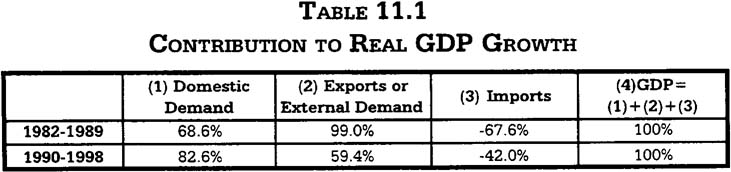
Meanwhile the domestic sector has emerged to become the major contributor to Macau's GDP growth. Between 1982 and 1989, external demand (i.e. exports) and domestic demand (i.e. domestic consumption and investment) accounted for 99 percent and 68.6 percent of Macau's GDP growth respectively. Between 1990 and 1998, the contribution of domestic demand expanded to 82.6 percent, whereas the contribution of exports sharply slid to 59.5 percent (Table 11.1).
In line with the reduced importance of the external sector, Macau's GDP growth appears to be losing steam. Under a mini-economy setting, the domestic demand is unlikely to grow in a sustainable manner without a concerted expansion in the external sector. In fact, Macau's recession in the 1990s was initiated by a drastic 31 percent fall in private-sector construction investment of MOP4 billion in 1996. As the economy has showed weakening signs,the growth of pro-cyclical private consumption has reacted quickly and subsided, further hampering the domestic activity. Meanwhile, the growth of government expenditure has slowed down due to the completion of major projects and the exhaustion of accumulated fiscal surpluses. All these undesirable developments have illustrated that the reliance of domestically generated growth in a mini economy is extremely risky. Producing for the world market is always necessary for a mini economy to accumulate resources and expand production.
Source: Underlying data from Estimativas do Produto Interno Bruto 1982-1998.
THE COMPETITIVENESS CONCERN
What is the underlying reason for Macau's deviation from the optimal development path? It mainly relates to the notable slowdown in merchandise export growth in the 1990s, parallel to the manufacturing slack, as discussed in Chapters 6 and 8. As Macau's exports are insignificant in absolute terms in the world market, the fluctuation of world demand is unlikely to have such a persistent impact on our export growth. The unsatisfactory performance of the export sector should therefore be attributed to the loss of relative competitiveness of Macau's manufacturing products.
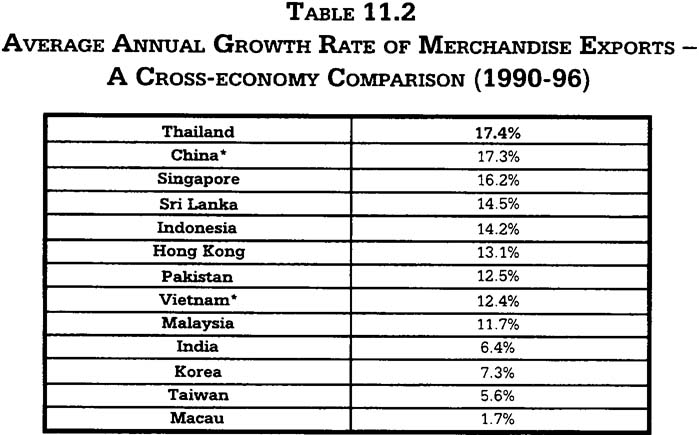
Table 11.2 provides a comparison of export growth between Macau and other economies in the Asian region, which supports our argument. Between 1990 and 1996, the average annual growth rate of Macau's merchandise exports was just 1.7 percent, which was one of the lowest in the region. The superior performance of most Asian economies indicates that the poor performance of Macau has little correlation with a general slowdown in world demand. One popular explanation of the slowdown in Macau's export growth is the re-location of production bases to South China by some local industrialists. This, however, is also attributable to the competitive disadvantage in producing goods in the Territory.
Note: *Only export value growth available.
Sources: World Bank and Direccao dos Servicos de Estatistica e Censos of Macau.
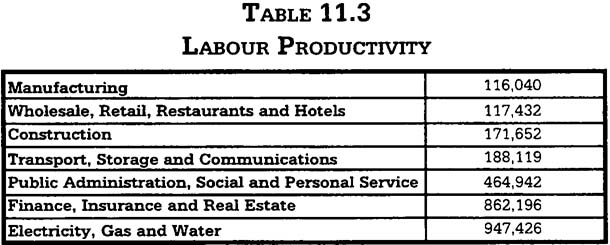
A study of the productivity level in the manufacturing sector helps uncover the rationale behind the decline in export competitiveness of Macau.As Table 11.3 shows, average labour productivity of the manufacturing sector is estimated to be the lowest among all economic sectors in the Territory. In absolute terms, Macau's manufacturing labour productivity is less than half of that of Hong Kong. As an estimated 40 percent of manufacturing workers in Macau are imported, the low productivity level could be partly explained by the low-paid foreign workers. As argued in Chapter 8, local manufacturers have chosen to rely on importation of low-skilled-but-cheap labour and quota protection under the MFA to sustain their exports. This strategy, nevertheless, proved to be largely ineffective in enhancing export competitiveness, as Macau has been losing these low-end markets to other low-cost production bases such as China and Southeast Asian nations. It has been argued that the continued survival of the manufacturing sector relies on the sacrifice of the cheap labour strategy and an industrial upgrade.
Unit: MOP
Note: Average labour productivity is measured by value-added output per person engaged.
Source:Author's calculation based on official employment and GDP data of Macau in 1996.
The above analysis shows that an effective economic rectification plan should be based on export promotion and competitiveness enhancement.However, even though local manufacturers are determined to invest in an industrial upgrade, it is unrealistic, at least within the next decade, to expect that the manufacturing sector can successfully re-gain its position as the engine of export or economic growth in the local economy. After a decade of consistent contraction in manufacturing activity, Macau has become a service-oriented economy, with tourism and gambling as a leading economic sector. As shown in Chapters 2 and 7, the tourism and gambling sector hasbeen well established, and is regarded as irreplaceable in view of its enormous economic contribution. Most importantly, the prosperity of export-oriented tourism is consistent with the optimal development strategy of mini economies as discussed at the outset of this Chapter.
The recent slowdown in the tourism and gambling sector has therefore raised the greatest concern for Macau's economic future. A meaningful recovery of the domestic economy, in particular, counts on a rebound of growth in exports of the tourist services. In view of the high importance of the sector,local professional bodies and business associations have conducted many studies of possible consolidation of and improvement in the tourist and gambling industry in the past few years. Major ideas of these studies have been summarized in a recent Macau Development Strategy Research Centre Report and by Chan (2000). One noteworthy proposal is to develop the Territory into a synthesized tourist and entertainment centre in Asia, in which major tourist attractions include not only casinos, but also family-oriented entertainment facilities. We believe that this proposal is the most feasible and least risky under Macau's current economic structure.
THE US EXPERIENCE
It is useful to take a serious look at the US's successful experience in developing its gambling and entertainment business, from which appropriate lessons can be learned. At the moment, legal gambling exists in every state of the country, except Utah and Hawaii. Las Vegas in the Nevada State, in particular,is the world's leading gambling city and family-oriented destination resort.Macau's development into a synthesized tourist and entertainment centre could learn from the US experience by studying the following areas:
1. Conditions for Gambling Development. The gambling business can generate significant revenues for small economies with limited resources.Las Vegas, for example, is in the desert area. Its gambling business has provided a huge amount of "non-painful" tax revenues for local development.The tax burden has largely been "exported" to other regions, as most casino customers are tourists. Gamblers also tend to pay the tax in a voluntary or unaware manner during selectable gaming. Currently, about two-thirds of the jobs in the state of Nevada are located in Las Vegas. Gambling taxes account for about one half of the State's total revenues, and as a result provide sufficient financial resources for local construction.
If the gambling industry mostly relies on non-resident customers, it ismost likely to have the greatest impact on GDP and employment. The development of gambling business is most suitable for an area with a small local population and a much larger population nearby from which to draw gamblers.Empirical research in the US indicates that gambling business with local residents as its major source of customers normally brings substantial social costs in relation to public security, regulation and infrastructure, which are sufficiently great to offset the social benefits (Tannenwald 1995). A study by the Office of Planning and Budgeting of the Florida State (1994), for example, estimates that annual projected state revenue related to casinos only covers 8-13 percent of the annual minimum projected costs related to casinos in the State. The basic reason for the large deficiency is that gambling business that exclusively sells services to local customers can only cause a diversion of spending, rather than a creation of spending. The residents' use of their time and resources on unproductive activities may even reduce economic growth.
Macau, like Las Vegas, possesses the features to benefit from further developing the gambling business. Macau has a small population and limited resources. Most customers in Macau's casinos are visitors from Hong Kong and other Asian countries. Although Macau adopts a different gambling regulatory regime from that of Las Vegas1, the gambling monopoly, the S.T.D.M., likewise shares about half of the total tax payments and contributes to local construction projects through various re-investment commitments.2
2. Development of Entertainment Business. An overconcentration of gambling activities could adversely affect the degree of economic stability as gambling revenues appear to be cyclically sensitive. To overcome this drawback, Las Vegas positions itself as a world-class and family-oriented holiday resort. It offers unnatural wonders, man-made artifacts, attractive edifices and many entertainment facilities for both adults and children. The city, in fact, is primarily in the entertainment business, rather than in the gambling business. Meanwhile, it brings in external capital under an open competition policy, which initiative and drive fosters innovations, service upgrades and price reductions. Benefiting from the high degree of competitiveness, Nevada has been the first US state to recover from the last nationwide recession, and continues to outperform the rest of the US in terms of economic growth. Engineered by the unbounded prosperity of the tourist and gambling industry,Nevada has promoted the development of other industries such as financial services, property and construction and manufacturing in recent years. The enlarged economic capacity and sufficient capital accumulation have eventually enabled Nevada to diversify into other business areas.
With the decline in the manufacturing industry in the early 1990s, short-comings of over-reliance on gambling activities have not taken long to surface in Macau. The Asian Financial Crisis and the relaxation of gambling regulations in other Asian cities have significantly dampened the gambling receipts.Given the premise that the existing operator is not precluded from participation in the business, a gradual introduction of competition into the gambling industry should be a desirable policy for long-term survival. Under a competitive system, Macau can rely on external capital for the investment in entertainment facilities and service quality. It actually has a distinct advantage over Las Vegas in developing non-gambling tourism, as there are many unique cultural legacies of an East-West hybrid in the Territory (Cheng 1999). Meanwhile, Macau could utilize its geographical advantage to relax its limited resource and area constraints by coordinating more closely with neighbouring cities such as Hong Kong and Zhuhai, with regard to the development of tourist facilities.
3. The Crime Problem. The US experience tends to support a positive correlation between casino gambling and crime rate. For instance, Atlantic City's crime rate had been on the decline before casinos came to the city, but recorded a 230 percent increase in thirteen years after the establishment of the first casino. Other states such as Nevada, Connecticut and Colorado share the same unhappy experience. As a substantial increase in law enforcement cost seems to be the inevitable cost of gambling development, the Government should therefore take all these related social costs into account in determining the rate of gambling taxation.
In the meantime, a satisfactory level of public security is a prerequisite of development of a family-oriented, wholesome tourist centre. Undoubtedly the significant increase in organized and violent crimes in Macau is a complex incident, but the deterioration in public security has certainly threatened the tourism development. The Administration and the industry should swiftly work out an effective resolution of the crime problem, in order to restore tourist confidence on Macau. Without a marked improvement in public security, the target to develop Macau into a wholesome tourist centre in Asia will never be achieved.3
Finally, in view of its advantageous location and cultural proximity, Macau is potentially an ideal place of residence for Hong Kong and Mainland Chinese retirees, and Taiwanese businessmen who have investments in South China.The living cost in Macau, in particular the cost of housing, is at least 50 percent lower than that of Hong Kong. Major obstacles to develop the new business remain the security concern and the lack of government supports and promotion. Once Macau has overcome these impediments, increased relocation of Chinese people in the Territory would bring additional vigour to the tourism sector.4
COMMERCIAL INTERMEDIARY SERVICES
In the foreseeable future, tourism and gambling will remain the leading economic sector in Macau. We believe that the sector will undergo a period of consolidation and advancement. The target is to develop Macau into a family-oriented tourist centre parallel to Las Vegas, hopefully within the next ten years. The focus on tourism, however, does not mean that Macau should miss out on other growth opportunities. Given its special features and advantages,the Territory has the potential to develop commercial intermediary services.Commercial services and tourist services are actually complementary as the former can encourage the arrival of business tourists. According to the World Tourism Organization, business tourist receipts have exceeded vacation tourist receipts in many countries, as business tourists tend to spend more and stay longer than vacation tourists.
Successful development of commercial intermediary services in Macau depends on a strong participation of foreign companies in the Territory. It is identified that foreign presence is motivated by some specific factors, including excellent and cost-effective infrastructure, geographical advantage and international connection, and sufficient supply of high-quality workers and professionals.
On infrastructure, the Government's strong commitment to upgrading facilities of transportation, communications and city environments in the past decade is commendable. The supply of office in Macau is more than sufficient and the office prices or rentals are one of the lowest in the region. The deficiency, however, remains in its "soft" infrastructure including the efficiency of its public administration and the rule of law.
With regard to its geographical advantage and international connection, Macau's commercial intermediary services should target customers from the Greater China region and the Latin-speaking countries. Macau has had a close economic relationship with both Mainland China and Hong Kong. Future development should focus on shifting the relationship from unilateral dependency to bilateral complementary dealings.
The link between Macau and Taiwan has been strengthened following the establishment of the Macau International Airport in 1995. Taiwan is now Macau's second largest source of tourists, and Macau-Taiwan flights account for over half of the air traffic of the airport. However, there are very few Taiwanese companies in Macau. According to leading Taiwanese businessmen in Macau, the reasons behind the weak presence of Taiwanese business are mainly the above-mentioned deficiency in soft infrastructure and the deterioration in public security (Chan 1999a). Provided that these fundamental problems are resolved, the commercial exchange between Macau and Taiwan is expected to intensify.
There are over 80 Latin-speaking countries in the world. France, Spain,Portugal and Italy in Europe, Brazil and Mexico in Latin America, and Angola and Mozambique in Africa are all members of the Latin cluster. In terms of population and GDP, the group of Latin-speaking countries is comparable to the group of Anglo-Saxon nations, but the Greater China region's trade with Latin-speaking countries has lagged far behind its trade with English-speaking countries. Hong Kong is reputed as a successful commercial intermediary for English-speaking countries. It, however, has difficulties in serving the businessmen and traders from Latin-speaking nations, who find little similarity in language, culture and the legal system in Hong Kong.
On the contrary, exchanges between Macau and the Latin-speaking countries have lasted for many hundred years due to the Portuguese occupation.As mentioned in Chapter 6, Latin-speaking countries used to be the largest exporting market for Macau in the 1950s. It is estimated that about three percent of Macau's population can speak Portuguese, and lots of them are also fluent in Chinese (Nagi 1996). There are similarities in culture and the law system between Macau and the Latin-speaking countries. If Macau can further develop these advantages, it would be able to play an important intermediary role in developing trade between the Greater China region and Latinspeaking countries. In the long run, Macau would possibly provide a parallel contribution as Hong Kong in the world trade system, which is currently dominated by English-speaking countries, Latin-speaking countries and Greater China. That achievement will definitely promise a rosy economic future for the Territory.
Finally, the supply of high-quality workers and professionals is insufficient in Macau as discussed in Chapter 3. To remedy this defect, the education and manpower policies should be adjusted to conform to the economic positioning of Macau. The local workforce should be appropriately trained up to cater to Macau's development into a synthesized tourist centre and a commercial intermediary centre. Qualified workers and professionals should be imported to compensate for the shortfall. Importation of labour is allowed under Macau's liberal employment and immigration policy, but the focus should now be shifted from unskilled workers to qualified professionals.
EPILOGUE
Entering into the 1990s, Macau has apparently moved away from the optimal development path of mini economies. Consequently, it has lost its growth momentum and resilience, and finally, has fallen into a prolonged recession. To formulate the blueprint for Macau's economic development in the21st century, we should be fully aware of the fact that Macau is by nature a mini economy with limited resources and small internal markets. Hence, its optimal development strategy is dictated to possess the following features:
1. It should put most resources into the development of a few leading industries, which can promise sustainable economic growth and job creation.To lessen the resource constraint, foreign physical and human resources should be lured to the leading sectors in an open and pro-competition domestic environment.
2. Its products and services should be export-oriented, and hence should necessarily be competitive in the world market, for the enhancement of persistently satisfactory sales.
3. The products and services of leading economic sectors should have enough variety, catering for the needs of a sufficiently large number of external customers with different backgrounds. The purpose is to broaden the customer base in order to minimize the risk of over-concentration on a few leading sectors.
While bearing these special features in mind, our analysis of the optimal development strategy for Macau has taken into account the Territory's unique economic condition and industrial structure, and observed successful foreign experience. It has been suggested that tourism and gambling should continue to be the leading economic sector in Macau. Family-oriented tourist facilities and environments should be established, with a target to develop Macau into a complete and wholesome tourist and entertainment centre. It is also argued that Macau has the potential to develop commercial intermediary services for business entities for the Latin-speaking countries and for the Greater China region. Should this potential be achieved, Macau would possibly regain its former glory as the leading commercial centre in Asia.5 That would bring substantial benefits to and guarantee a promising future for the Macau economy.
NOTES
1 Las Vegas adopts an open competition policy, while Macau only allows one monopoly operator.
2 See Chapter 7.
3 See the comment by S.D.T.M. general manager Stanley Ho, Macao Daily News, 29 July 1999.
4 It will also help relieve the property slack. See our analysis in Chapter 10.
5 Macau had been a leading commercial centre in Asia before the Opium War. See Chapter 1.