CHAPTER 6 INTERNATIONAL TRADE AND INVESTMENT
THE TREND OF TRADE
Macau's persistent reliance on external trade is understandable. As explained in Chapter 1, the Territory is by nature a mini economy, which always relies on external markets and imported resources. The free trade policy and the absence of foreign exchange control are also critical in promoting trade in the enclave. Macau is a founding member of the World Trade Organization (WTO) and has remained a "separate customs territory" in the WTO after 20 December 1999. Exports from the Territory are exempt from taxes1,and taxes on imports are restricted to a handful of consumer goods such as alcohol, tobacco and gas.2
The degree of openness, measured by the ratio of total trade to GDP,was at a high level of 110 percent in 1998. It, however, consistently dropped from over 160 percent in the early 1980s, due to a major slowdown in the growth of exports of goods in the 1990s. In terms of merchandise exports,Macau has lagged far behind Hong Kong and China. The Territory is now the 15th largest Asian economy in merchandise exports, while Hong Kong's and China's Asian rankings are in the second and third positions respectively.3 In 1998, Macau's merchandise exports valued at USD2 billion, which was just about one percent of Hong Kong's USD173 billion!
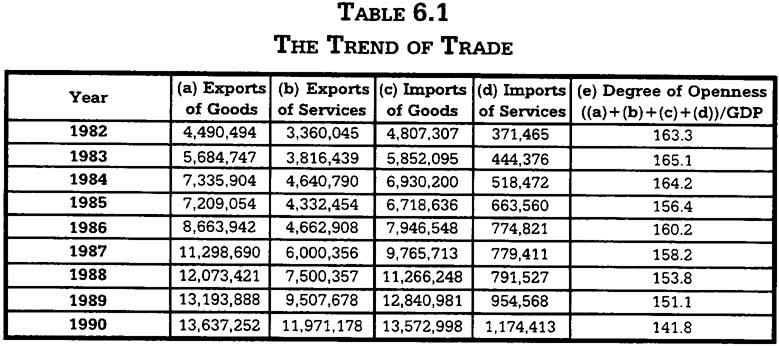
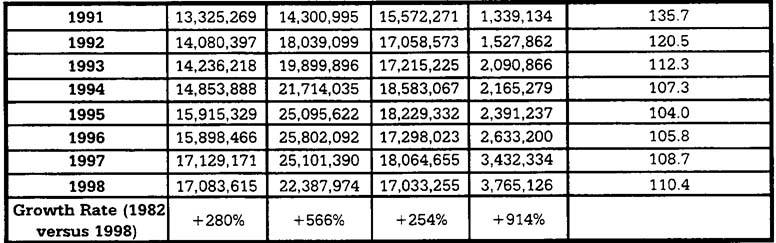
Unit: thousand patacas for (a)-(d), % for (e)
Source: Estimativas do Produto Interno Bruto 1982-1998.
It is argued that the unsatisfactory performance of merchandise exports has been caused by the relocation of local manufacturing establishments to Mainland China and the loss of competitiveness of Macau's manufacturing sector.4 The loss in exports of goods has been partly compensated by the gain in the export of services. Since 1991, the value of service exports has exceeded the value of goods exports. Tourist receipts account for over 90 percent of service exports in Macau.
TRADE STRUCTURE
Macau's trade sector is highly concentrated in both the geographical and product aspects. The geographical concentration is indicated by the topone and top-three concentration ratios (CE1 and CE3) in Table 6.2, which are the shares of the single largest and the top three largest export markets and import sources. By world standards, Macau's ratios are at the high end.5
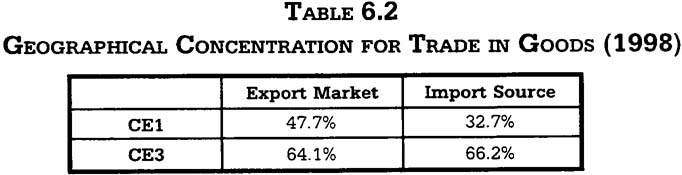
Note: For comparison, export CE1 and CE3 for Hong Kong are around 30 percent and 60 percent respectively.
Source: Underlying data from various issues of Estatisticas do Comercio Extemo.
The Territory has increasingly relied on a few external markets. The USA has been its largest export market since the 1970s, followed by some European nations. Exports to the USA and western European countries have greatly benefited from the MFA quota system and the Generalized System of Preferences (GSP). Hong Kong remains one of Macau's top-5 "export market" simply because of Macau's continued reliance on Hong Kong's transportation infrastructure. Following the establishment of Ka Ho deep-water port and container terminal in Coloane in 1991, Macau's exported cargoes to some Asian countries such as Taiwan, the Philippines and Japan have been handled locally. As a result, the importance of Hong Kong as an entrepôt of Macau has been slightly reduced.
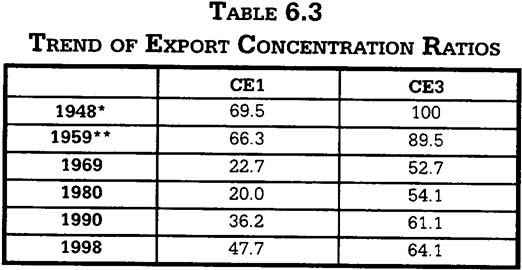
Notes: *Trade restricted to Hong Kong and China only; **Export concentrated in Portugal and its dependent territories due to the special duty-free privileges granted by the Portuguese government.
Sources: Underlying data from Huang and Chiang (1994), p. 211, 219220 (before 1990) and Anuario Eststistics, various issues (1990 and after).
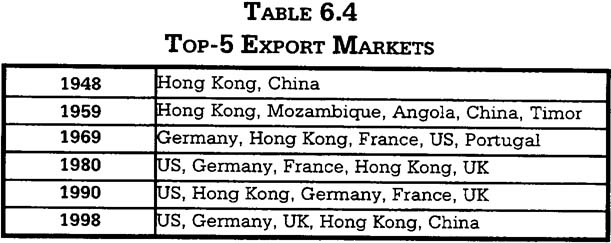
Sources: Huang and Chiang (1994), p. 211,219-220 (before 1990) and Anuario Eststistics, various issues (1990 and after).
Similarly, imports to Macau are concentrated in a few sources. Many imports to Macau are transshipped from Hong Kong due to Macau's insufficient transportation facilities, and hence Hong Kong has remained Macau's major "import source". Likewise, the establishment of Ka Ho deep-water port has helped Macau to reduce its reliance on Hong Kong. Hong Kong's share of Macau's imports dropped drastically from 60 percent in 1980 to 24 percent in 1998.
Taiwan has risen to become one of Macau's top-5 import sources in recent years due to three factors. First, Taiwan's increased investment in Zhuhai and Zhongshan has boosted imports of industrial machinery and raw materials to South China via Macau. Second, the establishment of Ka Ho Harbour and the airport in Taipa has improved the transportation link between Macau and Taiwan. Third, Taiwan's industrial machinery and raw materials have established a competitive advantage in terms of prices over other sources such as Japan. Imports from China have also edged up as Macau's expansion of outward processing facilities in South China has stimulated the growth of imports for re-exports from China.

Sources: Huang and Chiang (1994), p. 211,219-220 (before 1990) and Anuario Eststistics, various issues (1990 and after).
Macau's trade sector is also concentrated in export production. Close to 90 percent of its exports are clothing and textile products, which are under the regulation of the quota system. Technically, product concentration can be measured by the Hirschman Index. The Index is mathematically expressed as the square root of ∑(xi/x)2, where xi = the value of product group i and x =∑xi in a specific year. The Index indicates the degree of concentration as a function of both unequal distribution and fewness (Hirschman 1964). The value of the Index diminishes as the number of product groups increases and the distribution of products becomes more even. The highest possible value of the Hirschman Index is one and the lowest possible value is where nis the number of product groups. Following the World Bank classification, the number of product groups is set at five. The lowest value would then be about 0.45, and represents the case of equal division across all five groups.Macau's Hirschman Index, at 0.88 in 1997, indicates a high degree of concentration by international standards.6
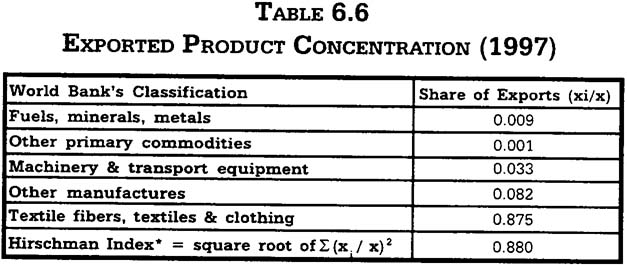
Note: *The highest possible value is 1 (maximum concentration) and the lowest possible value is 0.45, i.e. (maximum diversification).
Source: Underlying data from Anuario Eststistics 1997.
Exports of services obviously have a similar concentrated structure. Tourism accounts for over 90 percent of exports of services and close to 90 percent of Macau's tourists are from the Greater China region (Mainland China, Taiwan and Hong Kong).
FOREIGN INVESTMENT
The Macau Government does not compile a complete balance of payments (BOP) table, probably due to Macau's open capital account policy. Official statistics of foreign investment in Macau and Macau's investment in foreign countries are therefore not available.
One popular and reliable observation is that China and Hong Kong are the largest outside investors in Macau.7 It is estimated that China and Hong Kong account for about 40 percent and 30 percent of Macau's direct investment respectively. Portugal is the third largest outside investor with a direct investment share of about five percent.8 Over 200 firms from China have a presence in Macau. Their business covers all major sectors in Macau, including trade, manufacturing production, finance, tourist services, restaurants andhotels, property and construction and infrastructure. It is estimated that Chinese firms own assets of around MOP45-50 billion in Macau. Hong Kong's investment in Macau focuses on gambling and manufacturing. Hong Kong businessmen are major shareholders of the S.T.D.M. and the largest manufacturing companies in Macau. They are also actively involved in hotels, transportation, communications, finance and property. There are 20-30 Portuguese companies in Macau. Portugal's investment is mainly concentrated on banking and public utilities. The structure of Macau's outward direct investment is believed to be concentrated in South China. According to Mainland sources,Macau's cumulative direct investment in China amounted to about USD3.4billion in early 1999.9
Macau's cross-border financial investments are mainly related to offshore banking transactions. As Macau does not have established financial markets, foreign funds can only be placed in the local banking system. For the same reason, the Macau residents' portfolio investment is foreign-based. Hong Kong is the dominant destination and intermediary for Macau's overseas financial investments.10
A rough estimate of Macau's capital account of BOP, by the monetary authorities, reveals that the Territory is basically a capital exporter (Table 6.7).It is evidenced by a consistent increase in net foreign assets of the monetary authorities and the banking system, and a consistent trade surplus. The persistent capital account deficit (i.e. capital outflows) highlights the fundamental problem that Macau does not provide enough investment opportunities not only for outside investors, but also for local investors.
Notes: *+ve sign represents trade surplus; **Rough estimates which also include non-capital account items (income, transfer, errors, omissions and statistical discrepancies) in the BOP. -ve sign represents capital outflows.
Sources: IEM Annual Report & Accounts and AMCM Annual Report, various issues.
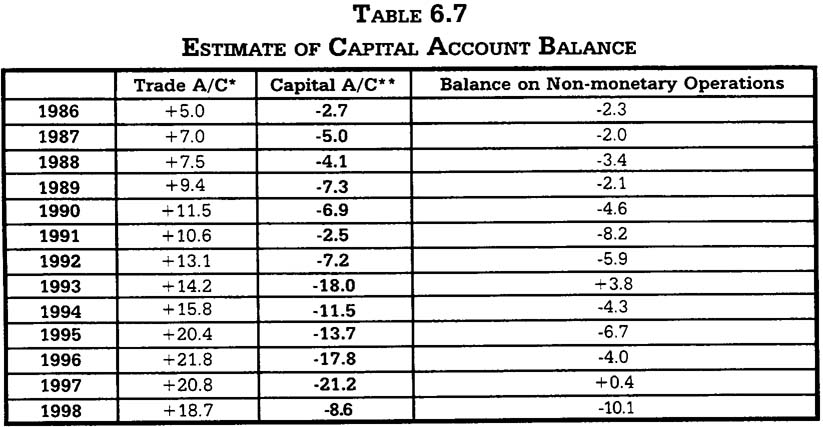
Unit: MOP Billion
NOTES
1 The majority of Macau's exports are subject to quota restrictions. Exporters of these products are required to pay a fee for certificates of origin. The fee is set at 0.7 percent of the product value. Exporters of other products only pay a negligible fee of MOP50, while administration fee for re-export products is MOP200.
2 See Chapter 5.
3 Japan's merchandise export is the largest in Asia.
4 See Chapter 8 for a detailed discussion.
5 For global comparison, see Direction of Trade Statistics Yearbook, IMF.
6 Hong Kong's Index, for example, is about 0.7. Very few countries record an Index value larger than 0.8. See Chan (1997b) and various issues of World Development Report, World Bank.
7 See, for example, Fung (1999).
8 Local capital is estimated to account for about 20 percent of direct investment in Macau.See Fung (1999).
9 See Macao Daily News, 15 June 1999.
10 A detailed analysis of Macau's offshore banking transactions is in Chapter 9.