CHAPTER 5 PUBLIC FINANCE
BUDGETARY PRINCIPLES
The Estatuto Organico de Macau, proclaimed in the 1970s, was the first official document to establish the fiscal autonomy and independent finance of Macau. Under the "one country, two systems" commitment, the Basic Law (Articles 104-106) largely follows the tradition of independent finance and legally dictates the budgetary principles as follows:
1. All fiscal revenues are managed and controlled by the Macau Government.
2. The central Government does not levy taxes in Macau.
3. The Macau Government should strive to achieve a fiscal balance and avoid deficits.
4. The budget should be commensurate with the growth rate of its GDP.
5. The Macau Government should practise an independent and low tax system.
For many years, Macau has implemented a "consolidated" budget policy in the sense that revenues and expenditures of all government departments and autonomous bodies are contained in an aggregated budget. The annual budget is based on calendar year from 1 January to 31 December. In every June, government departments and autonomous bodies compile their individual budget for next year based on estimated expenditures and revenues.The departmental budget is submitted to the respective policy secretaries for approval. The governor (or chief executive of the SAR) and the policy secretaries will determine the consolidated budget in September, and finally, the budget is sent to the Legislative Assembly for discussion by 15 December. By end-August, the Director of Finance Services compiles the book of public accounts for previous fiscal year, which is sent to the Administrative Court for auditing.
REVENUES
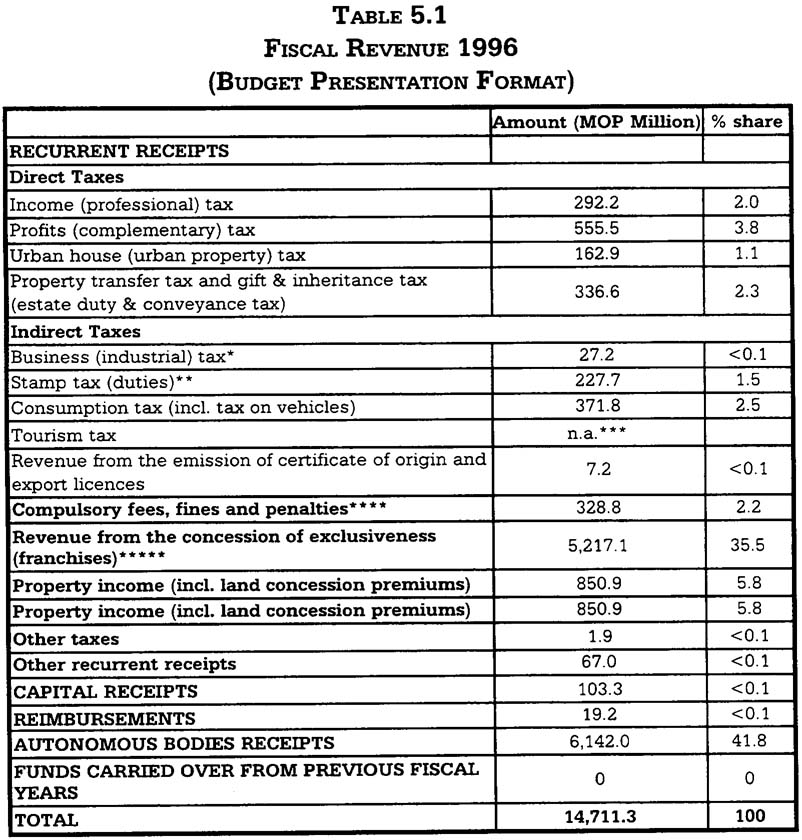
Government revenues in Macau include recurrent receipts, capital receipts and autonomous bodies receipts. Recurrent receipts comprise direct taxes (taxes on wealth or income), indirect taxes (taxes on expenditures and paid by producers), franchise revenues, property incomes and fees, fines &other penalties. In 1996, recurrent receipts accounted for 57.4 percent of total government revenues.
*Business tax is classified as indirect tax by the Direccao dos Servicos de Estatistica e Censos. See Contas Economicas do Sector Publico nao Empresarial 1996, p. 176.
**Strictly speaking, only 85 percent of the stamp duties are defined as indirect taxes, see Contas Economicas do Sector Publico nao Empresarial 1996,p.176.
***Included in the account of Tourism Fund.
****Part of the revenues is defined as indirect taxes by the government. See Contas Economicas do Sector Publico nao Empresarial 1996, p.176.
*****" Compensation of the concession of exclusiveness" is defined as direct tax; "rent of the concession of exclusiveness" is defined as indirect tax. The majority of gambling contributions are indirect taxes.
Source: Anuario Eststistics 1997.
Franchise revenues, from the gambling industry and public utilities,are a major source of revenues. In 1996, they accounted for over 60 percent of recurrent receipts. Their share of recurrent receipts has been increasing over the past few years, reflecting Macau's increasing reliance on the gambling industry. Property incomes are the second largest item in recurrent receipts. They include land concession premiums and interest and equity incomes from government investments in, for example,public utilities. Property incomes peaked in 1996 and were reported to decline significantly in the following two years due to a sharp drop in land concession premiums.1 The largest tax receipts come from profit or complementary tax.
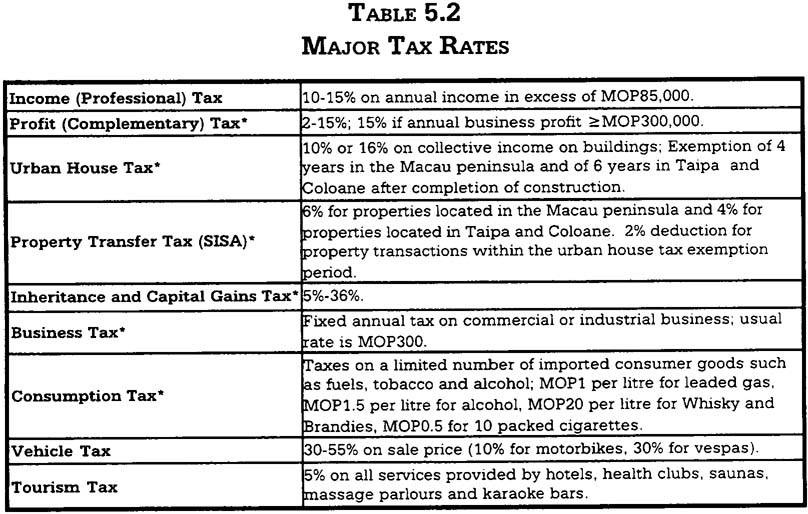
Capital receipts include sales of investment goods and capital transfers. In 1996, it accounted for less than 0.1 percent of total government revenue. Autonomous bodies receipts are normally offset by the same amount of expenditures in the consolidated budget. When actual receipts fall short of actual expenditures, the Government will transfer funds under recurrent payments to individual autonomous bodies. There are currently 33 autonomous bodies, which have their own accounts and assets.Major autonomous bodies include municipal councils, the AMCM and independent funds covering education, health, housing, culture and support for economic and social policies. Generally speaking, Macau is adopting a low-tax system, with heavy reliance on gambling revenues. The major tax rates are listed in Table 5.2.
*Tax exemptions upon application for business projects, which fulfil at least one of the following requirements: 1. Promoting diversification; 2. Contributing to promotion of exports to new market; 3. Promoting high value added production; 4. Contributing to technological modernization.
Source: Macau Trade and Investment Promotion Institute.
EXPENDITURES
Government expenditures comprise recurrent payments, capital payments and autonomous bodies expenditures. In 1996, recurrent payments accounted for 44.4 percent of total government expenditures. They include expenditures of government departments and transfers to autonomous bodies and funds (despesas comuns). Capital payments are related to the Government's infrastructure investment plans. They peaked in 1995, and have been declining in the past few years due to the completion of major projects.By function groups, security, economic services, health and education are all major expenditure items. Autonomous bodies expenditures are presented in the consolidated account, offsetting the same amount of autonomous bodies revenues.
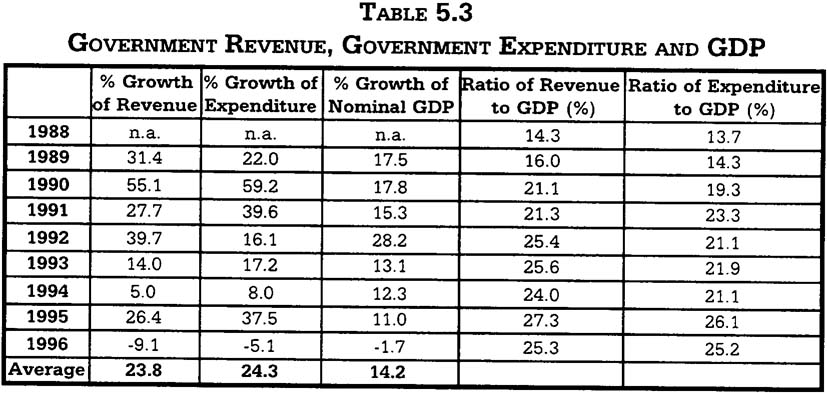
One notable development of Macau's public finance is the fast growth of government expenditure. Total expenditure has mostly grown faster than total revenue and nominal GDP. As a result, the ratio of government expenditure to nominal GDP rose markedly from 13.7 percent in 1988 to 25.2 percent in1996 (Table 5.3). The rising ratio implies increased government participation or intervention in the domestic economy and a modification of the laissez faire policy. The strong growth of expenditures, however, has been supported by a correspondingly fast growth of revenues. As a result, the fiscal accounts have largely been maintained in surplus.
Sources: Anuario Estatistico, various issues; Boletim Mensal de Estatistica, various issues; Produto Interno Bruto 1997.
PRIMARY BALANCE AND OVERALL BALANCE
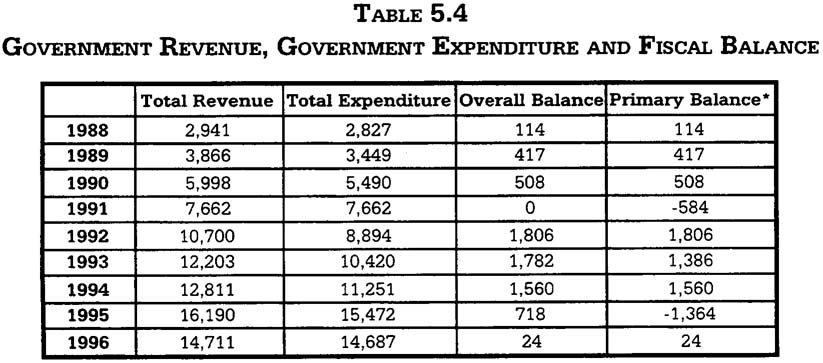
Macau's laws explicitly require a balanced budget for public finance.2In practice, the overall balance of government accounts should not be negative. Deficit in any fiscal year should be sufficiently covered by accumulated fiscal surpluses. As shown in Table 5.4, Macau's government receipts have largely exceeded its payments in the past decade. Overall balance were in surplus in all years except in 1991. The more meaningful primary balance,which is the overall balance adjusted to deduct budgeted fund transfers from fiscal surpluses in previous years, were also mostly in surplus. The fiscal years 1991 and 1995 registered primary deficits of MOP584 million and MOP1,384 million respectively. The record deficit in 1995 was mainly due to a sharp contraction in land concession premiums and a substantial increase in capital expenditure in relation to the construction of the airport, the setting up of Air-Macau and the operations of TDM, Macau's television station, in which the Government is a major shareholder.
Public debts are negligible. At end-1997, the Government only had a MOP727 million bank loan guarantee for the Macau airport company.3 It was reported in October 1998 that total accumulated surpluses in government accounts were MOP2.8 billion.4 The Land Fund was reported to have an asset size of MOP8.9 billion in May 1999, which should also be treated as part of the fiscal reserves of Macau SAR.
Unit: MOP Million
Note: *adjusted to deduct budgeted fund transfers from fiscal surpluses in previous years.
Sources: Anuario Eststistics, various issues; Boletim Mensal de Estatistica, various issues, AMCM Annual Report, various issues.
NOTES
1It is in line with the major contraction in the real estate market, see Chapter 10.
2 Referring to the Estatuto Organico de Macau and Decree Law No. 41/83/M.
3It excludes monetary bills issued by the AMCM, which are for non-financing purpose and fully backed by foreign currency assets.
4 See Macao Daily News, 28 October 1998.