CHAPTER 2 ECONOMIC STRUCTURE AND DEVELOPMENT
PRODUCTION STRUCTURE
The production structure of Macau can be characterized as unbalanced and highly concentrated. In 1996, primary production accounted for less than 0.1 percent of Macau's GDP; secondary production 15.1 percent; and tertiary production 84.9 percent (Table 2.1). Likewise, other measures such as employment and export shares indicate the prominent importance of tertiary production in the Macau economy.
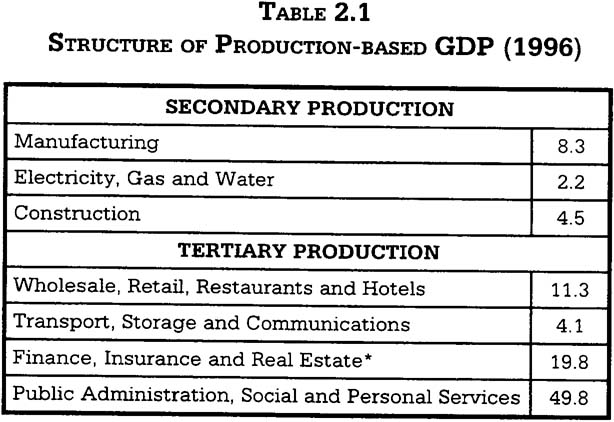
Unit: as a percentage of the total
Note: *adjusted to exclude net interest receipts or "expenditure on financial intermediation services".
Source: Produto Interno Bruto 1997.
Fishing forms the major part of the primary production in Macau. It accounts for a negligible percentage of domestic production, but indirectly stimulates certain types of secondary and tertiary production such as seafood manufacturing and trading, and construction of ice factories and storagefacilities. Harbour pollution, reclamation projects, scarce supply of fishing labour and keen competition from China all contribute to the decline of the fishing industry in Macau. In the last quarter of 1998, only 300 workers or 0.1 percent of total employed population were engaged in the fishing industry. Currently domestic seafood meets about five percent of domestic demand and the other 95 percent are mainly imported from China.
Secondary production in Macau includes the manufacturing sector,electricity, gas & water sector and construction sector.1 Manufacturing is the largest component of secondary production. Over 95 percent of its output are exported. The manufacturing sector's contribution to GDP has been on consistent decline in the 1990s, from 17.4 percent in 1990 to 8.3percent in 1996. In terms of employment, manufacturing firms in Macau employed 43,100 workers or 21.4 percent of total employed population in the fourth quarter of 1998.2 In 1990, they employed 33.1 percent of the total workforce. Exports of manufacturing goods accounted for 40 percent of total exports in 1998, whereas their share of total exports was 55.3 percent in 1990.
The construction activity has also been on the decline in the 1990s,mainly due to the excess supply of residential and commercial properties as well as the completion of major public sector projects. The withdrawal of Hong Kong and Mainland Chinese funds from the domestic real estate markets and the significant reduction in immigrants from China have brought a major correction in the property market, prolonging the slump in the construction sector.3 Its GDP contribution slid from 8.5 percent in 1990 to 4.5 percent in 1996. In the last quarter of 1998, the construction sector employed 11,700 workers or 5.8 percent of the total employed workers. Foreign purchase of domestic property should cause "export in nonindustrial services", though no relevant data of this activity is available in Macau.
The electricity, gas and water sector is insignificant in domestic production as gas and water are primarily imported for domestic consumption. The major value added in this sector is largely attributed to the operation of the Companhia de Electricidade de Macau (CEM). In the past decade, electricity, gas and water's share of GDP has remained at around two percent. This sector employed 1,200 people or 0.6 percent of total employed workers by the end of 1998.
Tourism and gambling comprise the largest component in tertiary production as well as the most important sector in the Macau economy. It is classified as one type of public, administration, social and personal services in Macau. In 1996, these services accounted for 49.8 percent of Macau's GDP It should be noted that tax on the gambling sector contributes to abouthalf of the government revenues, which finance public, administration and social services. Thus, the gambling business alone should contribute directly and indirectly to more than one-quarter of Macau's GDP. In addition,about 7,000,000 visitors arrive in Macau every year. They generate production in other service industries such as wholesale, retail, restaurants and hotel service and transport, storage and communications service. Therefore,it is realistic to state that the tourism and gambling industry is the leading business in the Territory, and directly and indirectly, contributes to about half of Macau's GDP.
On employment, 32 percent of the employed worked in the public,social and personal services sector in the last quarter of 1998. The employment shares for wholesale, retail, restaurants and hotel service as well as transport, storage and communications were 27.6 percent and 6.1 percent respectively. On export contribution, tourism and gambling export services as non-resident visitors consume in Macau. In 1998, the sector accounted for 56.2 percent of total exports after adjustment for reexports. Its share has been significantly larger than that of merchandise exports.
Another major tertiary industry is finance, insurance and real estate. This sector mainly comprises of 22 licensed banks, 21 insurance companies and a varying number of property agencies. Its share of GDP increased from 15.9 percent in 1990 to 19.8 percent in 1996. The sector employed 12,800 workers or 6.4 percent of total employed population in the last quarter of 1998. Exports of finance, insurance and real estate services are classified as "non-industrial" service exports by the Government, which does not provide further breakdowns. Non-industrial service exports as a whole accounted for 3.2 percent of total exports in 1998.
RAPID STRUCTURAL CHANGE
As emphasized at the outset of this chapter, Macau's economic structure is unbalanced and highly concentrated. Tertiary production accounts for over 80 percent of its GDP, which is one of the highest in Asia (Table 2.2). The share of tertiary production in the economy is likely to increase further with the consistent contraction in manufacturing. Eighty percent of the employed population are now engaged in tertiary production, rising from 57 percent in the early 1990s. In particular, the tertiary production is dominated by the tourism and gambling industry.
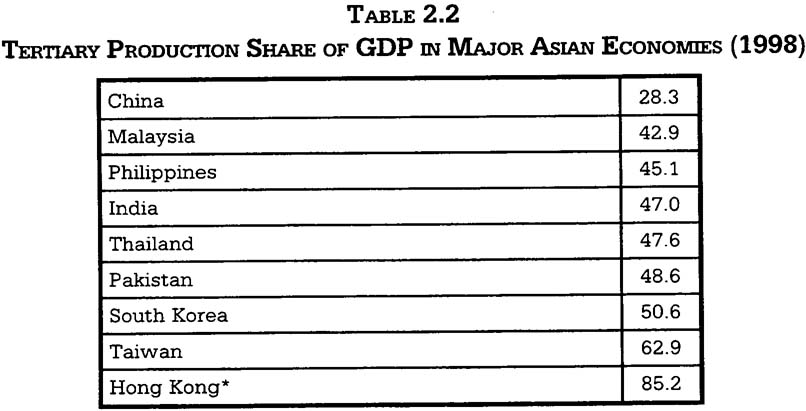
Unit: Percent
Note: *1997 figure.
Sources: Asian Development Outlook 1999, Asian Development Bank and Census and Statistics Department of the Hong Kong Government.
While tertiary production is generally technology-based or knowledgebased and absorbs the best-quality human resources in advanced countries,the professional level of tertiary production in Macau is relatively low. Dominance of tertiary production usually exists in highly developed countries, which have abundant professionals. This case, however, is not true in Macau. At the end of 1998, only 7.5 percent of the Territory's workforce had at least a university education, and 40.6 percent of the workforce had only primary education at best. The dominance of gambling and public services might contribute to the special feature of tertiary production in Macau. Gambling is basically a fairly ordinary, low-technology industry, while public services are largely nonmarket-driven.4
Meanwhile, production structure in Macau has changed at a rapid pace.In 1990, secondary production still accounted for 28 percent of the GDP. Six years later in 1996, its GDP share dropped drastically to 15.1 percent - a loss of about 13 percentage points! On the positive side, the swift change reflects the high flexibility of the Macau economy, which is argued by some economists as a distinct advantage of mini economies. On the negative side, it indicates that most production in Macau lacks a solid foundation, a long-term investment commitment and a degree of specialization.
The structural shift from secondary to tertiary production implies a possible upgrade of labour productivity, but it could also create structural unem-ployment if the adjustment of labourforce does not keep pace with the structural change. The manufacturing sector's contribution to the GDP is less than 10 percent, but it employs about 20 percent of the workforce. On the other hand, financial and commercial services only require seven percent of the workforce to produce 20 percent of the GDP. The largest type of tertiary production - public administration, social and personal services - only requires about 30 percent of the workforce to produce about half of Macau's GDP. The large proportion of imported workers in the manufacturing sector would cushion the negative impact of unemployment under structural changes, but the short supply of productive and qualified labour would curb the future growth of the tertiary sector. This structural character also delivers a message that the manufacturing sector urgently needs to upgrade its labour productivity and value added level, probably by investment in technology and labour quality.
The manufacturing sector currently adopts a "cheap-labour-intensive" production strategy. Even though Macau was able to maintain its manufacturing share of domestic production by all means, the current production strategy in this sector will certainly inhibit Macau's economic growth. This is due to the fact that a large proportion of the scarce human resources is occupied by the low value-added manufacturing production and the manufacturing workers are restricted to upgrade their productivity under the current production mode.5
The change in production structure is associated with a change in export structure. In 1991, export of services started to register a higher value than export of goods. Correspondingly, export of industrial services virtually recorded zero growth in real terms in the 1990s, while export in tourist services increased by 16.6 percent between 1990 and 1998. Export in non-industrial services, in particular, grew by about 1,116 percent during the same period!
HUMAN DEVELOPMENT INDEX
As mentioned in Chapter 1, the World Bank classifies Macau as a highincome economy. The classification, however, focuses on income and ignores critical socioeconomic factors in relation to human development. In fact, development economists increasingly believe that GDP or per capita GDP growth is insufficient to measure the welfare level of an economy, and is not necessarily consistent with the well being of the majority. Some economists further criticize it as a biased index of human development and welfare.6 In 1990, the United Nations (UN) published its first report on the Human Development Index (HDI), which aims to measure the socioeconomic development of an economy in a systematic and comprehensive way.
The HDI is based on the concept that "human development is a process of enlarging people's choices". The Index embodies three ultimate ends of development: longevity, access to knowledge and access to resources needed for a decent standard of living. Quantitative measures of these three factors include life expectancy at birth, adult literacy, mean year of schooling and per capita income. Each factor is set to carry equal weight. In 1996, the UN compiled the HDI for 174 countries, based on 1993 data.7
The range of the Index is 0-1. One represents the highest human development, whereas zero indicates the lowest human development level. The HDI ranks all countries into three groups: high human development (0.8040.951), medium human development (0.504-0.796) and low human development (0.204-0.481).
Although the UN has not included Macau in its HDI study, the Direccas dos Servicos de Estatistica e Censos published a report entitled Indice de Desenvolvimento Humano de Macau in January 1998, in which Macau's HDI,based on the UN methodology, was constructed. According to the official estimate, Macau's HDI was 0.891 in 1993, which was in the group of high human development. The Territory ranked 26th in the world, just behind Japan (3rd) and Hong Kong (22nd) in Asia. Macau's high ranking of HDI confirms its status as one of the highly developed economies in the Asia-Pacific region.
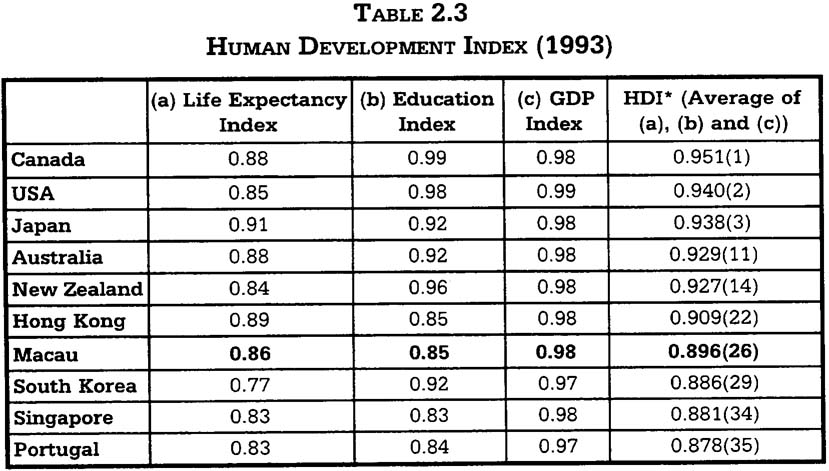
Note: *world ranking in brackets.
Source: Indice de Desenvolvimento Humano de Macau 1996.
NOTES
1 Macau's Direccao dos Servicos de Estatistica e Censos also includes "Mining and Quarrying" in the "secondary sector of activities ". The production of this sector, however, has never exceeded 0.1 percent of the GDP over the past decade.
2 It will be discussed in Chapter 3 that about 40 percent of workers in the manufacturing sector are in fact imported.
3 Detailed analysis of the property sector is in Chapter 10.
4 Some economists even define gambling as "directly unproductive profit-seeking activities", see Tannenwald (1995).
5 A detailed analysis of the manufacturing sector is in Chapter 8.
6 See Todaro (1997), Chapter 5.
7 The 1999 Human Development Report continued to rank 174 countries and presented a table on trends in human development from 1975 to 1997 for 79 countries.