Research and Development in Engineering in Macau:What Future?
Rui Martins(Centre of Scientific and Technical Research University of Macau)
This year the first batch of graduates in Engineering has finished their stud-ies in the Faculty of Science and Technology, University of Macau. This group of new Engineers is constituted of well-trained and talented young profes-sionals in the areas of Electrical and Electronics and Civil Engineering. This paper discusses the actual situation of the teaching and research in Engineer-ing in Macau and the possibility of starting future Research and Develop-ment projects that will involve the staff of the Faculty of Science and Technol-ogy, the professionals of Macau-based Companies. And, of course, that must include the available working force of the new Engineers of Macau.
Introduction
University level education in Engineering in Macau is a relatively recent ex-perience, started in 1989 with the creation of the Faculty of Science and Technol-ogy at the University of Macau. Before that date, professionals of Engineering working in Macau obtained their degrees outside the territory, namely, in China, Portugal, Hong Kong, the U.S.A. and other places, and only in a few cases were they citizens of Macau. The University studies outside of Macau were an heavy burden for the Macanese families interested in giving their children higher educa-tion, in this case in Engineering, which implied that only a limited number of families could do it. Sometimes, after studying abroad some of the Macanese came back while others did not, due mainly to the difficulty of getting a job in their specific field of Engineering in Macau, since most of the companies based here were related to business, the service sector, and traditional industries (textiles, toys, etc...), characterised by their intensive and general human resources. This situation is one of the reasons why Macau is considerably behind the so-called Four Little Dragons (Taiwan, Singapore, South Korea and Hong Kong)in terms of advanced high-technology industries. Of course, the situation can be and is under improvement in both territories due to the actions of both Governments in order to diversify industrialisation, but I think that for these policies to succeed in the future we need to promote education in the area of technology at the University level. The Faculty of Science and Technology (FST) can and must play an impor-tant role in the training of qualified professionals in Engineering, after the evolu-tion during the initial (and always difficult) transition period (4 years -- first batch of graduates in 1993), where everything needed to be set-up (in Engineering it is a specially difficult task due to the practical characteristics of the programs with the outfitting of several specialised and expensive laboratories). I think that in the "steady-state period "(the next 4 years) there is time now for two things: first, to open the Faculty to the Macau Industrial Society by establishing strong coopera-tive ties with the Macau-based companies, second, to develop and support the postgraduate programs in order to up-date the knowledge of Engineering profes-sionals from the industry and, simultaneously, to establish an academic career for the future educators born in Macau. Some of the ties mentioned above already exist due to the cooperation in the area of summer training of students in several companies and institutions, namely, CEM (for Electrical and Electronics Engineer-ing) and LECM (for Civil Engineering), but I think that they must be strengthened with the launching of several "Research and Development Projects," important for Macau industry. These could be implemented by seniors of FST (in their final gradu-ation project) or even by post-graduate students (the Master program was initi-ated this academic year of 1993/94 on a part-time basis) under the supervision of their respective professors in the area of their specialities. The Centre of Scientific and Technical Research (CSTR) of the same Faculty, recently activated, can and must also play an important role in the development of those cooperative ties and also in the coordination of the different projects.
This paper will describe the actual situation in FST and will show the possi-bilities of intervention by this Faculty in different areas of Engineering. The fu-ture success of several Research and Development projects of cooperation, Fac-ulty / Industry, in medium and high-technology, will demonstrate the feasibility of this solution and will constitute an important support for existing industry in Macau. Also it will provide a stimulus for the establishment of new industries in the territory, with the consequent growth of jobs for graduate and post-graduate professionals in Engineering from FST.
Research and Development in Engineering
Research and Development (R&D) in Engineering are presently two of the keywords for the Technological growth of an advanced Economy. The main rea-sons for this are almost obvious since in the perturbed, unpredictable and com-petitive world in which we live, only new products with a sufficient degree of quality and innovative design can give the technological companies means for survival. For that, we need well prepared and specialised working teams, com-posed of an adequate number of different Engineering specialities. These teams must develop (and of course must be capable of developing) first of all some ap-propriate Research on the topic under study and later to begin Development of the product.
Supposing the above two topics, cooperation between FST/CSTR and the Macau companies is of fundamental importance due to the fact that the studentsin the Faculty (under adequate supervision of the different Professors) have the time to reflect and are in the place where they can be innovative by trying different solutions, without the pressure of work in an operational company. Simplify-ing, they have the time for Research (mainly during the Final Project and the Mas-ter Thesis) and in a relatively short period of time they can implement and seek out good project solutions for potential products that can be developed later by the companies.
In order to start with the above concept of R&D two strategic ways can be followed in the starting of new projects: first, to get information from Macau companies and institutions, namely, CEM, LECM, EFACEC, CTM, CAM, etc..., about possible project areas of cooperation which could lead to future development projects involving final year students1 (or groups of students) of FST and after a preparatory phase to start the Development Projects (the Research component of the project must have in these cases less importance than the Development); second, to try to launch big R&D projects with interest for Macau, namely: Electrical Energy Saving, Water Pollution Control and Automatic Machine Translation of Portuguese-Chinese, involving a more complex Research team and work plan composed by specialised partners from Portugal and China (from Universities and Research Institutes) and also from Macau (FST and other institutions or companies inter-ested). Persons from Portugal and China must participate with at least one (two at the most) partner with significant scientific experience in the above areas; the students of FST must be post-graduates from the Master programs, because since these are very important and wide-ranging topics it will certainly be possible to initiate several master theses in those areas (see References).
Human and Technical Resources
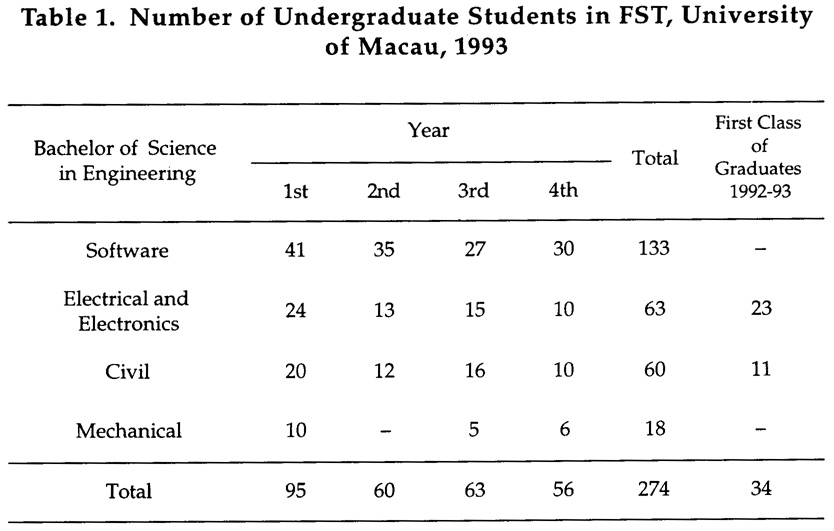
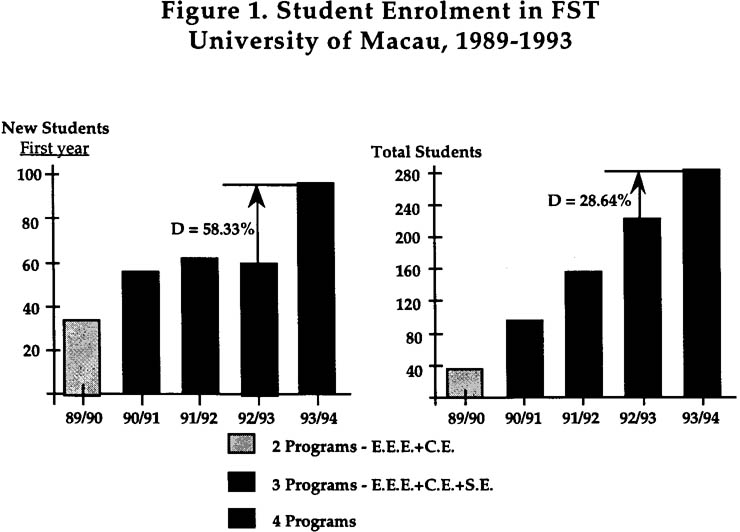
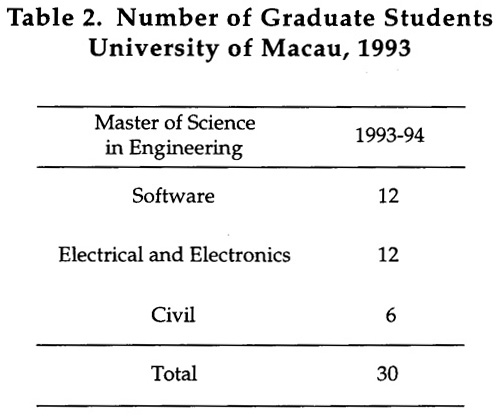
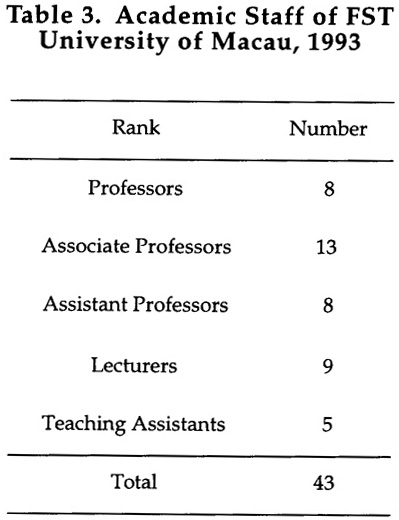
As mentioned before, the Human resources available to implement the above proposals in Macau must be FST. Students and Professors in collaboration with technical professionals from companies and specialists from Portugal and China. To substantiate this idea, it will be useful to analyze the actual situation, in terms of Students and Professors in the present academic year of 1993-94. For this we must analyze Table 1, Table 2 and Table 3. Table 1 shows that the number of new entries (first year) has taken a considerable jump in this academic year of 1993-94 (Δ=58.33%) and that the total number of students is constantly growing (Δ=28.64% also this year). On the other hand, the post-graduate programs started this year have also a considerable number of students (30) of different origins, such as re-cent graduates from FST working in industry or on the Faculty as Teaching Assist-ants, and Engineering professionals from industry, with background studies in Portugal and China. These numbers reveal a significant interest in Engineering and show also that part of the human resources needed to implement the above strategy are already in FST. From Table 2 we may conclude that the number of professors in the faculty is also considerable, but, depending on the future direc-tions of R&D, appropriate specialists from other areas could be included on the
 faculty.
In terms of technical resources, some of the present laboratories of FST can already support several projects (for example: Electrical Machines, Microproces-sors, Strength of Materials and Hydraulics, Mechanics, etc...). In the near future
 other laboratories under implementation (like Software Engineering and Control) will be availabe to the Faculty. Nevertheless, the utilisation of technical resources from industrial partners is also possible,and, simultaneously, in specific areas of work the faculty can develop with the financial support of the companies appro-priate laboratories dedicated to more important special projects.
Projects and Partners
The appearance of new projects must be a constant work of investigation and cooperation, mainly driven, from the University side (I mean from different Pro-fessors with the help of CSTR) to industry based in Macau in order to understand the needs of companies and also to investigate possible areas of intervention. For this purpose, several visits between academic staff and industrial Engineering professionals from the industry must be organised in the future, in order to get a better knowledge of different realities and also to create confidence between the future partners in R&D cooperation projects.
As for the partners, they must be selected mainly within Macau companies that are technologically advanced or that are trying to cope with the technologies of today to improve their competitiveness in the market place. Any of the above companies can be considered as future partners but there are also many others interested in participating in such projects. From Portugal and China we must choose carefully our partners in order to contact Research Institutes and Universi-ties with high technical standards, and for this, we consider the Instituto Superior Técnico -- IST, INESC (Institute of Systems Engineering and Computers) and the New University of Lisbon, all situated in Lisbon, and the University of Tsinghua, Beijing to be among the preferred institutions for this purpose. As an example of this cooperation, a group of six (6) recent graduates from the top ten of the Electri-cal and Electronics Engineering Program have already been working, for a period of 14 months, in specialised development projects in several technological advanced centres from INESC. After this period, these engineers will constitute a highly specialised working force in their own fields, available for developing and super-vising future R&D projects in Macau or even for starting their own small compa-nies using high technology.
Attraction of New Companies
The development of Macau and surrounding areas (Zuhai, Shenzhen, Hong Kong, etc...) including the construction of the Airport and other good communi-cation infrastructures like the new bridge, the railway and highway to Guangzhou, will bring to Macau new investments and, I think, a significant number of them should be in the medium and high technology area due to big competition from China in the labour-intensive industries. The appearance in the next years of an educated and specialised class of professionals in the Engineering area, well pre-pared by FST, will increase the possibility of success of a new and diversified type of industry in Macau where the quality and sophistication of the products would be very high.
Conclusions
This paper has discussed the actual situation of teaching of and research in Engineering in Macau, and it has discussed the possibility of starting future Re-search and Developments projects between FST and Macau-based companies. These projects must invite, in some cases, the participation of Research Institutions and Universities in Portugal and China and should lead to development of a new class of highly specialised Engineering professionals that will contribute with their knowledge to the necessary diversification of industry in the territory.
Note
1 We have made several contacts with different companies in order to support the final projects of different programs.
References
Martins, Rui. 1993 Plan of Activities for 1993/94 of the C.S.T.R., Centre of Scien-tific and Technical Research, Faculty of Science and Technology, University of Macau.
Martins, Rui. 1993 University of Macau CHIP -- UMCHIP, Research Project Pro-posal approved by the Research Committee of the University of Macau.
Zhou, Li-Gao, et al.1993. Electrical Energy Saving in Macau -- EESAVING, Research Project Proposal approved by the Research Committee of the University of Macau.