An Econometric Analysis of Macau's Tourism
Gordon T.H.Wong(Faculty of Social Sciences and Humanities, University of Macau)
The tourism industry is very important to Macau's economy. In 1991, the non-resident expenditure and gambling revenue accounted for 39 percent and 27 percent of Macau's GDP, respectively. The purpose of this paper is to de-velop econometric models to analyse the fundamental socioeconomic and in-stitutional factors that determine the growth and change of Macau's tourism industry. Econometric models are formulated and estimated on (1) gambling receipts in Macau, (2) number of HK visitor arrivals in Macau, (3) number of Japanese visitor arrivals in Hong Kong, (4) number of Japanese visitor arriv-als in Macau, and (5) demand for accommodation from the hospitality indus-try of Macau by Hong Kong residents. Quarterly data are used in the analy-sis. The most recent developments in Macau's tourism are also discussed. Topics include (1) the increase in visitor arrivals by land, (2) the influx of visitors from the People's Republic of China to Hong Kong and Macau, and (3) the oversupply of hotel rooms in Macau.
Introduction
In 1992, the total number of visitors to Macau was 7,699,178. Along with the inflow of tourists is the demand for services and spending that support and nour-ish Macau's economy. In the national income accounting system of Macau, tour-ists' spending on accommodation, transport, entertainment, shopping, dining and, above all, gambling,1 are recorded as non-resident expenditure (NRE). A brief re-view of the figures of NRE in Macau reveals the fact that the territory is highly dependent on tourists' spending. Non-resident expenditure in Macau accounted for 39 percent of the gross domestic product (GDP) in 1991.2 The largest and fast-est growing component of the NRE was gambling revenue. It increased from 13 percent of Macau's GDP in 1986 to 27 percent in 1991. Further, taxes on gambling in 1991 accounted for 32 percent of total government revenue.3 Judging from the above figures, there is little doubt that tourism is the major pillar of Macau's economy.4 With the decline in the traditional manufacturing and export indus-tries, this dependence will be more prominent in the foreseeable future.
Because of the importance of tourism and gambling revenue to Macau's economy, it is imperative to investigate the factors that determine their change and growth. The purpose of this paper is to develop econometric models to ana-lyse Macau's tourism. In general, econometric models seek to determine the rela-tionships among a number of causal variables and a dependent variable. In tour-ism researeh studies, tourist traffic is the typical dependent variable. Economic indicators, seasonality, travelling costs, the realisation of major socioeconomic events, and the imposition and relaxation of travelling restrictions are the causal variables (see Martin and Witt 1988,1989, Calantone, Benedetto, and Bojanic 1988, Sheldon and Var 1985, and Uysal and Crompton 1985). Based on this line of re-seareh, five econometric models are developed and estimated by the ordinary least squares (OLS) method in this paper to explain the tourism flows from Hong Kong and Japan to Macau. The most recent developments in Macau's tourism are also discussed. Topics include visitor arrivals from land, the influx of Chinese visitors from the People's Republic of China, and the oversupply of hotel rooms.
Model Specification and Estimation
Gambling Revenue
The first econometric model attempts to analyse the factors that determine the gambling revenue of Macau. The Specification of the model is described as follows:

where
LGAMBLEt = the natural log of the gambling revenue, in million Macau patacas,
LHKGDPSt = the natural log of the seasonally adjusted gross domestic prod-uct of Hong Kong at current market prices, in million HK dollars,
D2 = 1 in quarter 2
= 0 otherwise,
D3 = 1 in quarter 3
= 0 otherwise,
D4 = 1 in quarter 4
= 0 otherwise,
NEWPROD = 1 since the second quarter of 1987
= 0 before the second quarter of 1987,
NSHIP = 1 since the third quarter of 1989
= 0 before the third quarter of 1989,
JUNE4 = 1 for the second quarter of 1989
= 0 otherwise,
STOCKCR = 1 for the fourth quarter of 1987
= 0 otherwise,
MIDWAR = 1 for the first quarter of 1991
= 0 otherwise, and
Ut = disturbance term.
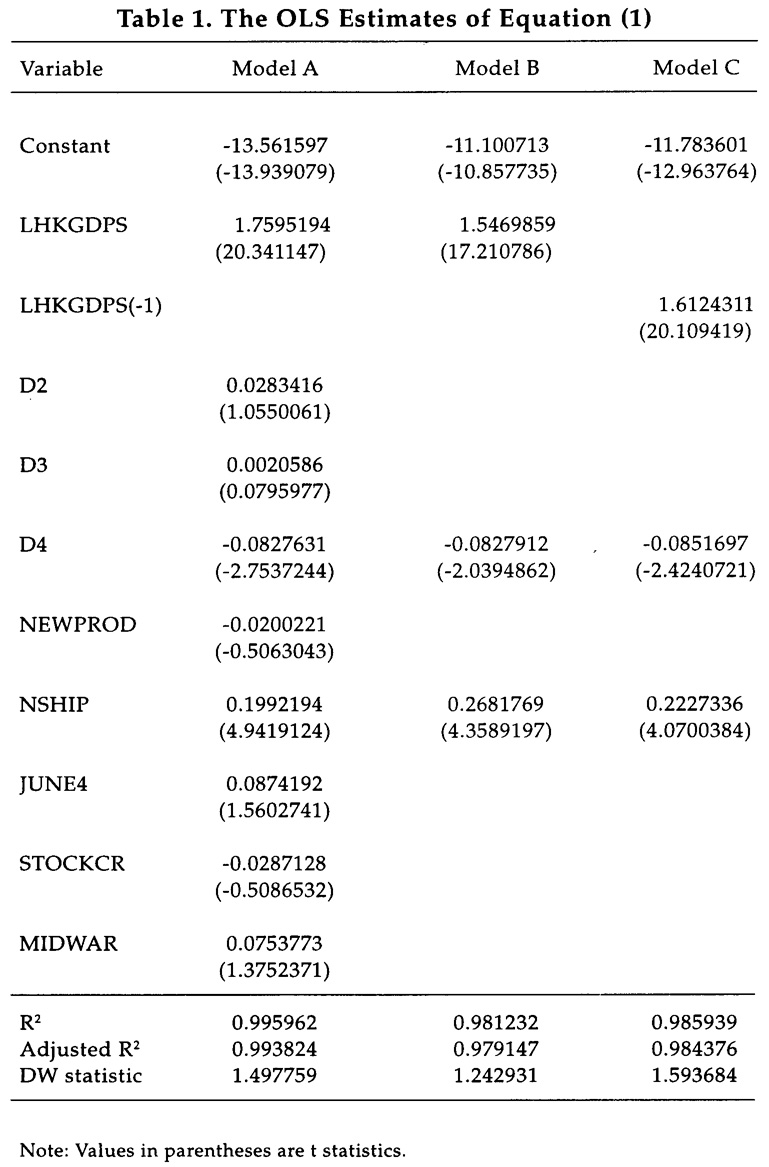
The income variable (LHKGDPS) is included in the regression model because gambling is considered to be a "service" that is demanded more as income goes up. Since Hong Kong residents registered the predominant share of the total number of visitor arrivals by sea in Macau, 79.3 percent in 1992, and this group of visitors showed a stronger inclination towards gambling,5 it is natural to tie the economic perform-ance of Hong Kong to the total gambling revenue received by Macau. A priori, we do not have any strong conviction of whether we should use the current income or in-come lagging, say one quarter (LHKGDPS(-1)) in the regression model. The actual fitting of the regression model may indicate which one is more appropriate. D2, D3, and D4 are seasonal dummies for the second, third and fourth quarter, respectively. Since April 1987, the Hong Kong Government has greatly simplified the entry and exit procedures for Hong Kong permanent residents when they enter and leave Hong Kong territory (NEWPROD). This is expected to have a positive effect on the de-mand for short-term visiting to Macau and hence the demand for gambling. Since July 1989, an all-night jetfoil service between Hong Kong and Macau has been intro-duced (NSHIP). This is expected to stimulate more HK gamblers to come to Macau. The political instability in China during the summer of 1989 (JUNE4), the world-wide stock market crashes during October 1987 (STOCKCR) and the Middle East War during January 1991 (MIDWAR) are expected to have a negative effect on the demand for gambling. The data cover the range from the first quarter of 1986 to the third quarter of 1992.6 The OLS estimates of equation (1) are presented in Table 1.
In model A of equation (1) (see Table 1), the explanatory variables NEWPROD, JUNE4, STOCKCR, MIDWAR, and some of the seasonal dummy variables are not statistically significant at the 5 percent level. In model B and C of equation (1), some of the original explanatory variables are excluded. Based on the adjusted R2 and the Durbin- Watson (DW) statistic, model C gives the best results.
From the adjusted R2 of model C of equation (1), we know that the explana-tory variables collectively explain more than 98 percent of the variation of the dependent variable. Since equation (1) is a log-linear model, the estimated param-eter of the explanatory variable LHKGDPS is a measure of the (HK) income elas-ticity on gambling revenue. Specifically, one percent increase in the current dollar Hong Kong GDP lagging one quarter will lead to a 1.61 percent increase in the gambling revenue of Macau. Since the elasticity is positive and larger than one, the gambling "service" is an elastic superior good. The estimated values of the parameter of LHKGDPS do not change very much across the three models, indi-cating that the result obtained is very robust. The estimated parameter of D4 shows a negative sign. This is hardly surprising. Winter is the slack season for HK visi-tors coming to Macau, and the gambling revenue shows a corresponding decrease in that quarter. The statistical significance of the estimated coefficient of the ex-planatory variable NSHIP indicates that the availability of an all-night jetfoil service between Hong Kong and Macau has generated more gambling revenue for Macau.
Hong Kong Visitors
Since non-resident expenditure in Macau comes from the inflow of visitors, it is important to have a clear understanding of its composition and changes. Before
 1992, the Macau Government published the figures of visitor arrivals by sea only. Since 1992, it has begun to publish the number of visitors coming by land, sea and air, as the number of visitor arrivals by land has become increasingly significant. The issue of visitor arrivals by land and air will be discussed in a later section.
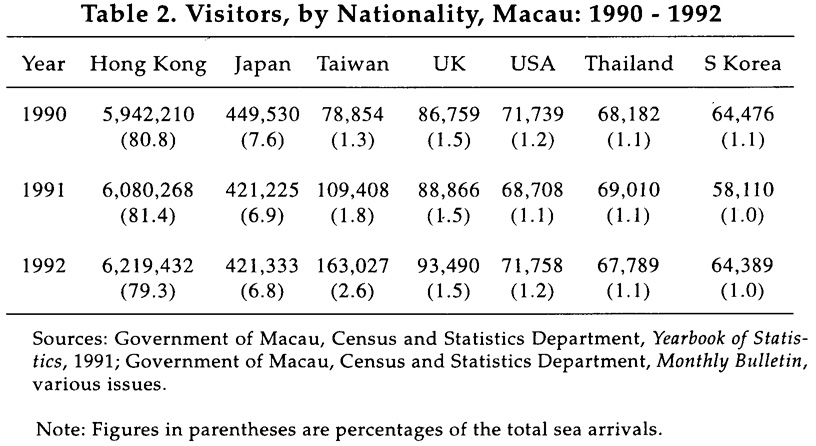
From the figures in Table 2, we observe that Hong Kong residents are the most important source of visitors to Macau, and they are followed by the Japa-nese. Since 1991, the number of visitors from Taiwan has surpassed that of the UK and become the third largest source of visitors by sea. Since visitors from Hong Kong are the dominant source of visitors by sea, there is a need for closer scrutiny of the factors that govern its behaviour. The following regression model is em-ployed to fulfil this task.

where
HKMAWt = the number of Hong Kong visitors entering Macau by sea, and
HKGDPSt = the seasonally adjusted gross domestic product of Hong Kong at current market prices, in million H.K. dollars.
The definitions of other explanatory variables and the a priori reasoning for putting them into the model have been explained in the regression model (1). The sample range is from the first quarter of 1985 to the first quarter of 1993. The OLS estimates of equation (2) are presented in Table 3.
The empirical results from models A and B of equation (2) reveal the follow-ing important findings:
(1) There is a strong seasonality in the number of HK visitors coming to Macau by sea. Summer is the peak season and winter is the slack season.
(2) According to the results from model B, when the nominal national incomeof HK increases by one million HK dollars, the number of visitors coming from HK increases by 0.65 person per quarter.
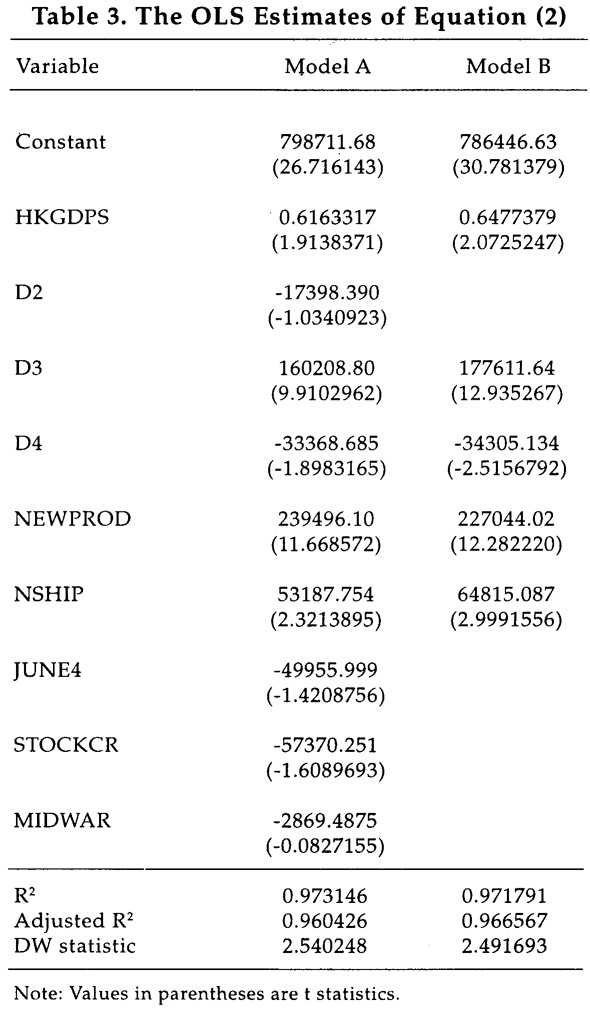
(3) Since the new HK entry and exit procedures were introduced in April 1987, the number of HK visitors entering Macau has increased by an additional 227,044visitors per quarter. This result should provide a very important insight for those in authority who want to encourage more visitors to come to Macau. Any further changes that shorten the travelling time between HK and Macau will have a sig-nificant impact on Macau's tourism industry. With the new external ferry terminal entering service at the end of 1993, extra handling capacity and modern facili-ties should speed up the entry and exit procedures and hence encourage more Hong Kong tourists to come to Macau.
(4) The availability of an all-night jetfoil service between Hong Kong and Macau has stimulated an additional 64,815 Hong Kong visitors to Macau per quarter since the third quarter of 1989.
(5) The negative impacts on Macau' s tourism associated with the events of June 4 1989 and the world-wide stock market crashes in October 1987 were not very strong, at least on the number of HK visitors coming to Macau. The estimates of β7 and β8 are statistically significant only at the 17.2 percent and 12.4 percent level, respectively. The impact of the Middle East War during Janu-ary 1991 was even weaker.
Japanese Visitors
Japanese visitors provide the second largest source of tourists to Macau. Further, they have the highest per-capita spending among all visitors to Macau.7 So it is important to understand the factors that influence their visits to Macau.
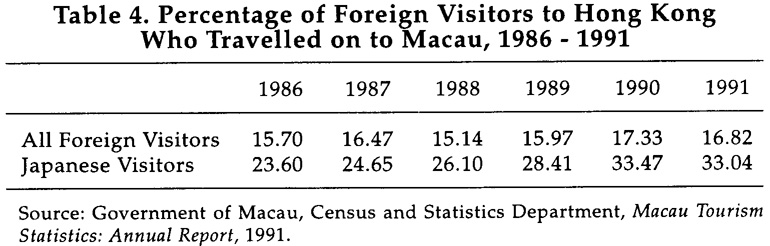
Among foreign visitors arriving in Hong Kong, the Japanese tend to have the highest inclination to travel on to Macau (see Table 4). Since almost all the Japanese who visit Macau have to go to Hong Kong first, it is important to understand both (1) the factors that cause Japanese visitors to go to Hong Kong, and (2) the factors that cause Japanese visitors to come to Macau after their stay in Hong Kong.The econometric model that is used to analyse Japanese visiting Hong Kong is described as follows:

where
JAPHKt = the number of Japanese visitor arrivals in Hong Kong,
JAPGDPt = the gross domestic product of Japan at current market prices, in billion yen,8
RYENHK$t(-1) = the real exchange rate of the yen against HK dollar lagging one quarter;9 the increase in the value of RYENHK$ implies a real appreciation of the yen.
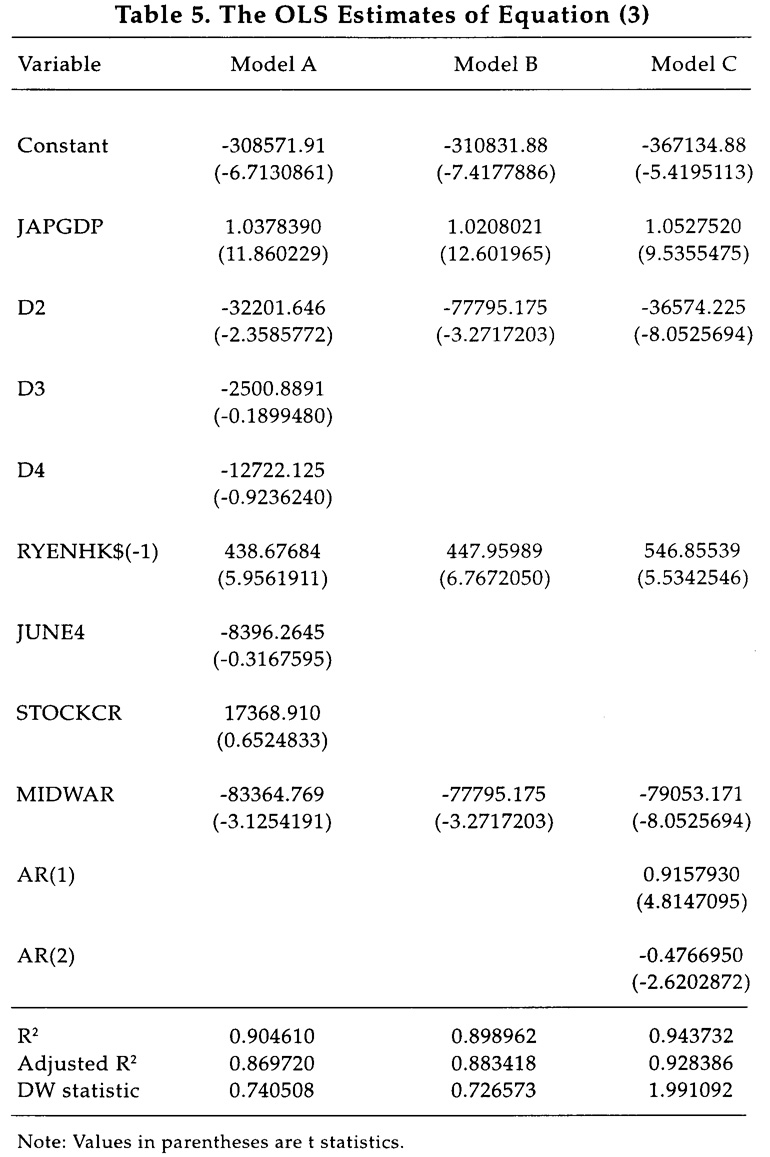
D2, D3, and D4 are seasonal dummies. The definitions of JUNE4, STOCKCR and MIDWAR have been discussed before in regression model (1). A priori, I ex-pect β1 and β5 will be positive. The more income increases, the more Japanese travel abroad. As the yen appreciates, the purchasing power of Japanese visitors to Hong Kong increases, and thus they demand more foreign visits. The real exchange rate rather than the nominal one is used in the model because the higher inflation rate in Hong Kong, as compared with its Japanese counterpart, could wipe out any gain in purchasing power for Japanese visitors associated with yen appreciation. The data cover the period from the second quarter of 1985 to the fourth quarter of 1992. The OLS estimates of equation (3) are presented in Table 5.
Both model A and B of equation (3) show autocorrelation in the residuals. The most likely reason for that is the omission of one or more relatively important variable(s) in the models.10 But to include all the relevant variables in regression model (3) would be impossible because Hong Kong is only one out of many po-tential foreign travel destinations for the Japanese. With the adjusted R2 reaching 0.88, model B does a reasonably good job in explaining the pattern of Japanese visitors to Hong Kong.
The autocorrelation problem in model B of equation (3) is corrected by a sec-ond-order autoregressive (AR2) process in model C. Both the estimates of the in-come and exchange rate variables show the positive sign that was expected. The events of June 4 1989 in China did not have a strong impact on the numbers of Japanese visitors going to Hong Kong, but the Middle East War during the first quarter of 1991 reduced it by more than 79,000.
To explain the Japanese visitors coming to Macau by sea, the following re-gression model is employed.

where
JAPMAWt = the number of Japanese visitor arrivals in Macau by sea, and
JAPHKt = the number of Japanese visitor arrevals in Hong Kong.
All the other explanatory variables are explained in model (3). The OLS esti-mates of equation (4) are presented in Table 6.
The empirical results of model A of equation (4) (see Table 6) indicate that the explanatory variables MIDWAR and D2 are statistically insignificant, whereas in model C of equation (3) they are significant. The opposite happens to the esti-mates in D3 and D4. These results are not surprising because of the presence of the causal variable JAPHK in equation (4). All the influences of the causal vari-ables MIDWAR and D2 on Japanese visitors to Macau have already been captured by the presence of the causal variable JAPHK.
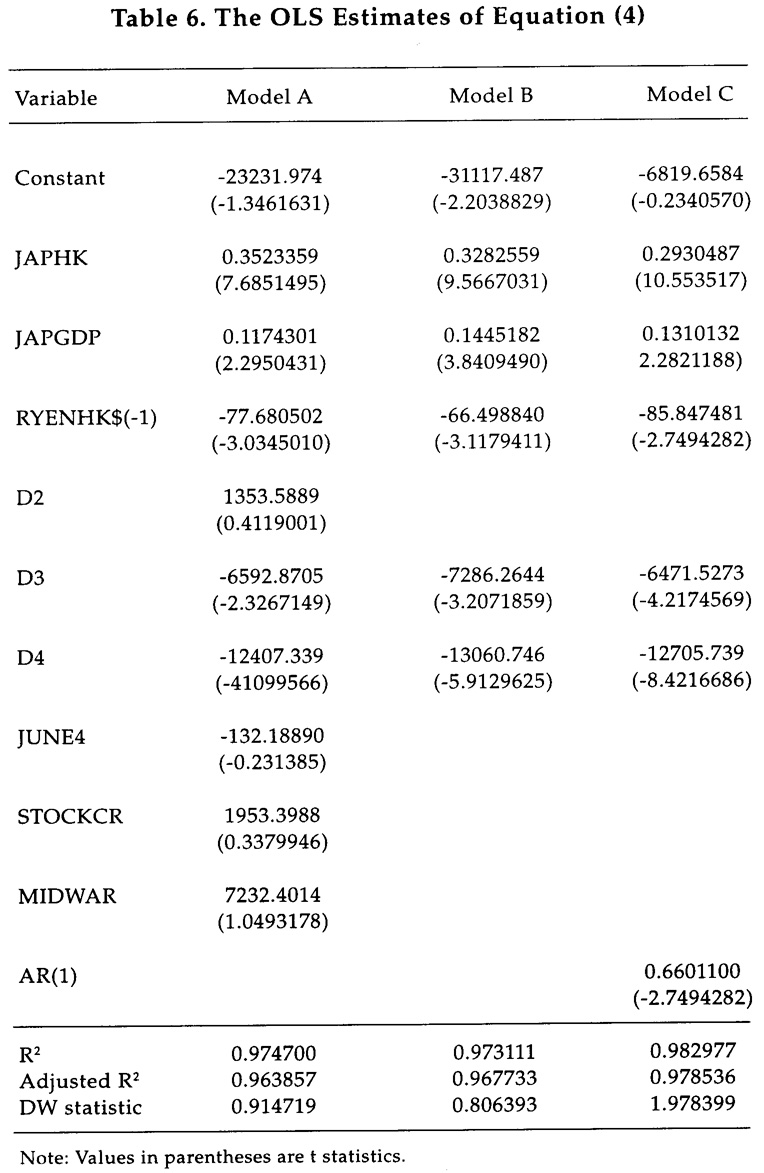
The statistical significance of the causal variables JAPGDP, RYENHK$(-1), D3 and D4 in model C of equation (4) indicates that the explanatory vari-able JAPHK alone cannot explain all the variations of the dependent variable. This implies that the number of Japanese visitors to Macau is not in a fixed proportion to those to Hong Kong. On average, and holding the influences of other factors in model C of equation (4) constant, for every one Japanese visi-tor to Hong Kong, 0.293 Japanese visitors will come to Macau. As the Japanese national income goes up by an additional one billion yen, an extra 0.131 Japa-nese visitors will come to Macau. But when the yen, after correcting for the inflation differential between Hong Kong and Japan, appreciates, it dampens the interest of Japanese visitors in coming to Macau. One potential explana-tion of this result is that when the yen appreciates a lot, more Japanese are inclined to spend more time in shopping and bargain-hunting in Hong Kong than in coming to Macau for an excursion.
The Demand for Accommodation in Macau
We now turn to a segment of the total visitors to Macau that contributes di-rectly to the prosperity of the hospitality industry -- the group that demands over-night accommodation in Macau.
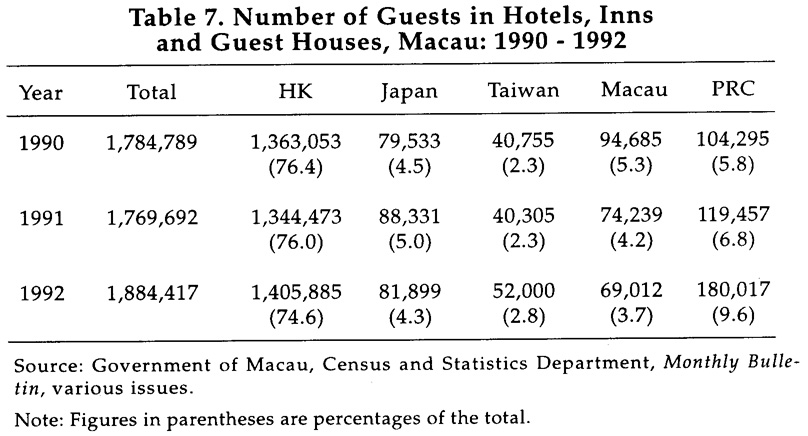
From the figures in Table 7, we observe that the number of guests that demanded overnight accommodation in Macau during 1992 was 1.88 million.11 HK residents and Japanese visitors accounted for about 75 and 4.5 percent ofthe total demand, respectively. The slowdown in economic growth in Japan since 1992 has dampened the Japanese visitors' demand for hotel services in Macau. Guests from the PRC staying overnight in Macau increased rapidly, both in terms of the total number and of the proportion to total overnight guests in Macau.
Since about 75 percent of the overnight guests were HK residents, we should study the factors that influence their demand for accommodation from the hos-pitality industry carefully. The following regression model is constructed to fulfil the above task.

where
RDHKt = the number of HK residents that demanded accommodation (hotels, inns and guest houses) from Macau's hospitality industry,
HKGDPSt = the seasonally adjusted gross domestic product of Hong Kong at current market prices, in million HK dollars, and
SUPPLY = 0 from the first quarter of 1985 to the second quarter of 1989
= 1 from the third quarter of 1989 to the first quarter of 1993.
D2, D3, and D4 are seasonal dummies for the second, third and fourth quar-ter, respectively. NEWPROD, JUNE4, STOCKCR, and MIDWAR have been ex-plained in previous models. The sample range is from the first quarter of 1985 to the first quarter of 1993.
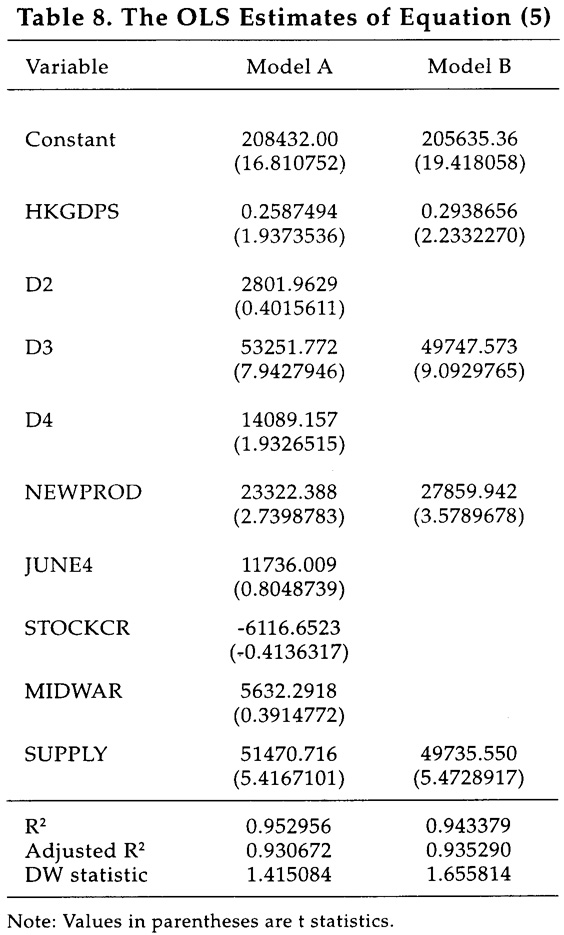
The demand for accommodation in Macau by HK residents could be restricted by availability. The demand for three-star hotel rooms had been very keen relative to their supply before the availability of new three-star hotel rooms after the sec-ond quarter of 1989. The occupancy rates of the three-star hotels were very high and many would-be customers must have been turned away. The dummy variable SUPPLY is used in regression model (5) to separate the period with supply con-straints (before the third quarter of 1989) and the period without the constraints (since the third quarter of 1989).12 The OLS estimates of equation (5) are presented in Table 8.
The empirical results of model B of equation (5) show that when the current dollar HK GDP increases by one million dollars the demand for accommodation from HK residents increases by 0.294 unit per quarter. The third quarter is the peak season for the hospitality industry in Macau, around 50,000 additional tour-ists demanding accommodation at that time. Both the estimated coefficients of the explanatory variables NEWPROD and SUPPLY are statistically significant. With the simplification of the entry and exit procedures for Hong Kong residents since the second quarter of 1987, many more of them (27,859 per quarter) have come and required accommodation in Macau. The shortage in the supply of three-star hotel rooms in Macau before the third quarter of 1989 had severely restricted the effective demand for accommodation by Hong Kong residents. With the relaxa-tion of that constraint, an extra 49,735 Hong Kong visitors per quarter have ob-tained accommodation in Macau.
Recent Developments
This section of the paper deals with three new developments in Macau' s tour-ism: (1) new release of the figures for visitors by land, (2) the rise in the number of PRC visitors, and (3) the rise in the supply of hotels.
Visitor Arrivals by Land
Since January 1992, the Census and Statistic Department has begun the publication of figures for foreign visitors by land. Before that, only the num-bers of visitor arrivals by sea were published. In 1992, out of 7,699,178 visi-tors to Macau, about 19 percent came by land. The number of visitors coming by air was negligible, less than 0.15 percent. Among those who came by land, about 83 percent were Hong Kong residents. The second largest source of visi-tors by land was Taiwan residents.
The release of the figures of visitor arrivals by land has improved our understanding of Macau' s tourism. But at the same time it creates new chal-lenges for studying Macau's tourism. For example, is a visitor coming by land, in terms of his/her economic contribution to Macau's economy, as important as a visitor coming by sea? Another question is: can we assume that the ratio of Hong Kong visitor arrivals by land and by sea have been stable over the past few years, so that we can also extend our analysis of regression equation (2) to Hong Kong visitor arrivals by land?
Visitors from the PRC
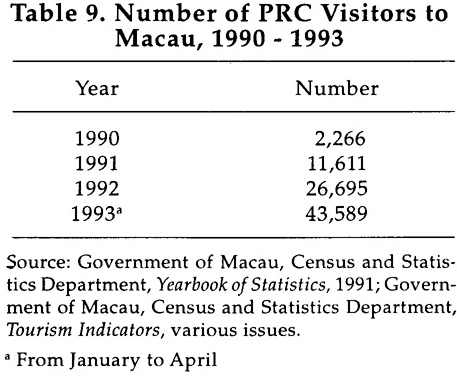
The second major development in Macau's tourism is the rapid increase in the number of visitors from the PRC to Macau over the last two years (see Table 9).
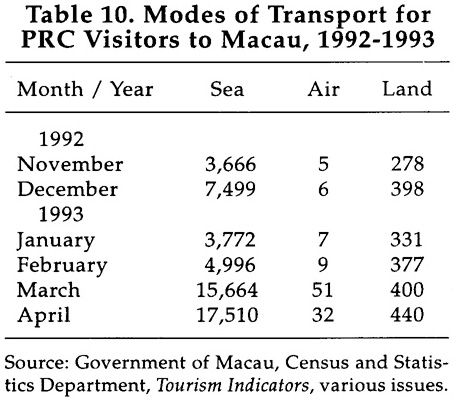
Most of the PRC visitors came into Macau by sea (see Table 10). This im-plies that most of them had travelled to Hong Kong first before they visited Macau. As a matter of fact, the number of PRC visitors to Hong Kong during 1992 was 1,149,002 -- the fastest growing and second largest source of foreign visitors to Hong Kong. And for the first five months of 1993 the number of PRC visitors to Hong Kong has reached 668,622, an 64.5 percent increase over the same period last year. Of this enormous number of PRC visitors to Hong Kong, Macau only attracted a tiny fraction (around 2 percent in 1992). If Macau can capture a larger share of PRC visitors, the monetary benefit to Macau's economy will be very substantial.
In the near future, two important factors will shape the influx of visitors from the PRC to Hong Kong and Macau. The sharp depreciation of the renminbi in 1993 and the attempts of the Chinese central government to cool down the economy since July of 1993 could dampen the trend of overseas travelling among PRC residents. On the other hand, the relaxation of the entry visa re-quirement for PRC residents going to Hong Kong after August 1, 1993 could induce more of them to make short visits to Hong Kong and Macau.13 Only time can tell the relative importance of these two factors on PRC travellers. An optimistic view, taken by many, is that in the near future the number of PRC visitors to Hong Kong will surpass Taiwan figures, and become the larg-est source of foreign visitors to Hong Kong. If this becomes true, Macau will benefit too.
Increase in the Supply of Hotel Rooms
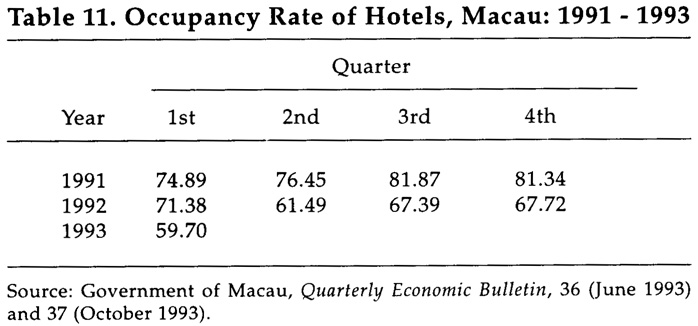
The number of new hotels in Macau has increased rapidly since early 1992. Because the number of visitors has not shown a corresponding increase, occu-pancy rates have recently decreased rapidly (see Table 11).
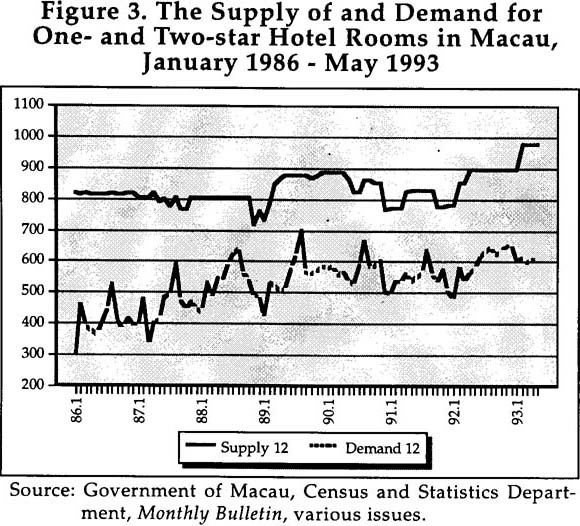
There are five types of accommodation available from the hospitality indus-try to visitors (and Macau residents) in Macau: (1) four- and five-star hotels, (2) three-star hotels, (3) one- and two-star hotels, (4) inns and (5) guest houses. Since rooms from inns and guest houses account for only a small proportion of the totalamount of accommodation available, I will concentrate on the supply and demand conditions of hotel rooms only.
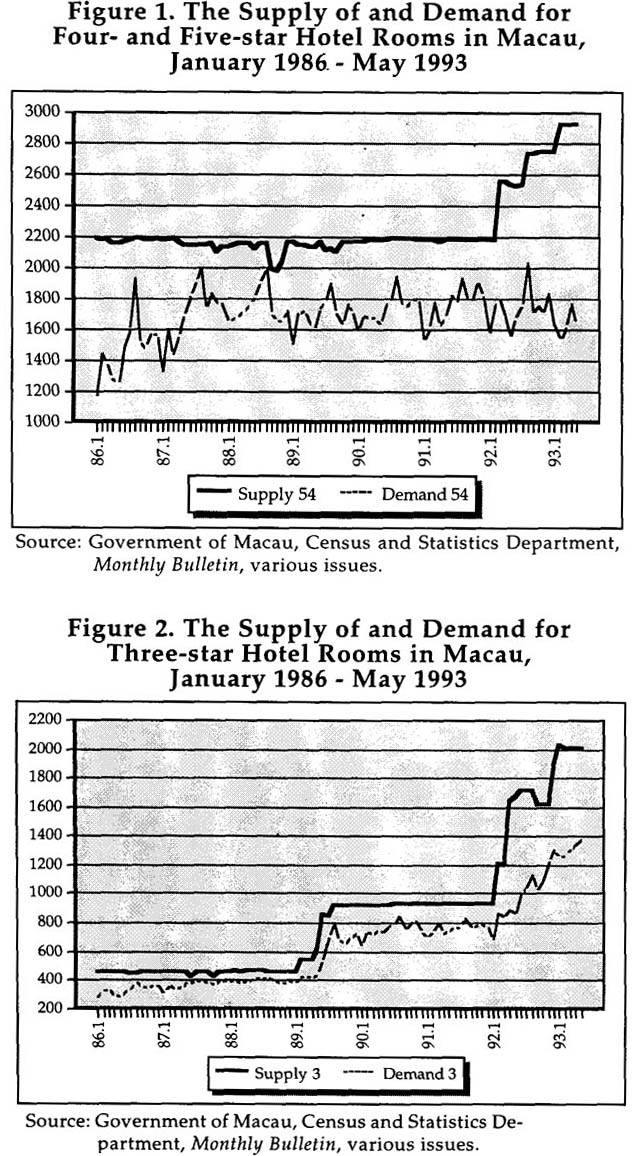
The supply of hotel rooms is simply the number available for customers per day. Since the decline of the occupancy rates of hotels can reflect either (1) a de-crease in the number of visitors that demand accommodation while the supply of hotel rooms remains constant or (2) an increase in the supply of hotel rooms while the number of visitors that demand accommodation remains steady, the occupancy rate is not a good measure of the demand condition of hotel rooms. To alleviate this defect, I will use the following measure to show the demand condition: de-mand = supply x occupancy rate.
The demand for four- and five-star hotel rooms has been very steady in the last few years (see Figure 1). The rapid increase in the supply since early 1992 has widened the gap between the number of rooms available and the demand for them;hence the rapid downfall in the occupancy rate for this group of hotels.
The supply of three-star hotel rooms has shown two separate major increments since 1986 (see Figure 2). The first occurred during early 1989. With the increase in the supply of three-star hotel rooms, there was a corresponding rise in the demand for them. This implied that there was a strong demand for this type of accommoda-tion in Macau and the shortage before 1989 had definitely discouraged some would-be customers. The second major rise happened during early 1992. The demand has shown a corresponding rise, but its rate of increase has not been able to match the rise in the supply. Hence, the occupancy rates of three-star hotels have also decreased.
The supply of rooms from one- and two-star hotels has increased moderately since early 1992 (see Figure 3). With no major rise in the demand since then, the occupancy rate has also dropped.
Based on the above observations, we can conclude that the hospitality in-dustry in Macau is going to have a difficult time in the near future. With the rise in operating costs, low occupancy rates, and downward pressure on room prices, the profit margins of most of the hotels are being squeezed. The hard times that the in-
 dustry is facing now may last until the new airport begins operation in mid 1995.14
Finally, another potential threat that Macau's hospitality industry may have to face is the rise in the number of Hong Kong residents owning apartment units in Macau. The sharp rise in HK housing prices since 1991 has stirred up a specula-tive boom in the Macau property market. Many of the newly constructed apart-ment units in Macau are being purchased by Hong Kong residents. Will they use them as resort houses for themselves and then sell them after further appreciation of the housing prices? If so, potential customers will be lost to the hotel industry.
Conclusion
In this paper, econometric models have been employed to analyse the inflow of tourists and their spending in Macau. In the five models estimated, all the in-come variables are statistically significant and show a positive sign. This confirms the economic theory that demand for a normal good or service increases as in-comes increase. Judging by the income coefficients, the growth of HK and Japa-nese visitors to Macau will be sluggish. On the other hand, gambling service in Macau is estimated to be an elastic superior good. So the growth in gambling rev-enue in Macau will continue to be strong as long as the economic environment in HK remains good, despite the slow growth in the number of HK tourists to Macau.
The occurrence of major socioeconomic events, such as the world-wide stockmarket crash in October 1987, the events of June 4, 1989, or the Gulf War in Janu-ary 1991, did not have a major impact on the number of HK tourists to Macau. On the other hand, the easing of border regulations, the availability of an all-night jetfoil service and an increase in the supply of three-star hotels have induced more HK tourists to visit Macau.
Any factor that attracts more tourists to HK is going to have a beneficial spill-over effect on Macau's tourism. In this way, the appreciation of the yen brought more Japanese tourists to both HK and Macau, while the Gulf War discouraged such visits. By the same token, the influx of PRC visitors to Hong Kong, under the strong economic growth conditions in China, will also benefit Macau.
Notes
1 See Visitor Expenditure Survey: Annual Report, 1991, published by the Census and Statistics Department, Government of Macau.
2 See Yearbook of Statistics, 1991, published by the Census and Statistics De-partment, Government of Macau.
3 See Quarterly Economic Bulletin, 32, (July 1992), published by Government of Macau.
4 The importance of tourism to Macau's economy cannot be fairly judged by simply inspecting its share of GDP. Since it is part of the exogenous spending, any change in its size can lead to further change in national spending and income through the expenditure multiplier.
5 In 1991, 20.3 percent of Hong Kong visitors to Macau declared gambling as their visiting purpose, while other foreigners with the purpose of gambling regis-tered 5.8 percent. 78.9 percent of the latter group declared "vacation" as their vis-iting purpose. See Visitor Expenditure Survey: Annual Report, 1991.
6 The data on HK GDP are obtained from Census and Statistics Department of Hong Kong, Estimates of Gross Domestic Product 1966 to 1992. The data on gam-bling revenue are obtained from Government of Macau, Quarterly Economic Bulle-tin, various issues. The most recent estimates of the GDP of Hong Kong were cov-ered by a report in Fai Pou (Express) on August 10, 1993, p. 13.
7 The per-capita spending here does not include gambling. In 1991, the per-capita spending of all visitors and Japanese visitors alone was estimated to be 672 and 1170 Macau patacas, respectively. See Visitor Expenditure Survey: Annual Report, 1991.
8 The data on the Japanese GDP are ob4tained from various issues of Interna-tional Financial Statistics, published by the IMF.
9 The nominal exchange rate of the yen against HK dollar is measured in terms of HK dollars to 100 units of the yen. The real exchange rate of the yen against HK dollar is created by dividing the nominal exchange rate by the relative price ratio of Japan and HK. The Japanese price index is the consumer price index (CPI) of Japan. The counterpart of HK is the implicit deflator of the private consumption expenditure of HK. The data on the nominal exchange rate between the yen and Hong Kong dollar are obtained from the Hong Kong Monthly Digest of Statistics, published by the Census and Statistics Department of Hong Kong. The data on the Japanese CPI are obtained from various issues of International Financial Statis-tics, published by the IMF. The data on the implicit deflator of the private con-sumption expenditure of HK are obtained from Estimates of Gross Domestic Product 1966 to 1992, published by the Census and Statistics Department of Hong Kong.
10 The explanatory variables that are most likely to be omitted in econometric model (3) are the substitute prices of the demand function for foreign travel. See Christine A. Martin and Stephen F. Witt, "Substitute Prices in Models of Tourism Demand," Annals of Tourism Research 15 (1988): 255-268.
11 Among these guests, about 46.4 percent stayed in five- and four-star ho-tels, 30 percent stayed in three-star hotels, 17 percent stayed in two- and one-star hotels, and 6.5 percent stayed in inns or guest houses.
12 Coincidentally, July 1989 was the time when an all-night jetfoil service be-tween Hong Kong and Macau was introduced. So the supply constraint can be referred to both the restriction on transport and accommodation.
13 After August 1, 1993, Mainland Chinese going to or returning from overseas countries do not need to a have an entry visa to Hong Kong as long as they do not stay beyond seven days (article in Shun Pou (Hong Kong Economic Journal), July 13, 1993, p. 6). The easing of border regulations always generates a powerful response in the tourism industry of both countries. For example, since 1987 the Taiwan gov-ernment has abolished the regulation that Taiwan residents could not go to China through another nation. With the removal of this restriction, the number of Tai-wan visitors going to Hong Kong surged, since 1990, becoming the largest source of such visitors.
14 See an article on Macau's hospitality industry in Oumun Yat Pou (Macao Daily News), September 6, 1993, p. 23.
References
Calantone, Roger J., Anthony Di Benedetto, and David C. Bojanic. 1988. "Multimethod Forecasts for Tourism Analysis." Annuals of Tourism Research 15:387-406.
Martin, Christine A., and Stephen F. Witt. 1988. "Substitute Prices in Models of Tourism Demand." Annuals of Tourism Research 15:255-268.
_____. 1989. "Accuracy of Econometric Forecasts of Tourism." Annuals of Tourism Research 16:407-428.
Sheldon, P. J., and T. Var. 1985. "Tourism Forecasting: A Review of Empirical Research." Journal of Forecasting 4:183-195.
Uysal, M., and J. L. Crompton. 1985. "An Overview of Approaches Used to Forecast Tourism Demand." Journal of Travel Research 23(4):7-15.