Macanese Entrepreneurship:Past,Present and Future
Nelson António Santos Y. W. Khong Virgínia Trigo S. H. Kong Fanny C. K. Vong(Faculty of Business Administration University of Macau)
This paper is a study of Macanese entrepreneurs in Macau. The Macanese are those of mixed Portuguese and Chinese blood born in Macau. Those born of purely Portuguese parents are also included, as long as they are born and raised in the Territory. Decrease in the security of government jobs, coupled with the fact that the payoff from doing business is often greater than from working in the civil service, has induced some Macanese to choose to start up businesses. The number of Macanese entrepreneurs, however, is not signifi-cant. Lack of capital, relative ease in getting secured employment with the government, upward mobility (to a certain extent) in their career life and some other factors contribute to the low number of Macanese entrepreneurs. Some recommendations are given to turn this situation around.
Introduction
In 1999, Macau will become a Special Administrative Region (SAR) of The Peo-ple's Republic of China. Different ethnic groups are already trying to define and prepare for the role they will play after 1999. A local economist has described the Macanese1 as an ethnic group with a political dilemma because explicitly identifying themselves with Portugal or China will jeopardise their position in the future.2
The exact number of Macanese in the government administrative sector is unknown, but most of the employed Macanese occupy government positions of various rank. Their Chinese and Portuguese bilingual ability has enabled them to serve as a bridge between the Portuguese-speaking bureaucrats and the Chinese-speaking populace.3 However, the competitive edge of the Macanese' bilingual ability in the civil service may erode after 1999. If the Macanese can no longer enjoy their status quo in the government administration, yet still choose to remain in the SAR of Macau after 1999, will they venture into the commercial sector? If they do so, will they become successful entrepreneurs? Previous research indi-cates that the Macanese as a group are under-represented in the entrepreneur com-munity of Macau.4 This paper attempts to answer some of the questions related to the emergence of Macanese entrepreneurs. It is hoped that this study will contrib-ute to an understanding of the Macanese attitude towards business and to their search for a niche in pre- and post-1999 Macau.
Data and Method
The data for this study are based upon three main sources:
1. A field survey of Macanese entrepreneurs and non-entrepreneurs:
The survey was carried out by students of the University of Macau who took the course "Organisational Behaviour" during the academic year 1992-1993. The students conducted interviews based on two sets of questionnaires. One set was for Macanese entrepreneurs and inquired about the nature of their businesses, entrepreneurial characteristics and perceptions of their future roles in Macau; while the questionnaire for non-entrepreneurs covered issues re-lated to general attitudes towards entrepreneurship and reasons for not going into business. As it was not possible to identify precisely from previously pub-lished information the location of Macanese enterprises, the students had to rely mostly on their own previous knowledge. A total of 147 questionnaires were completed, out of which 50 were the entrepreneur questionnaires and 97 the non-entrepreneur questionnaires.
2. Published data from the Macau Census and Statistics Department and other departments
3. Interviews with government officials, opinion-makers and prominent Macanese entrepreneurs:
Interviews were conducted, principally by the authors of the paper, to gain a wider perspective and more insight into the dynamics of Macanese society in gen-eral and entrepreneurial behaviour in particular.
Findings
Demographic Profile of Respondents
Of the fifty entrepreneurs interviewed, 37 were male and 13 were female. We interviewed 56 male and 41 female non-entrepreneurs. Their age distribution is shown in Table 1.
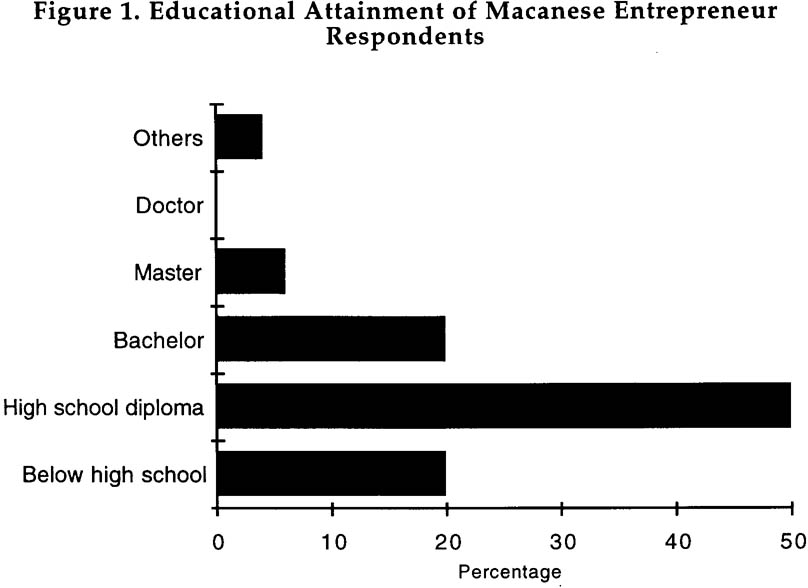
Half of our entrepreneur respondents had attained only a high school di-ploma, and 20 percent did not finish high school (see Figure 1). Low academic attainment impedes promotion in government jobs, and administrators from Portugal take most high positions. These factors may be incentives for some less-educated Macanese to look for career opportunities in business rather than in the civil service.
Table 1. Age Distribution of Respondents
Age                Non-
Group    Entrepreneurs   Entrepeneurs
20-29       11         40
30-39       19         36
40-49       15         19
50 & over     5         2
Total       50         97
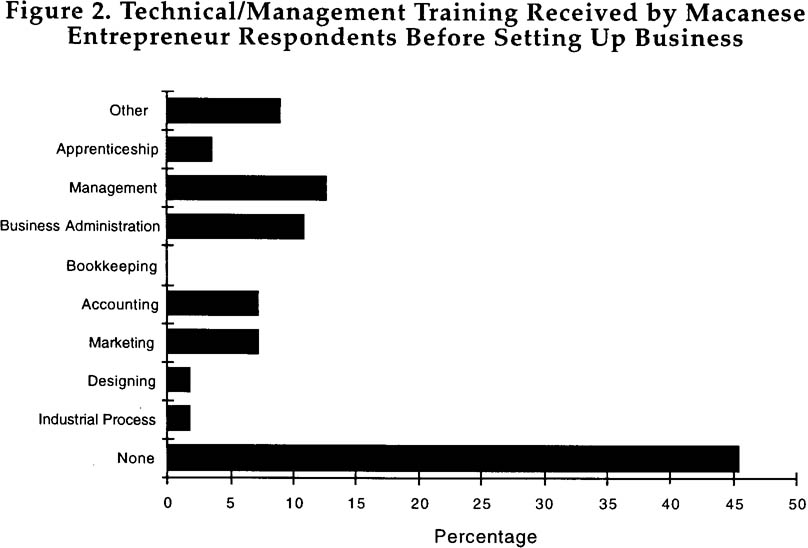
Nearly half of the respondents who are entrepreneurs did not have any for-mal technical or management training related to their businesses before setting them up (Figure 2). Neither had they attended any training courses after setting up their businesses, said 80 percent of the respondents (Table 2). This seems to be a common trend among entrepreneurs in Macau.5 A combination of several fac-tors, such as the absence of appropriate courses for entrepreneurs, lack of time to attend courses, and the fact that people with higher education tend to be less in-clined to become entrepreneurs might account for this phenomenon.
   Table 2. Training Courses Taken
    After Setting Up Business
Courses                  Percentage
None ............................................. 80
Technical ......................................... 0
Management ........................................ 6
Other ............................................ 12
No response ....................................... 2
Total number of respondents ...................... 50
Most of our entrepreneur respondents' fathers were civil servants, (see Table 3) so they had not followed their fathers' career path.
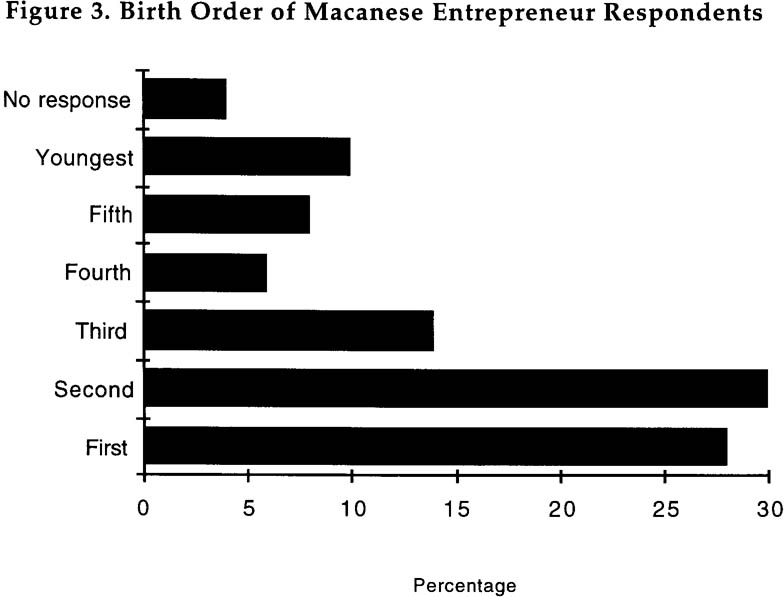
Nearly 60 percent of the respondents were the first- or second-born children in the family (see Figure 3). This is also true of Chinese entrepreneurs.6
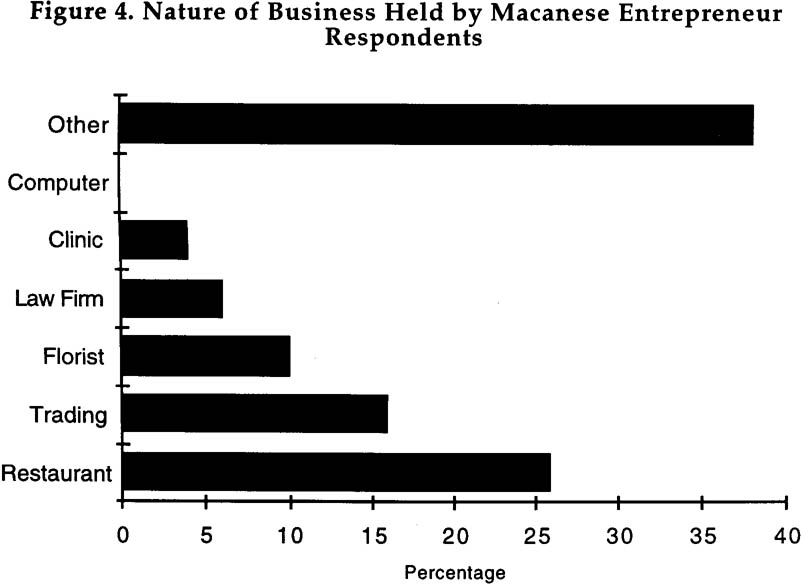
Restaurant owners form the largest single group of respondents (26 percent) from the entrepreneur category (see Figure 4), though other miscellaneous busi-nesses like engineering, architecture and so on, grouped under "others," claim nearly 40 percent. Most Macanese restaurant owners are older and provide Portu-guese cuisine. The younger generation of Macanese entrepreneurs engage in other
Table 3. Occupation of Macanese Entrepreneur Respondents'
             Parents
Occupation            Father              Mother
Farmers & Fishermen         0                0
Traders               8                2
Artisans/skilled workers      1                0
Industrialists           0                0
Managers/Executives         1                0
Government Employees        32                8
Manual Workers           0                1
Professionals            4                4
Homemaker              1                28
Never Worked            0                4
Unemployed             1                0
Other                2                3
Total number of respondents    50                50
 types of business, especially trading and professional services.
Except for some of the restaurant owners, most Macanese entrepreneurs have little business experience. Fifty-six percent have been owners for less than 5 years, while 25 percent have been owners for 5 - 10 years. Perhaps more Macanese are setting up in business now than 5 years ago. One incentive for the emergence of the Macanese entrepreneur is that, starting from the mid-1980s, the government no longer offered any permanent positions; one-year contracts were offered instead.7 Therefore 'life-time employment' is no longer guaranteed in the civil service. As the security of government jobs decreases, the opportunity cost to open up a business instead of serving in the adminis-tration also decreases. Also, 58.8 percent of our entrepreneur respondents had never worked in government administration before setting up their own busi-ness. Perhaps it was easier for them to choose to open a business if they had little job security or seniority to lose.
Attitudinal Profile of Respondents
Around 39 Percent of our respondents stated thatprofit wasteir main motive in business(see Figure 5).
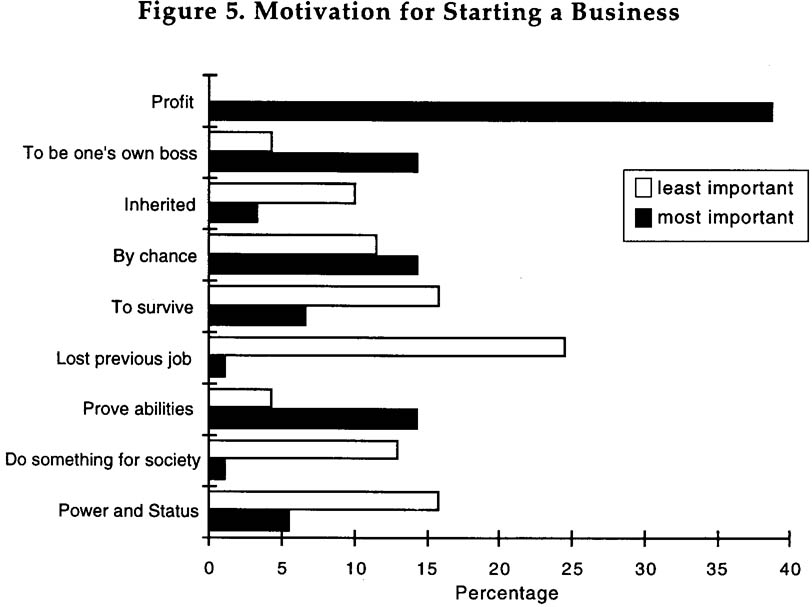
Table 4. Source of Ideas to Start a Business: A Comparison between Macanese Entrepreneurs and Macau Entrepreneurs
               Macanese          Macau Entrepre-
Source of Ideas       Entrepreneurs        neurs in 1987
               in 1992 (N=50)         (N=76)
               Percentage         Percentage


Experience and training      19.6             56.5
Business contacts         5.4             19.7
Successful friends         3.6             9.2
Advice from family        28.6             5.3
Advice from friends        19.6             2.6
Market situation          5.4             2.6
Other               17.8             3.9
Source: Figures for Macau entrepreneurs 1987are obtained from V. F. S. Sit, R. D. Cremer, S. L. Wong, Entrepreneurs and Enterprises in Macau (Hong Kong: University of Hong Kong Press and API Press, 1991), Table 6.17, p. 83.
Nearly half of the Macanese entrepreneurs got their business ideas from their families and friends. This result is very different from the general com-munity of entrepreneurs in Macau.8 A comparison is shown in Table 4.
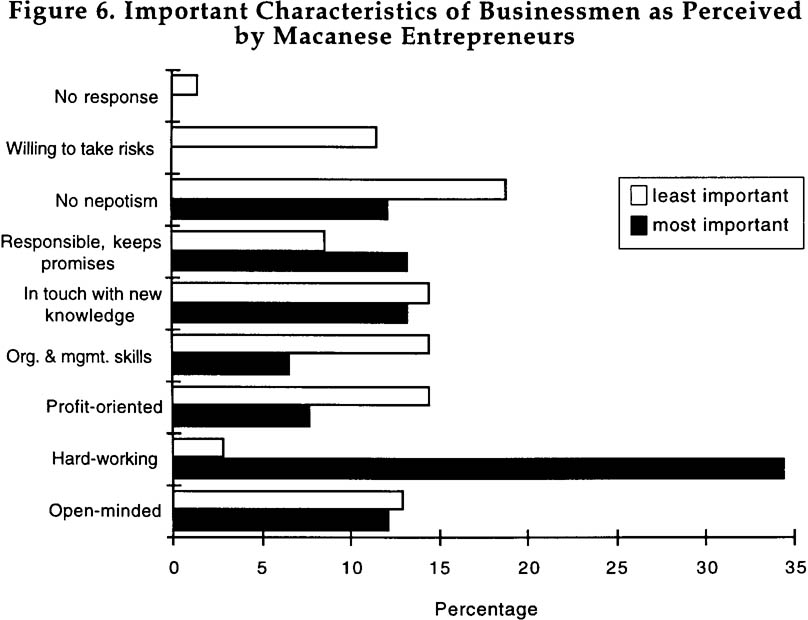
Willingness to take risks and ability to start up new modes of production are often singled out as key characteristics of an entrepreneur. However, these two characteristics are not mentioned by Macanese entrepreneurs. To them, the most important characteristic of a successful businessman is his willing-ness to work hard (see Figure 6). Only an insignificant portion of respondents feel that organisational skill is the most important, and none mentioned the willingness to take risks. When asked whether they would consider expand-ing their business, there was an equal number of "yes" and "no" responses, and an inclination to "no" when asked if they would consider setting up an-other business.
The Emergence of Entrepreneurship Among the Macanese
John Kao argues that the availability of capital is an ingredient that influ-ences the entrepreneurial environment. The mere spirit of entrepreneurship is not sufficient to make an entrepreneur.9
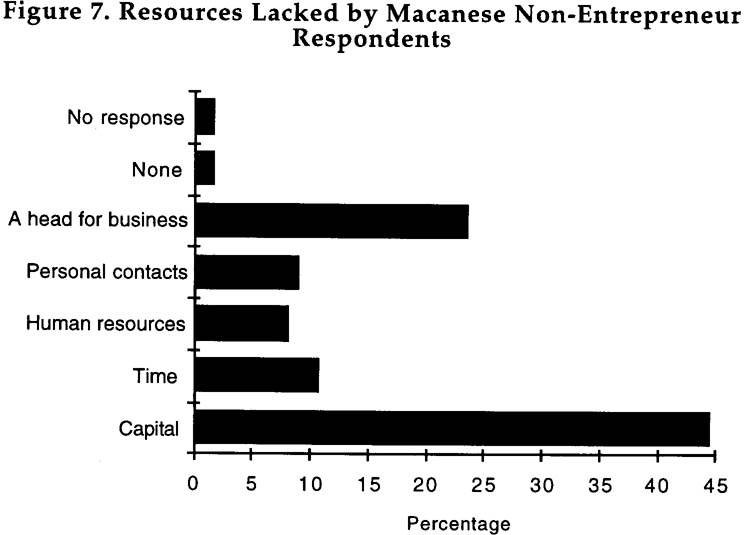
  Table 5. Major Problems Encountered
      When Starting Business
Major Problems                   Percentage
Capital ................................................. 20.0
Human resource .......................................... 11.3
Time ..................................................... 4.8
Knowledge ................................................ 6.6
Lack of government support ............................... 3.8
Lack of customers ....................................... 20.0
Competition .............................................. 4.8
Language barrier ......................................... 1.0
Raw materials ............................................ 4.8
No problems at all ....................................... 1.9
No response .............................................. 2.9
Total number of respondents ............................... 50
Table 6. Average Monthly Income by Industry in 1991
Industry                              Average Monthly
                                  Income (MOP$)
Construction and public projects .........................................$ 3,038
Retail, restaurant and hotel trade ...................................... $ 2,874
Transportation, warehousing and communication ........................... $ 3,512
Banking, insurance and other financial businesses ....................... $ 4,209
Public and private services ............................................. $ 4,072
Source: Macau Daily News, June 3, 1992.
Figure 7 shows that the non-entrepreneur respondents cited lack of capi-tal as the hindrance factor in not starting their own business. We also see from Table 5 that entrepreneurs cited insufficient capital as one of the three major problems encountered when they started up a business.
If blocked opportunity for career advancement in the civil service sector experienced by the Chinese in Macau has encouraged the emergence of Chi-nese immigrant entrepreneurship, then the reverse is true for the Macanese. Until the mid-1970s, the Macanese and the Portuguese enjoyed a monopoly over tenured employment in the middle and upper ranks of the civil service. Then the local Chinese had to content themselves with the lower-ranking jobs and worked only on a temporary contractual basis. The average income for civil servants has always been higher than the income of the average resident of Macau. According to the Census and Statistics Department of Macau, the average monthly income received by employees in different fields was only MOP$2,900 in 1991 (see Table 6 for industry breakdown).10 On the other hand, the average monthly income of a civil servant was MOP$7,918 in 1991 and rose to MOP$9,067 in 1992.11This economic incentive, coupled with easy entry into the civil service, afforded to the Macanese has helped to perpetuate the tradition of Macanese taking positions in the civil service as the first choice. The satisfaction that they find in this stable life-style has not encouraged them to be risk-takers, which has been cited as one of the main reasons for not en-gaging in business (see Table 7).
The government, on the other hand, has always adopted a laissez-faire policy towards the economy whereby business activities are not highly regulated. A policy to assist the Macanese in business activities was never established. There is still today no complete census on the Macanese, let alone any special effort to facilitate their entry into the business world. Yet, in our study, the respondents indicated that the government should play a more important supportive role, which does not necessarily need to be directed to them. Providing financial assistance to start up an enterprise, helping to market "made-in-Macau" products in other countries, and providing more efficient government services are among some of the govern-ment's roles recommended by the respondents in our study.
Table 7. Reasons Given by Macanese Non-Entrepreneurs for Not Being in Business
Reasons                         Percentage
Already financially secure................................... 15.8
Cannot compete in business.................................... 9.5
Business is not a reputable profession ....................... 0.0
Not sure will stay in Macau after 1999 .......................27.4
Life as a businessman is too demanding ..................... 10.5
Not a risk-taker ............................................ 31.6
No response .................................................. 5.2
Total number of respondents.................................... 97
The Making of an Entrepreneur
In general, Hong Kong and Macau entrepreneurs choose to go into business on the basis of their previous job experience and training. A Small Industry Survey con-ducted in Macau in 1987 indicated that well over half the respondents were making such a decision. The same study also showed that the typical career pattern for entre-preneurs in Macau was to work in one job, accumulate capital and experience and then start their own business.12 If this is how entrepreneurs arise in Macau, then the probability of entrepreneurs arising from the civil service, where most of the Macanese are employed, would be slim because in the civil service administrative skills are required, not business skills. Our study informs us that more than half of the entre-preneur respondents were not in the civil service before setting up their own enter-prises, and 73.5 percent of the respondents have enterprises unrelated to their former jobs. This pattern contrasts sharply with entrepreneurs in Macau in general.
In a high-tech age, it is increasingly difficult to get into the market unless one possesses "the skills of tomorrow" and a vision of the future market. The ability to learn and master the increasingly complex skills is directly proportional to the level of educational attainment. Already, the present Macanese entrepreneurs are citing the advanced technology and management skills of their competitors as the most severe threat to the survival of their businesses. Vesper's concept of distinc-tive competence for successful entrepreneurs, which includes an entrepreneurial desire to start a business coupled with the ability or experience to compete effec-tively once the enterprise is initiated, is upheld here.13
1999 and Its Implications for Macanese Entrepreneurship
One is not able to make judgements about the loyalty of the Macanese toward Macau, Portugal or China. However, many of them are uncertain whether or not they will stay in Macau after 1999, when the Portuguese government hands overthe Administration to China. This may mean that they have fears about how the Chinese government will run Macau, but at the same time they are unsure that Portugal will provide them with their desired lifestyle. It seems that the Macanese will stay in Macau if their present freedom and lifestyle are guaranteed. However, as their minds oscillate between staying in and leaving Macau, business opportu-nities come by and escape them. Non-entrepreneur respondents cited "uncertainty after 1999" as the second most important factor for not engaging in business (Ta-ble 7). A survey conducted by the Macau Civil Servants Association further rein-forced this view.14 In spite of the economic boom in China, many Macanese have, in their zeal for "political insurance," opted to invest in the ailing economies of Europe in general and Portugal in particular.
Discussion
This study has offered us a sketchy portrait of the Macanese entrepreneur. An examination of the various factors influencing the emergence of entrepreneurship among the Macanese community indicates that there are more factors inhibiting than encouraging its emergence. The lack of capital, relative ease in getting se-cured employment and upward mobility (to a certain extent) in their career life help to explain the low number of entrepreneurs among the Macanese. The find-ings imply that not many Macanese will become entrepreneurs, although this sphere of activity may determine their future economic well-being in the post-1999 era. However, if the Macanese or the government of Macau hope to see more entrepreneurs emerging from the Macanese community, we offer the following recommendations for consideration.
1. Awareness -- The Macanese themselves have to accept the notion that they need to get into business if they want to emerge as winners in the future. Action may be taken to make the Macanese aware of the needs and opportunities of the future. The tightly-knit Macanese community may achieve this through a cultural hero. A successful entrepreneur could inspire many fellow Macanese. If lack of confidence and experience is a hindrance, a practical solution may be for the Macanese to form partnerships with relatives and friends who are successful in business. This would also enable them to tap into a wider network of business associates.
2. Information -- There need to be seminars or short courses for aspiring Macanese, especially young professionals, to learn how to explore business op-portunities, identify their strengths and gain other important entrepreneurial skills essential for success in the competitive business world.
3. Assistance -- Although it may favour the Macanese at the expense of a lais-sez-faire economy, the government may consider a new economic policy aimed at helping the Macanese, similar to the policy in Malaysia that helps the indigenous Malays. For example, they may give special financial assistance to competent Maca-nese who aspire to become entrepreneurs but lack the means to do so. Special areas in new industrial parks could be set aside for the Macanese and new foreign inves-tors could be required to have mandatory alliances with the Macanese.
Notes
1 "Macanese" in this study refers to people of mixed Portuguese and Chinese blood and who are born in Macau. It includes not only the offspring of a Portu-guese and Chinese couple but also those born of purely Portuguese parents, as long as they have Portuguese lineage in the family tree and are born and raised in Macau. See also R. A. Zepp, "Interface of Chinese and Portuguese Cultures," in R. D. Cremer, (ed.), Macau - City of Commerce and Culture, (Hong Kong: UEA Press Ltd., 1987), pp. 131-134.
2 R. D. Cremer, (ed.), Macau - City of Commerce and Culture, 2nd ed. (Hong Kong: UEA Press Ltd., 1991), p. 54.
3 "Macanese" Monopolisation of the Middle Level of Government Adminis-tration," Macau Daily News, 6 January 1992.
4 S. L. Wong, "Chinese Entrepreneurship in Macau," in R. D. Cremer, (ed.), Industrial Economy of Macau in the 1990s (Hong Kong: API Press Ltd. and China Economic Research Centre, 1990), p. 32.
5 Ibid., p. 35.
6 V. F. S. Sit, R. D. Cremer and S. L. Wong, Entrepreneurs and Enterprises in Macau (Hong Kong: University of Hong Kong Press and API Press, 1991), p. 60.
7 Mr. Fong Weng Keong, Chairman of Macau Civil Servants Association, in-terviewed by the author, Macau, October 1993.
8 V. F. S. Sit, and others, op. cit., p. 82.
9 John Kao, Entrepreneurship, Creativity, and Organisation (New York: Prentice Hall International Inc., 1989), p. 94.
10 "Average Monthly Income in Macau Was $ 2,900 Last Year," Macau Daily News, 3 June 1992.
11 Recursos Humanos da Administração de Macau (SAFP, 1992): I - 3.
12 V. F. S. Sit, and others, op. cit., pp. 74-75.
13 Karl H. Vesper, Entrepreneurship and Public Policy (Pittsburgh: Carnegie-Mellon University, 1983), pp. 42-43.
14 Mr. Fong Weng Keong, interviewed by the author, Macau, October 1993.