Age-Sex Profile of Chinese Immigrants in Macau*
D.Y.Yuan(Faculty of Social Sciences and Humanities University of Macau)
During the period of "open-door immigration policy" before 1980, the stream of Chinese immigrants into Macau included both families and individuals mi-grating for economic reasons. Men slightly outnumbered women. After im-migration controls were introduced in 1980, economic migration became more prevalent. There are few children or aged people among the most recent immigrants. Therefore, the dependency ratio is low. Regardless of age,female immigrants outnumber males, especially those in their late teens and twenties. In short, Chinese immigration can bring benefits to Macau because of its con-tribution to the work force.
Introduction
In 1981, China-born immigrants constituted 48.9 percent of the total resident population of 241,729 in Macau; in 1991, they comprised 50.3 percent of Macau's 355,693 residents. In the past ten years, there has been an increase of 60,823 China-born residents, most originating from the province of Guangdong. Although there has been a significant increase in China-born immigrants residing in Macau, rela-tively little is known about their demographic characteristics. It is the purpose of this study to examine the changing age-sex profiles of Chinese immigrants and to relate these changes to the nature of social and economic activity in Macau within the limits of the published census data for 1991.
As defined by the 1991 Population Census of Macau, Chinese immigrants are those Chinese who were born in the People's Republic of China and resided there more than three months immediately before their arrival in Macau.1
Data
Since data collected during registration for personal identity cards have never been released, the present paper draws on the published population census dataof 1991 and other registration data for legal and illegal immigrants. For the first time, the 1991 census provided data on the length of Macau residency by country of birth and by previous country of residence. The number of years lived in Macau is a good indicator of a China-born resident's year of immigration.
Between March 1982 and March 1990, there were three separate amnesties for illegal immigrants. A total of about 70,111 were granted amnesty: 29,800 factory workers and their dependents in 1982; 9,111 primary- and secondary-school stu-dents and 4,200 parents of these children; and 27,000 further illegal immigrants of all types in 1990.2 A comparison of this figure (70,111) with the published intercensal increase of 60,823 China-born residents indicates that the 1991 census has slightly under-enumerated these residents. However, this should not distort to any significant extent the analysis of their age-sex structure.
Findings
Two successive waves of Chinese immigration are examined which have oc-curred at two periods: the period of unrestricted or free immigration and the later period of controlled immigration. A typical age-sex pyramid, or population pyra-mid, for each period is presented as a basis for discussion. In addition, separate pyramids are given for legal immigrants and deported illegal immigrants.
Chinese Immigrants by Year of Immigration
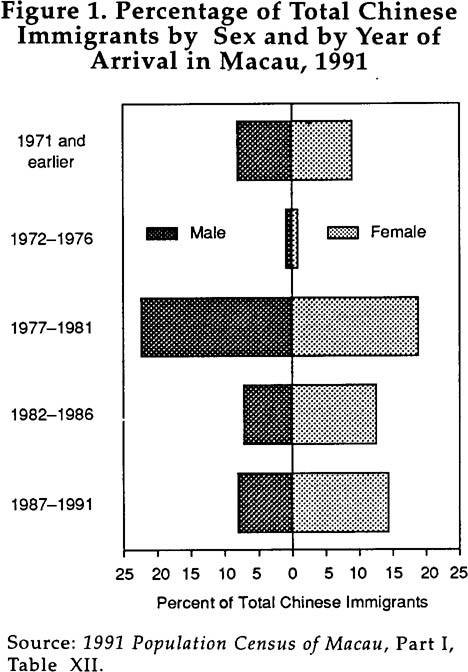
Figure 1 is a graph showing Chinese male and female immigrants as a per-centage of total Chinese immigrants in the 1991 census, classified by year of ar-rival in Macau. The narrowest bar in this figure indicates that the smallest amount of Chinese immigration from the PRC occurred during 1972-76, when only 0.8 percent of all 168,917 Chinese emigrants came to Macau. The peak period of im-migration was reached during 1977-81, when 40 percent came -- as indicated by the broadest bar. Thereafter, immigration seems to have levelled off: about 20 percent of the immigrants arrived during the periods 1982-1986 and 1987-1991. This was the result of immigration controls enforced after 1980.
Figure 1 also shows that before 1982 there were slightly more male immi-grants from China than female immigrants, whereas the opposite was true af-ter 1982. Possible reasons for the changing sex ratio from predominantly male to predominantly female are discussed later, in the section on illegal immigra-tion.
The period of unrestricted immigration before 1980. From Macau's point of view, there were no restrictions on Chinese immigration before 1980, although the Peo-ple's Republic of China required its citizens to apply for exit permits to travel to Macau. When China closed its door to the outside world, it was difficult to obtain an exit permit, at least before 1979.3 However, many sneaked over the border ille-gally. Whoever came to Macau at that time became a Macau resident simply byapplying for a local ID card.At that time,Hong Kong had the same open-door policy:
By the 1970s the facts of immigration had changed. No longer were migrants the cream of China's crop...; they now were almost all rural laborers drawn to the better economic life that Hong Kong promised. In 1974, the government of Hong Kong reversed its open-door policy and required new immigrants to show their exit cards from mainland China. But still the migrants came -- legal, and illegal alike. In 1980 tight immigration restrictions were announced, with the added feature that all illegal immigrants were to be repatriated.4
Most Chinese immigrants are economic migrants who are pulled to an over-seas destination by the prospect of higher incomes, better job opportunities and vocational training. In this respect, they prefer Hong Kong to Macau. Unlike for Hong Kong, China did not set a monthly quota for emigrants to Macau until 1984. Until 14 January 1979 the majority used Macau as a stepping-stone to reach Hong Kong; after that date Hong Kong closed its doors to Chinese immigrants fromMacau except for tourism purposes.5 This is why the smallest number of Chinese immigrants to Macau was recorded during the period of the 'open-door policy' between 1972 and 1976. (See Figure 1.) Only after early 1979 did Macau begin to receive a large number of Chinese immigrants in its own right, as indicated by Figure 1.
The period of immigration control after 1980. As Chinese immigration peaked during 1979 and 1980, Macau took immediate action to defuse the potential 'popu-lation explosion' by ending the so-called 'touch-base policy' for issuing a Macau ID card. After 1980, all new arrivals became illegal immigrants subject to depor-tation, except for those permitted by China to settle in Macau. Between March 1982 and March 1990, a total of about 70,111 illegal immigrants were granted am-nesty, while 125,000, including repeated migrants, were deported.6 Because of these immigration controls imposed after 1980, subsequent waves of Chinese im-migration have levelled off.
Unlike the previous period, three different groups of Chinese immigrants can be identified during this period of immigration control: (1) legal immigrants per-mitted by China to join their families or relatives in Macau; (2) illegal immigrants deported; and (3) illegal immigrants pardoned under special amnesties. Since the census cannot enumerate those already deported, different sources must be used to construct a separate age-sex pyramid for illegal immigrants deported.
Age-Sex Profiles of Chinese Immigrants by Year of Immigration
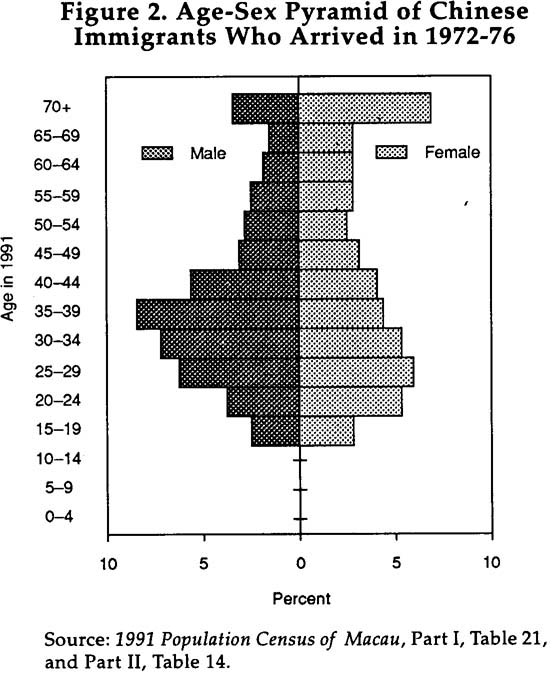
Using the 1991 Population Census data, Figure 2 presents a population pyra-mid for 2,806 Chinese immigrants resident in Macau for fifteen to nineteen years. In other words, these immigrants came to Macau during the period of free immi-gration in 1972-76. About 27 percent of them arrived in Macau when they were under 15 years of age, while 10 percent were 55 and over (making them 70 and over in 1991). The presence of a large proportion of children and working-age adults is characteristic of family migration. On the other hand, the bulge of peo-ple in their twenties at the time of their arrival indicates that there were also sub-stantial numbers of economic migrants. During this period, the stream of Chinese immigrants included both families and individual economic migrants.
Generally speaking, men outnumbered women, especially at the peak migra-tion ages (20-24) at the time of immigration. Family migration and better employ-ment opportunities for males at that time largely account for the high (dominantly male) sex ratio. For aged persons, the sex ratio was reversed and females were dominant. This is partly because a woman's life expectancy is usually five years longer than a man's. Figure 3 presents two age-sex pyramids for 7,994 and 4,802 Chinese immigrants who arrived in Macau in 1989 -- the year preceding the gen-eral amnesty of March 1990 -- and in 1990 respectively. The striking resemblance between these two pyramids suggests several general findings.
First, in contrast to the age-sex pattern displayed by the mixed family and economic migrants arriving during the period of free immigration (1972-76), shownin Fgure 2,the 1989 and 1990 pyrmids indicate that economic migration has pre-dominated during the period of immigration control since 1980.This is evident in Fingure 3 which shows few children or aged people among the most recent immi-grants.
Second, as a result, there is a low dependency ratio; that is, the ratio of the dependent population (aged below 15 and over 65) to the working-age population is low. In this respect, Chinese immigration can be of benefit to Macau because China has paid for the cost of bringing up and educating the immigrants, while Macau can readily use their manpower. As Cremer points out:
The steady supply of immigrants from China has provided cheap labor, which has helped to make and keep Hong Kong and Macau competitive in the manufac-turing marketplace. In addition, and perhaps more important, many of those im-migrants brought with them considerable entrepreneurial skill.7
Third, the 1989 and 1990 pyramids illustrate the case where a very small pro-portion of children and senior citizens is coupled with a very large proportion ofimmigrants at the prime ages for tertiary education, (20-24 and 25-29). This configu-ration suggests that, since a high proportion of the immigrants are university-age migrants coming to Macau for manual jobs instead of attending universities or col-leges in China, the overall educational level of recent migrants is low. A survey of 200 recent illegal immigrants granted amnesty in 1990, conducted by Penny Chan, confirms this expectation: only one was university educated and thirty-seven were illiterate.8 The high illiteracy rate exposes their peasant origins in rural areas of China where the educational level is much lower than in the cities.
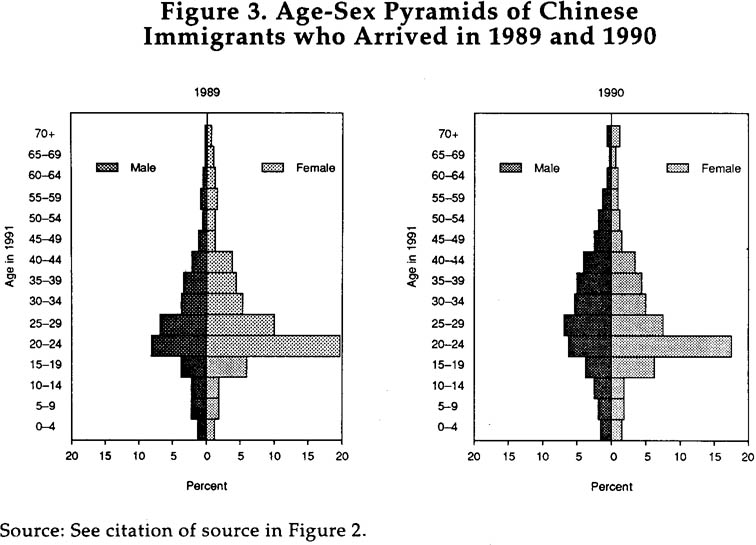
Fourth, the small numbers of immigrants of both sexes in their 30s or under 15 indicate that there are relatively few married couples with young children. After 1980, parents of young children may not want to take the risk of smuggling them into Macau illegally and facing the possible consequences of deportation. (It should be noted that most economic migrants who move from rural to urban areas are single.)
Fifth, the heavy preponderance of males and females in their twenties is ex-pected because "clearly the propensity for persons in the younger economically active cohorts to move is substantially greater than that for the rest of the popula-tion,"9 particularly among migrants from rural to urban areas. In the case of Macau, the continuous expansion of the toy, garment, textile, service and construction industries has increased the demand for young adult workers.
Among females, the age cohort of 20-24 stands out clearly as the one with the largest number of immigrants to Macau, where the booming tourism business --hotels, casinos and night clubs -- has created a demand for more female immi-grant workers in their early twenties. Official tourism figures show that 53 per-cent of visitors to Macau went gambling during their stay in the territory.10 Eight new hotels, ranked from three to five star, with a total capacity of 2,955 rooms, are either under construction or have recently been completed.11
Sixth, regardless of age, females outnumber males, especially those in their late teens and early twenties. To understand the possible reasons for the very low sex ratio (dominantly female), it is necessary to examine the age-sex structure of the coun-terpart group -- the illegal immigrants who are deported. This is because most of the recent Chinese immigrants who entered in 1989 and 1990 and were counted in the 1991 Census were those pardoned by the general amnesty in 1990.
Age-Sex Profile of Illegal Chinese Immigrants
Referring again to Figure 1, the graph shows that only one third of the Chi-nese male immigrants counted by the census in 1991 came to Macau during the period of immigration control (after 1980), whereas about one half of the females came during the same period. This seems to suggest that immigration control has less effect upon females than males. Deportation statistics partly confirm this as-sumption: between 1981 and 1985 more males (29,664) than females (27,756) were deported to Zhuhai, China. The sex ratio for these deportees was 107 males per 100 females. It increased to 217 for those deported in 1989: 14,577 males to 6,726 females. After the 1990 amnesty, there was a slight decrease in the sex ratio of deportees: 4,114 males and 1,992 females were deported in 1991.
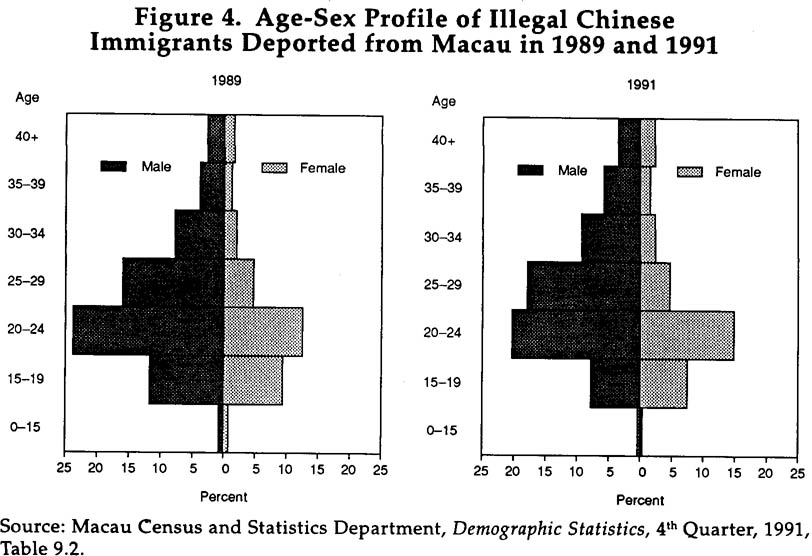
The different 'occupational risks' of male and female illegal immigrants may largely account for the very high sex ratio of deportees shown in Figure 4. Since most illegal female immigrants have been employed as domestic maids or sew-ing-machine operators in small family-run garment factories, they can easily evade detection by the police, who cannot enter a private household without a search warrant. In addition, housewives can take refuge in their homes. On the other hand, most males have been employed as manual labourers on construction sites12 and other public places where police can search without a warrant.
Because of the double standards of law enforcement, police deported more male illegal immigrants in the most active working age groups (20-39) than fe-males in the same age group. (See Figure 4.) A comparison of Figures 3 and 4 suggests that, contrary to popular belief, there were not more females than males coming to Macau illegally, but only that more males were deported. Consequently, more females had been able to hide and escape deportation until they were par-doned in the amnesties of 1982, 1989 or 1990.
The age-sex pyramids for Chinese immigrants arriving in 1989 and 1990 (Figure 3) and that for illegals deported (Figure 4) have one common feature: both are character-ised by an over-representation of people in their 20s, especially the 20-24 age group. As noted before, the pull of Macau has attracted these young persons over to meet the increasing demand for cheap labour. Immigration from China may also be explained by pressure outwards from migrants' home towns. Agence France Presse reports: inChina, "the rural surplus labour has meanwhile surpassed 100 million people,...putting added pressure on cities as peasants move to urban areas to find work."13
Statistics on deportees' places of origin indicate that most migrate only short distances from the nearby rural areas in China to the metropolitan city of Macau. Out of the 21,303 illegals deported in 1989 and the 6,106 in 1991, the great majority came from the adjacent province of Guangdong: 74 percent and 72 percent respec-tively. Among those from Guangdong, only about 4 percent came from the urban county of Zhuhai bordering Macau with about 87 percent from five rural counties. The depressed Chinese rural economy has probably pushed many young people to Macau; as noted previously, Hong Kong has faced the same situation.
Finally, the proportion of deportees under 15 decreased between 1989 and 1991. Since Macau schools can no longer admit any illegal immigrant children after the special amnesty given to these children in 1989, the decrease reflects an actual decline in illegal immigrant children of school age.
Age-Sex Profile of Legal Immigrants
In 1984, China and Macau agreed that 120 Chinese per month would be per-mitted to emigrate to Macau to join their relatives.14 China issues one-way exit permits for these emigrants on the basis of their 'overseas family connections'within the limitation of the monthly quota. Because of the small quota, there is a long waiting list. A similar situation exists in Hong Kong: under present proce-dures, it takes about ten years before a Chinese wife may come to Hong Kong to join her husband.15
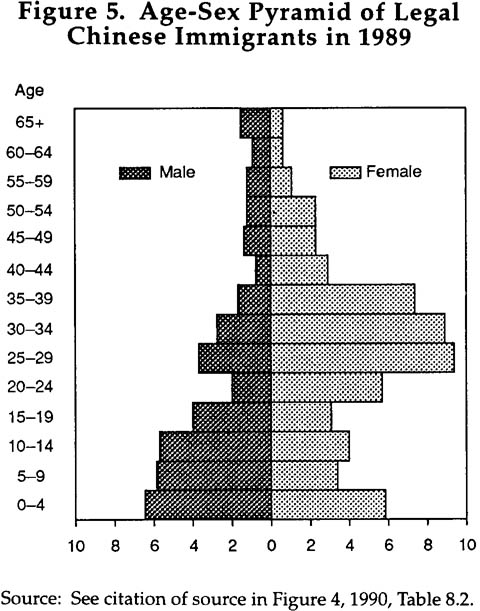
Chinese people who have business connections in Macau, or labourers ad-mitted under the labour import scheme, are not considered by China as legal emigrants nor by Macau as legal immigrants, since at the expiration of their con-tracts, they must return to China. Figure 5 shows the age-sex pyramid for 1,463 legal Chinese immigrants admitted in 1989. Comparing the age groups, there are substantially more children under 15 than older persons aged 60 and over. China-born children of earlier immigrants are evidently coming to Macau to join their parents.
Comparing the percentages of male and female immigrants, we observe a pro-nounced male-female difference: especially in the 25-39 age-group, there are pro-portionally more females. Earlier immigrants may return to China to get married and bring their spouses back to Macau, and the evidence from this pyramid sug-gests that more males have done so. This is because women usually marry up-ward in socioeconomic terms. As is evident, many young women prefer to marry overseas Chinese men with higher incomes from Hong Kong, Macau or other coun-tries in order to emigrate from China.
Implications
Chinese immigration has played a major role in population growth in Macau. In 1991, half of Macau's resident population was born in China.
The most important implication of the age structure of the immigrants is the potential contribution to the territory's manpower, given the large proportion of males and females in the most active working-age groups (20-49). No doubt they have already contributed a great deal towards the supply of manpower in Macau.
An equally significant implication, based on sex ratios, is the substantial re-productive potential of the immigrant population, as a large proportion of female immigrants are in the age groups with highest birth rates (20-34). Their presence is expected to continue to sustain Macau's population growth.
Macau's labour-intensive industries would not have expanded so fast if it had not been for the cheap labour supply from China. These cheap labor resources are the result of the age-sex structure of recent immigrants.
Because of the lack of consistent immigration policies, Macau cannot choose whom to welcome as residents. Consequently, many recent immigrants are less educated peasants from the adjacent province of Guangdong. Without providing adequate vocational training for adults, it is unlikely that Macau can switch suc-cessfully from dependence on labour-intensive industries to those employing higher levels of technology.
Acknowledgements
The author wishes to thank Dr R. D. Cremer, the former Director of the China Economic Research Centre, University of Macau, for including this paper in the Centre's series of unpublished occasional papers. The author would also like to thank his colleagues: Mr William B. Simmons for the graphic presentations and Dr Bruce Taylor for his helpful comments. I am also grateful to Joyce Choi for typing the manuscript.
* This paper was also presented at the International Seminar on the Population of Macau and the Pearl River Delta sponsored by the Macau Census and Statistics Deprtment,October20,1993.
Notes
1 An exception to this is that Chinese contracted labourers and businessmen from China are included if they reside in Macau more than three months. But their number is small.
2 D. Y. Yuan, "Illegal Immigration and Urban Living Indicators in Macau." Paper read at the Conference on Socioeconomic Development and Quality of Life in Macau, University of Macau, February 1992, Table 1.
3 Yau-Kwan Wong, "The New Immigrants from the People's Republic of China in Macau," in D. Y. Yuan, Wong Hon Keong, and Libanio Martins (eds.), Population and City Growth in Macau (Macau: University of East Asia and Macau Census and Statistics Department, 1990), p. 169.
4 John R. Weeks, Population (Belmont, California: Wadsworth, 1989), p. 209.
5 Chinese immigrants who arrived in Macau after January 14,1979 must reside in Macau for more than seven years before they can visit Hong Kong as tourists.
6 Macau Census and Statistics Department, Demographic Statistics, 1982-1991.
7 R. D. Cremer, "Hong Kong, Macau, and the People's Republic of China: A David and Goliath Relationship?" Asian Affairs, Vol. 18, No. 3 (Fall 1991), 154.
8 Penny Chan, Opinion Survey on the Social Integration and Family Planning of Temporary Macau Residents (Macau: Macau Radio Station, 1992), Table 4.
9 Graeme J. Hugo, "Indonesia: Patterns of Population Movement to 1971," in Robin J. Pryor (ed.), Migration and Development in Southeast Asia (Kuala Lumpur: Oxford University Press, 1979), p. 187.
10 Marrita Eager, "Profits Soar at Macau Casinos," South China Morning Post, July 10,1992, p. 2.
11 Chan Wai Hang, "Hotel Industry and Economic Development in Macau," Economia de Macau, No. 2 (August 1991), Table 1.
12 For illegal immigrant workers at construction sites, see Macau Daily News, July 13, 1992, p. 12.
13 "Millions will lose jobs," South China Morning Post, July 15, 1992, p. 10.
14 Wong Hon Keong (Compiler), Economy of Macau (Macau: Journal Va Kio, 1988), p. 14. [translated from the Chinese by Huang Wei-Wen]
15 "Illegal wives total 2,000," South China Morning Post, July 13, 1992, p. 3.