Two Experiments on Helper's Reactions to Rejection of Their Help.
Rosen,sidney(University of Georgia) Cheuk,Wai Hing(University of Macau) Wong,Kwok Sai(University of Macau)
助人者被他人拒絕時的感受及反應
我的研究是集中於助人者的感受及反應。假設有一位明顯需要他人幫助的人,助人者向他/她提供幫助。但需要幫助的人則不接受幫助。在這時助人者將產生不安感受。產生不安的原因是那拒絕令助人者覺得自我能力或自尊心受損。他繼而作出思維上、情緒上及評價上反應,圖令自己相信自我仍是一個有能力的人。兩項採用學生相互輔導方法的實驗,得出的結果是支持上述論點:相對於幫助被他人接受者,被拒絕的助人者認爲他的被拒絕更可能是於對方過份的防禦;以及對方對助人者的評價比對其自己的評價還低等等。文章亦提及兩項涉及澳門教師的研究,內容是有關教師的幫助不被學生接受時的反應及感受。
Introduction
We first reported a model relevant to understanding how lay and professional helpers react when their offer of help is rejected by the recipientd of the offer. This would be followed by two esperiments that esamined major aspects of the model. In the last section we described two studies currently in progress that extended the model to encompassing long-term reactions of professional help-givers, including teachers.
Our model proposes that rejection of an offer of help by a recipient who appears to need help is experienced as a violation of the helper's expectations of a favorable outcome, i.e., of acceptance of the offer. The model suggests that this disconfirmed expectancy has unfavorable implications for the would-be helper's self-image. Namely, the disconfirmation casts doubt on the helper's beliefs in his or her own interpersonal efficacy and/or prosocial concerns, depending in part on how much importance this helper attaches to the outcome of the offer. At this stage of theory development, these self-image implications comprise an inferred cluster of intervening variables.
The model further proposes that the helper tries to cope with these self-doubts through various reaction modalities, affective, evaluative, cognitive, and behavioral. Finally, the model proposes that there are both personal, i.e., individual difference factors, and situational factors that serve as moderator variables that can influence the perceived importance of the outcome and the magnitude of expectancy violation.
To date, our basic laboraory paradigm has used the cover story that we are exploring whether peer tutoring can successfully supplement the alledged College Office ofRemedial Instruction's tutoring program. Each prospective helper is recruited from the introductory psychology research participant pool in exchange for participation credit. The helper is asked to administer a practice task or two on word construction to a so-called Learner. The Learner, the Prospective recipient (R), who is in reality a confederate, always fails to complete them on time. Then the helper is coaxed to offer the Learner some 3x5 index cards containing helpful rules for word construcrion. and is even invited to add rules if the helper wishes to write some.As prearranged, the Learner either rejects or accepts the offer that nearly every helper makes. After this, the helper completes a series of questionnaires that address the dependent variables, in the mistaken belief that the Learner's test tesk will come next. The following presents the gist of two experiments that examined major aspects of the model.
Experiment 1
In one experiment we varied the outcome, i.e., rejection or acceptance of the offer, by way of replication. We also introduced as a possible situational moderator the recipient's need level, by representing the Learner eirher as a remedial student referral, or as a typical or control student picked at random from the undergraduate student body. Need level could be thought of as contributing to outcome importance. About a week before any individual experimental session was run, nine individual difference measures were group-administered to our prospective helpers.
Expectancy violation. The results presented in Table 1 show that rejection of the offfer is experienced as an expectancy violation.
Insert Table 1 here
Specifically, the helpers were far more likely to report that they were surprised by the Learner's response to their offer if the offer had been rejected than if it had been accepted. They were also much less likely to say that the surprise was pleasant, if the offer had been rejected.
Inset Table 2 here
Outcome main effects. The means in Table 2 are based on standardized scores. The means are all ordered in the appropriate direction. As we expected, the overall reactions to the outcome of the offer took on a negative cast if the offer was rejected: Rejected helpers, in contrast to their accepted counterparts, expressed more negative affect, more negative evaluations of R's competence and sociability, and tended to be relatively unattracted to the Learner. They also came up with a relatively uncomplimentary portrait of the Learner in explaining why the offer was rejected. One cluster of these causal attrbutions we labelled defensiveness: it included such characterizations as stubborness, being too proud, and being concerned about appearing inferior. We speculated that these rejected helpers were projecting their own defensiveness onto the Learner. Another cluster we called perverse counter-dependency, to suggest that, in the helper's judgment, the Learner wanted to appear independent, even though it was obvious that the Learner needed help (a sort of attributed self-deception). Rejected helpers, compared to accepted helpers, were also more likely to say that the Learner's poor task performance was due to the Learner's personality and general outlook, i.e., it was due to stable-internal attributes. They also gave a relatively gloomy prognosis concerning the Learner's future performance: they maintained that the Learner had learned relatively little from the present experience: and they maintained that they thmselves has contributed very little to that learning, as though to disclaim responsibility for the consequences that would befall the rejecter.
Hindsight bias. Helpers were asked toward toward the end of the session to what extent they has thought it likely that the Learner would accept their offer at the time when they were making the offer. We werelooking for evidence of hindsight bias as a cognitive coping mechanism in the present context. One way of coping with the threat that rejection posed to their self-image is for rejected rather than accepted helpers to assert after the fact, “I knew all along that the offer would be rejected.” Such a main effect is precisely what happened. Specifically, accepted helpers stated afterwards that they had thought the likelihood of acceptance was hihg. More important, however, rejected helpers stated that they had considered the likelihood of acceptance low.
Two rival rationales have been suggested in the literature as explanations for hindsight bias, one cognitive, the other motivational (Leary, 1981, 1982). The cognitive version would go something like this: Because the causal structure leading up to the critical event is not readily available, the person uses the critical event to construct or reconstruct that causal structure so as to make the event appear inevitable. Leary (1981, 1982), in two conceptual replications, tried to test the motivational alternative, by investigating, whether high egoinvolvement or high eslf-presentation concerns, or both could account for hindsight bias. Neither one did. Leary concluded that may be a cognitive explanation was the only viable alternative. We feel that that conclusion may have been premature. The following shows where motivation might operate in our model in bringing on the postdicted outcomes.
A plausible locus for relevant motivational factors is the set of factors we have called “Personal Moderators.” The rationale is that would-be helpers who are chronically disposed to see themselves as highly efficacious persons and/or as having hihg prosocial concern for others, have more self-investment in the outcome of the offer than would their low counterparts. That is, the outcome of their offer is more important to them, and a rejection would therefore pose a greater threat to their selfimage, as evidenced from the effects of the dispositional measures that had been collected earlier on these helpers.
Insert Table 3 here
The first four measures in Table 3 could be considered facets of a chronic self-as efficacious outlook; they are Perceived Own Competence, Masculinity, Personal Efficacy, and Interpersonal Control. The next four measures could be considered facets of a chronic self-as-prosocial outlook; they are Perceived Own Sociability, Femininity, Perspective Taking, and Empathic Concern. Competence and Sociability are indices that we have developed and used successfully before but as dependent variables. Masculinity and Femininity are form the PAQ battery (Spence, Helmreich, & Stapp,.1974). Personal Efficacy and Interpersonal Control are from Paulhus' Spheres of Control battery (1983). Perspective Taking and Empathic Concern are from Davis' battery of empathy scales (1983). The last two rows represent composites based on the first four and the next four dispositional measures, and that we've labelled self-as-efficacious and self-as-prosocial, respectively.
The means for those who are high on these measures show more polarized postdiction than do those who are low. The Highs claim that they knew all along that the needy R would accept help when in fact if was accepted. That claim is quite logical, and need nor necessarily constitute hindsight bias. For instance, acceptance of aid from helpers who generally harbor high expectations of interpersonal control, could simply be just another confirmation which may be their long history of interpersonal successes;such helpers would almost certainly have predicted acceptance, and probably have been correct. In contrast, however, for them to postdict that they knew all along that the needy recipient would reject their offer, is hardly logical. That they did so, provides support for the motivational explanation of hindsighr bias. Notice that this pattern occurs on all 8 dispositional measures, and of cou-rse on the two composites.
Recall now, that we manipulated recipient need level as a possible situational moderator of reactions to the outcome. Its performance as a moderator was disappointing for the most part. Postdiction, however, exhibited interesting changes when need level together with the personal moderators are brought to bear. Suppose our reasoning is correct that those who are high on these dispositional factors have relatively more of a stake in the outcome. If a peer whose need for help was relatively small were to accept their help, this would be most supportive of, if not flattering to, their self-image. On the other hand, if a person whose need. for help was great were to reject their help, this would be most threatening to their self-image. Therefore, these dispositional Highs should show greatest postdicted acceptance after their offer is accepted by the typical learner, but greatest postdicted rejection after their offer is rejected by the remedial Learner.
Insert Table 4 here
As shown in Table 4, with one exception, those who are high on these dispositional moderatos were likely than their low counterparts to postdict acceptance from their typical Learner, if the offer had been accepted. By contrast, on all 8 dispositional moderatores those who are high were more likely than their low counterparts to posdict rejection from their remedial Learner if the offer had been rejected. For such dispositional highs, to say that they knew all along that this remedial person would reject their offer is quite illogical. It is consistent, however, with the motivational interpretation of hindsight bias. The form that hindsight bias took in the present context might also be regarded as a manifestation of self-serving bias.
Experiment 2
In a later experiment we modified our peer-tutoring paradigm by presenting prospective helpers with a table of bogus performance norms allegedly based on a large sample of freshmen. The table indicated that the average freshman was able to complete six words on time on two successive tasks. Helpers were told that if their learner failed both practice tasks and showed little improvement from the first to the second, theri the learner probably needed help. It was also intimated that due to random assignment within each pair of research participants, they themselves were selected to be the tutor whereas their partner was selected to be the learner. The learner, of course, did not improve, and failed both practice tasks.
Expectancy vioation as a mediator. According to tne model, if expectancy violation is truly a mediator in this context, then controlling for its influence should substantially reduce the effects of the outcome on he lper's reactions. As one test of this, we carried out a series of Analyses of Covariance (ANCOVAS) on each of our major dependent variables. Our measure of expectancy violation, i.e., perceived surprise, served as the covariate in each analysis.
Insert Table 5 here
For each reaction modality, the least square means and associated values in the first row are based on an Analysis of Variance. They show the main effect of the outcome of the offer on the reaction modality in question. The second row shows the relevant adjusted means and associated va lues after the ANCOVE is performed. In the case of outcome attributions, we came up with two new factors besides Defensiveness, as helpers' explanations for the rejection. We labelled the first new factor Chronic Reticence. It consisted of chatacterizations of the Learner as shy and easily embarrassed. The other one, which we labelled Situational Insensitivity, consisted of descriptions of the Learner as lacking awareness of needing help and of not wanting to be sociable.
Notice that on all five measures, if the influence of perceived expectancy violation is controlled, the impace of the outcome is either eliminated or is substantially reduced.
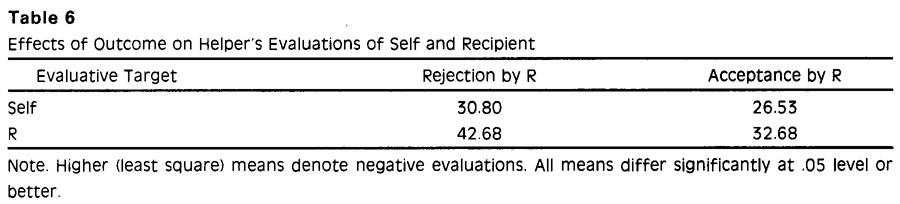
Effects of outcome on self-other evaluations. Another objective of this experiment was to demonstrate empirically something that had previously only been assumed to occur. Namely, our aim was to show that rejection abversely affected the helper's selfevaluation, but that helpers would cope with the underlying threat by evaluating the recipient even more negatively after being rejected than they evaluated themselves.
Insert Table 6 here
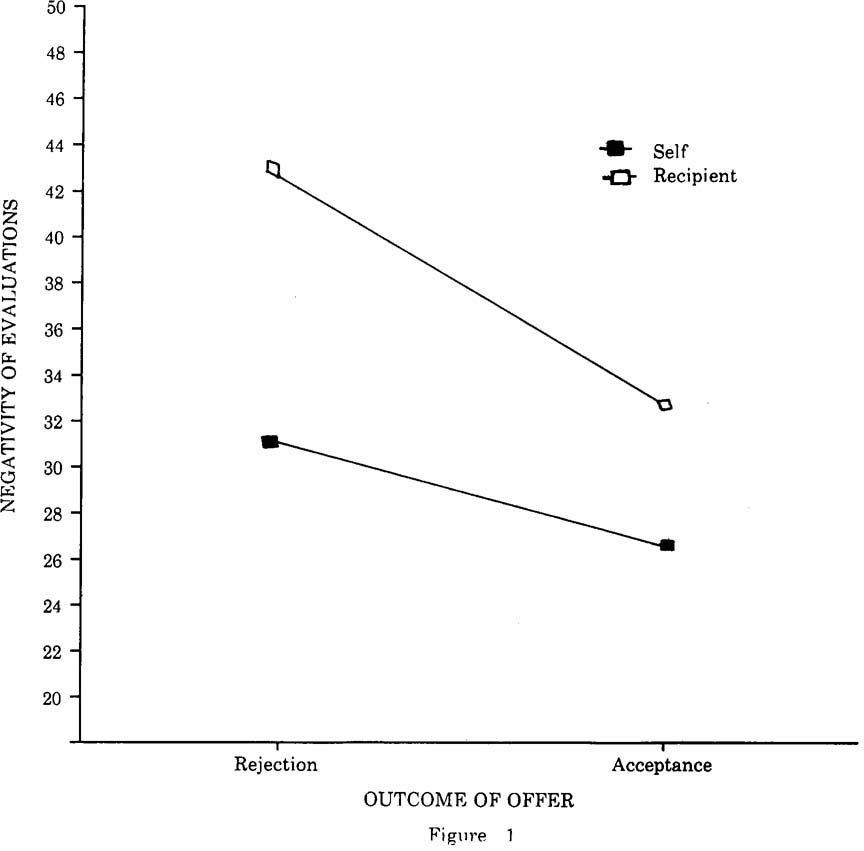
These predictions were supported; larger means in Table 6 denote more negative evaluations of the target person. The interaction effect take the following form:
Insert Figure 1 here
Although rejection makes for more negative evaluations of self and of recipient that does acceptance, negative evaluation of the recipuient increases much more that does negative self-evaluation. Thus, one way in which the helper's self-image is maintained following an unfavorable outcome is via self-other comparisons that still favor the self.
Other Work in Progress
The role and performance of teacher in the process of education are generally regarded as extremely important. Yet how teachers in Macau perceive their role, what factors affect their performences, and how satisfied they are with their work and what contribute to such have yet to be systematically explored. We believe that one of the factors that may contribute to teacher satisfaction is the extent to which students accept the advice and help from the teachers.
We are in the process of collecting relevant data from teachers. in Macau. The major objecive is to determine to what extent students' refusal of their help, or students, resistance to being helped by them contribute to burn-out, an indication of job satisfaction, in these professionals. Our model sees coping as a result of expectancy violation. We are trying in another study with teachers freshly graduated from the School of Education, University of Macau, to determine to what extent the professional training that these teachers had received functions as a buffer that enables them to cope actively with perceived student resistance. It seem plausible, for instance, that the training they had received would prepare them to anticipate resistance of rejection as a common occurrence, thus implying that the fault may not lie in these helpers. If so, their morivation for posdicting rejection is reduced.
References
Leary, M.R. (1981). The distorted nature of hindsight. Journal of Social Psychology, 115, 25-29.
Leary, M.R. (1982). Hindsight distortion and the 1980 presidential election. Personality and Social Psychology Bulletin, 5, 257-263.
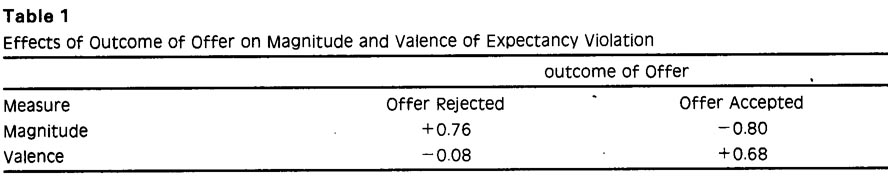
Note. N=148. Means are based on standardized scores.
Magnitude was measured by a 7-point scale on which 7 indicated that the rater was very surprised at the recipient's response to the offer. Valence was measured by a 7-point scale on which 7 rneant that the surprise (however little), was very pleasant and 1 meant very unpleasant. Both differences are significant at P <. 0001.
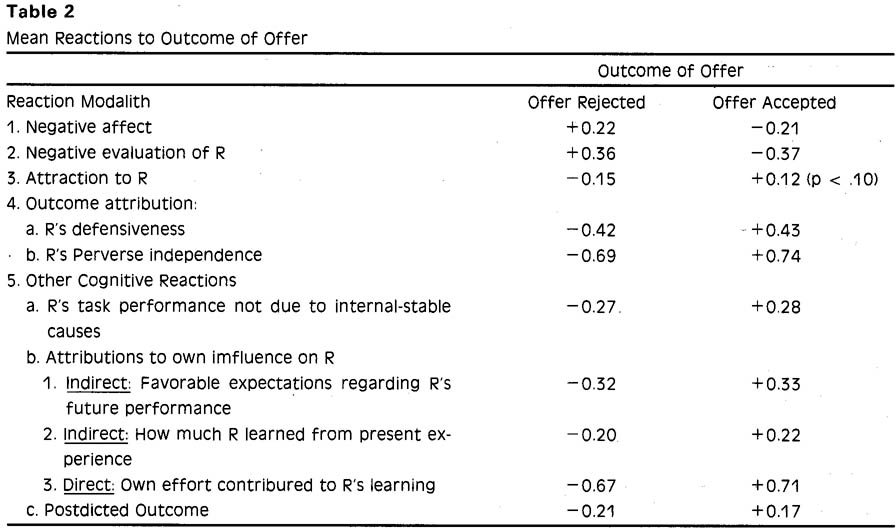
Note. R = recipient. Except as noted, all outcome differences are significant at or beyond the .05 level. N = 148. Means are least square. Scores on attributed defensiveness, counterdependency, and causes of R's perforemance are negatively keyed such that low (negative) scores indicate high defensiveness, high counterdependency, and perforemance due to internal-stable (chatacterological) causes.
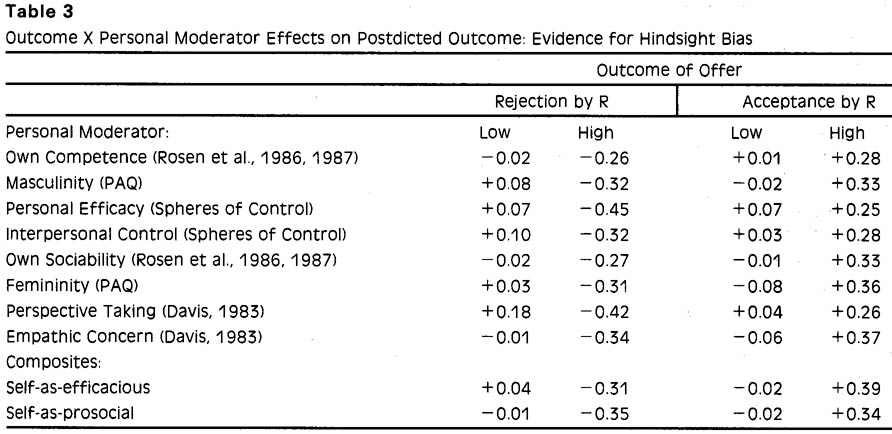
Note. High mean scores denote high postdicted acceptance. Low mean scores denote low postdicted acceptance (or high postdicted rejection). The self-as-efficacious composite index is based on the mean standardized scores of individuals in the top scores of individuals on the bottom four personal moderators.
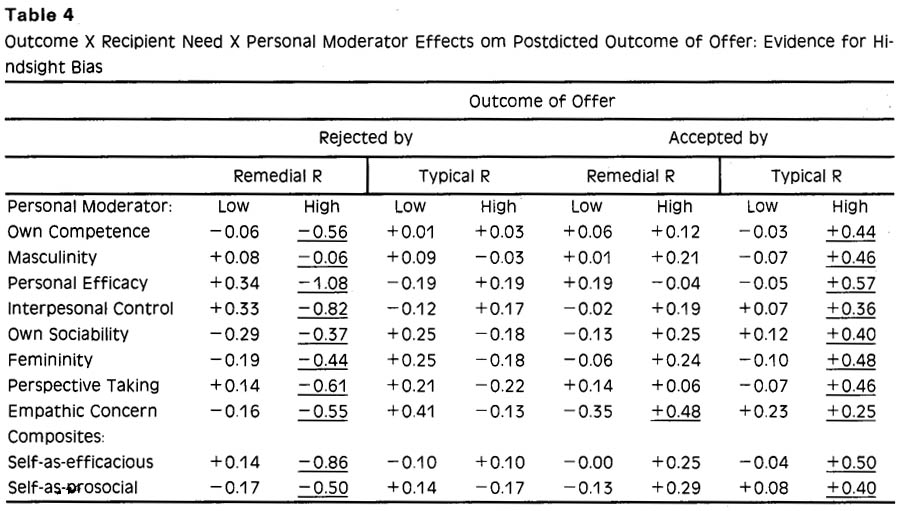
Note. High means denote high postdicted acceptance. Low means denote low postdicted acceptance (or high postdicted rejection). The self-as-efficactious and the self-as-prosocial composites are based on the mean standardized scores of individuals on the top four and bottom four personal moderators, respectively.
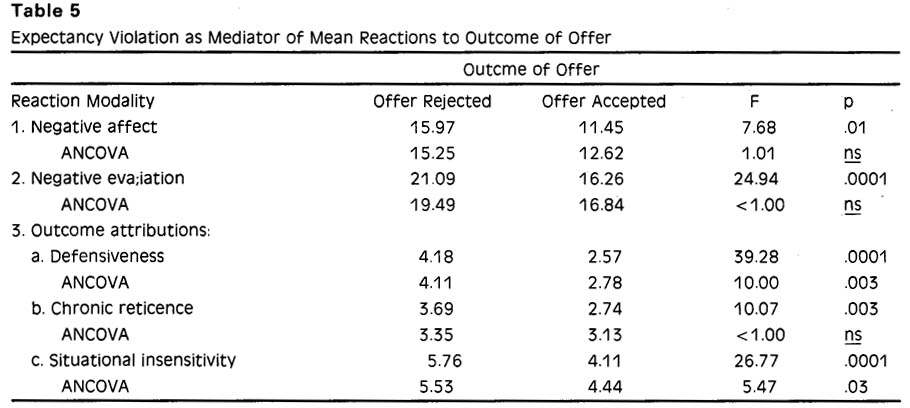
Note. Analyses on first pair of (least square) means for each reaction modality are based on ANOVAs. Those on the second pair of means are based on ANCOVAS with
expectancy violation as the covariate. The latter means are adjusted means. N = 67.