International Organization and Macau's Development
Liu Bolong(Faculty of Social Sciences and Humanities,University of Macau)
國際組織和澳門發展
中葡聯合聲明已訂明,1999年以後的澳門特別行政區可以單獨加入國際組織發展同這些組織的經濟,文化關係。這一條文的確認對於澳門以後的繁榮至關重要。本文主要探討澳門以獨立身份參加國際組織的政治和經濟意義,以及迄今爲止,中葡雙方在這方面所作的努力。本文還試將澳門有必要參加的國際組織進行分類分析,並討論這些組織的加入會給澳門帶來的巨大利益。
Significance of Macau's Partipation in International organizations
The realization of the “one country, two systems”. grand design for Hong Kong and Macau is a mammoth task unprecedented in history. To reach this objective in Macau's case, it is necessary that Macau be incorporated into the network of international organizations and be accepted by the world community. If Macau is admitted into international organizations, it proves that the model of “one country, two systems” adopted for Macau is recognized at the international level.
In Macau, it is commonly acknowledged that three tasks have to be fulfilled before 1999: adoption of Chinese as an official language; localization of civil servants; and localization of the legal system. Many analysts share the opinion that Macau's participation in international organization should be a fourth task. Both Chinese and Portuguese delegations to the Joint Liaison Group have pinpointedthe importance of this missio.1This indicates that China and Portugal have reached a common stance on this issue.
Fulfilment of this task will boost the confidence of the Macau people in the future of Macau, as they would see clearly that the “one country, two systems” model is well received by the world community. With this confidence, Macau could develop into a very special zone within the PRC. As a Chinese commentator suggests, “To safeguard and promote the economic prosperity of the Macau Special Zone, it is necessary to build up and develop Macau as an international city, so that in quotas from tsxtile to air line, Macau could be given special treatment.”2
A very important rationale for Macau's independent participation in international organizations is that Macau may gain some preferences for its foreign trade -- par-ticularly its textile exports -- in the form of lowered tariffs, higher export quotas and other general preferences. As a developing area, Macau still relies on quotas from the developed world for most of its textile and other exports. Although trade diversification and industrial enhancement are both necessary for Macau, no one should underestimate the difficulties involved. Independent participation in major organizations that regulate world trade enables Macau to argue more directly and forcefully in order to protect its interests and accomplish its aims. It is, without doubt, a lifeline for Macau's future. Even more important, Macau can compete more vigorously in world export markets if it is given direct access to such essential information as trade policy changes, techmical know--how and moves toward product standardization. These areas of socalled “software” (trade information and know--how) can be considered even more meaningful than trade preferences for Macau. One could hardly imagine how Macau could remain an international city if it had no direct access to information on quality control methods, hotel and tourism management, air traffic regulation, seaport regulation, and so forth.
Promotion of tourism and culture in Macau is another essential reason for supporting participation in international organizations. Macau has a splendid cultural heritage with mixed Chinese and European flavors. Earnings from tourism and recreation account for about 50% of the income received by the Macau Government. In 1990, Macau received 6 million visitors, a figure ten times greater than its own population.3 Joining international tourism organizations represents a major chance to promote Macau worldwide. Only by receiving more data on tourism patterns, taking part in more conferences and seminars, and acquiring the latest information on hotel management practices and quality standards can Macau meet the world challenge in tourism.
As a centre of tourism in the Far East,Macau should deem maintaining law and order a first priority. This suggests that Macau should join international police organizations and maintain close cooperation with neighbouring countries and with the countries of the West.
The last, but not the least, reason for supporting Macau's participation in international organizations is that it confirms to Chinese interests. If Macau could gain more export quotas and trade preferences, for instance, it will benefit neighbouring areas in China, especially the Zhuhai Special Economic Zone. Macau would become China's second --ranking export outlet in the future, after Hong kong, and like Hong Kong would become a source of capital, know--how and information. Common prosperity and mutual benefit shared by Macau and China are a key to Macau's future.
International Organizations Joined by Macau
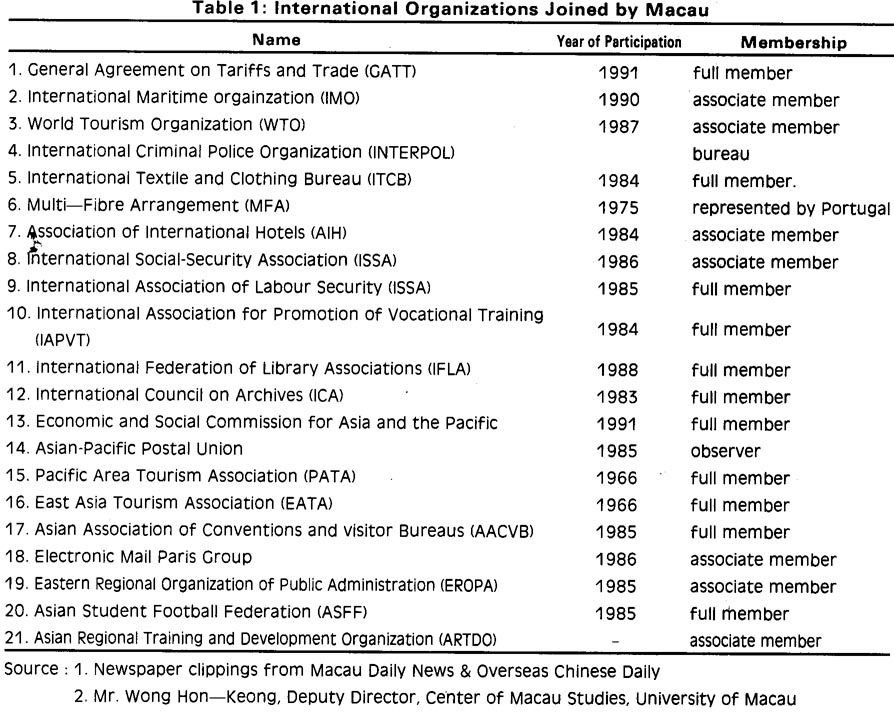
Since most of the significant international organizations are organized by sovereign states, a non--sovereign territory will have no access to them without the recognition and help from the state or states which exercise sovereignty. Only through the joint efforts of the Chinese and Portuguese governments can Macau maintain seats or apply for membership in international organizations. It has been only 4 years since the Sino--Portuguese Joint Declaration on Macau came into effect in 1987. However, the Sino--Portuguese Joint Liaison Group has given the matter constant attention and has discussed this issue many times. A special meeting was held in July 1990 to discuss Macau's participation in international organizations.
The persistent efforts of the Joint Liaison Group have achieved remarkable progress so far, especially when considering the complexity of this issue. Table 1 lists the international organizations that Macau has joined to date.
Categorization of International organizations
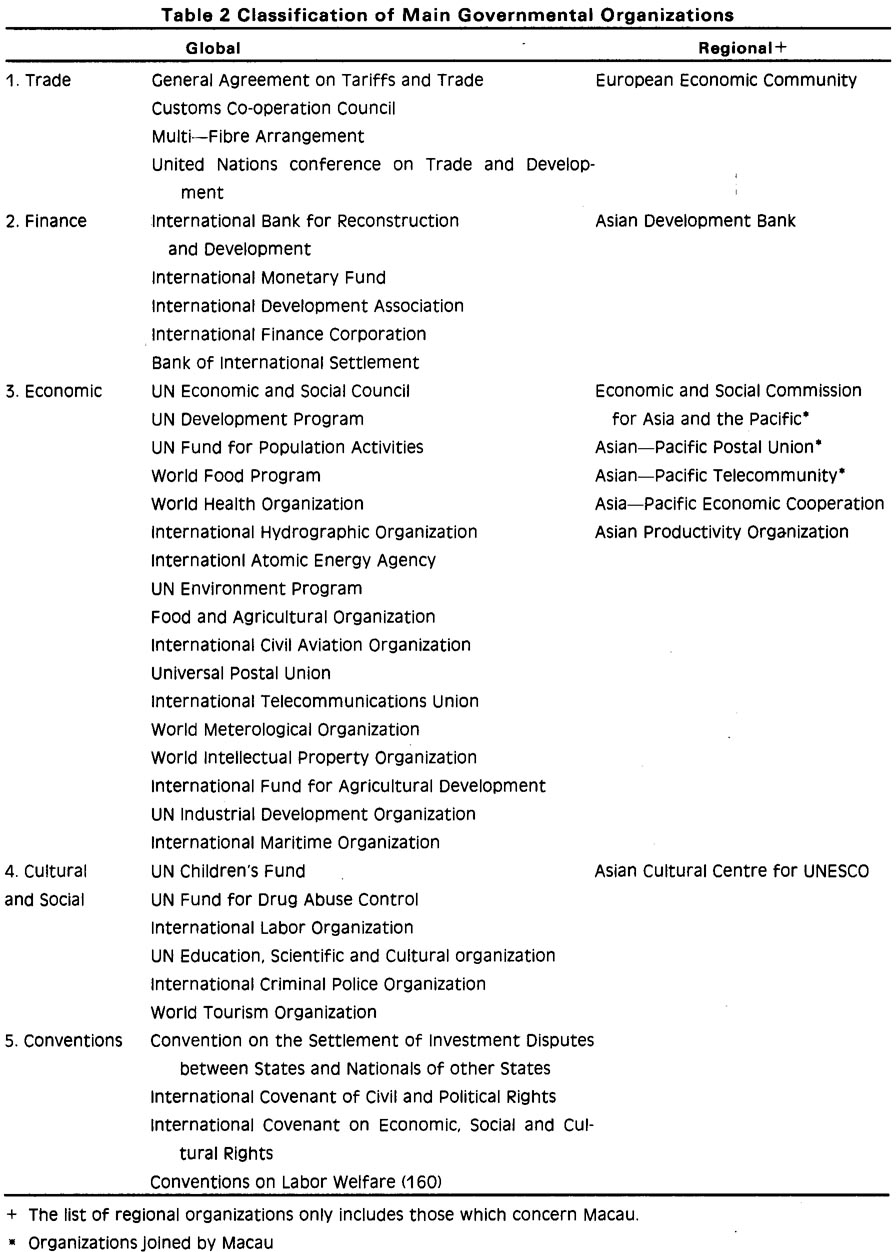
The growth of international organizations has been a prominent phenomenon inthe period since the Second world War. There are now altogether about 380 governmental and 3,700 private international organizations, 5which are involved in all aspects of human life: trade, finance, labour, culture and society, population, children, environment ans sports, among others. These organizations can be divided into classifications based on three main criteria:
1. Governmental or non-governmental organizations:
2.Multi-purpose or single-function organizations;
3. Global or regional organizations.
This analysis is concerned with governmental organizations, which are those made up of sovereign states. Although quite a number of private organizations are very important, they can be joined freely without the direct involvement of the governments concerned.
Table 2 classifies governmental organizations into five categories, and lists the most significant organizations falling in each category.
Benefits of Membership to Macau
This section discusses the potential benefit to Macau from joining the organizations listed in Table 2, with reference to the classification given in that table.
1. Trade
Trade Organization are established to regulate world trade, to ensure an ordered trade flow between countries. In this field, the General Agreement on Tariffs and Trade (GATT) is a very important organization since its activities arouse world attention. China and Portugal helped Macau to become a full member of GATT in 1991. Thus, Macau can enjoy Most Favoured Nation (MFN) treatment in all major export markets and participate in all trade--related negotiations.
The European Economic Community (EC) will by 1992 have formed a unified trade policy towards the outside world. Macau signed a trade and commencial agreement with the European community in June 1992. This agreement will promote Macau's trade and tourism substantially.
2. Finance
Out of the six organizations listed in the finance category, five belong to the World Bank Group although administratively they are quite independent from each other. At the beginning of its establishment, the World Bank (International Bank for Reconstruction and Development) and IMF (International Monetary Fund) played a very essential role in consolidating a fixed exchange rate and safeguarding the balance of trade of member countries. Now the World Bank no longer has this function; its main role at present is to channel funds from the developed world to developing countries (i.e., those with per capita GDP less than US $ 700 -800 per annum)6. Macau has far surpassed that level. However, joining the world Bank and International Monetary Fund (IMF) could help Macau gain monetary independence and credibility for its monetary policies at the international level, especially if the Macau Pataca could be linked to SDR (Special Drawing Rights ) -- a paper money issued by the IMF to guarantee members' financial credibility. This could, to some extent, increase the Pataca's independent status and guarantee its credibility as a fully convertible currency trading on world markets. Therefore, it is this author's a view that Macau should join the World Bank Group immediately.
3. Economic Cooperation
In this field, the UN has established a wide range of agencies promoting cooperation among nations. They are concerned with improving various aspects of human life and contribute to the welfare of all societies. Macau should be encouraged to join as many of these organizations as possible. With China's and Portugal's help, Macau has joined some important regional organizations, as noted earlier. But this is not enough. There are other important global organizations that Macau should participate in. For instance, the UN Economic and Social Council deals with all aspects of economic and social life;its agencies consume more than four--fifths of the UN budget. Many development projects are financed and supported by the UN Development Program. The UN Fund for population Activities carries out research and collects statistics on population and birthcontrol topics. The UN Environment Program provides support for activities on environmental protection and pollution control, and encourages the exchange of information and technology among its member states. The International Civil Aviation Organization gathers information on air transportation, and guarantees that all members have the same rights on air routes. Other improtant organizations for Macau to join include the world intellectual Property Organization and the UN Industrial Development Organization.
4. Cultural and Social
In this field, many organizations fall under the umbrella of the UN Education, Scientific and Cultural Organization (UNESCO), which undertakes such activities as reducing illiteracy, encouraging historic preservation, and supporting educational and scientific cooperation. By joining UNESCO, Macau could gain information and assistance in these areas, some of which are of special relevance for the tourism industry. Other organizations Macau could benefit from joining include the UN Children's Fund and the International Labor Organization.
5. Conventions
There are quite a number of conventions voluntarily signed by members of the UN. Among them, two conventions on human rights are important. Macau could follow Hong Kong's example and declare the two conventions applicable to Macau after1999. A further convention concerning investment disputes between states is relevant for future investment in Macau after 1999; Macau would benefit from signing independently. Macau could also sign some of the 160 conventions concerning labour welfare administered by the International Labor Organization.
Conclusions
Macau's Participation in international organizations is tied to Macau's future: to the realization of the “one country, two systems” grand design and its acceptance by the world community. Participation could also bring substantial economic, social and cultural benefits to Macau and support its future growth. Encouraging participation is a difficult but rewarding mission.
Through the common efforts of the Chinese and Portuguese governments, Macau has joined a number of the most important global and regional organizations. However, there remains a wide range of international organizations of which Macau is not a member in its own right. The workload for the chinese and Portuguese negotiators discussing this issue is still quite heavy, as it is in Macau's interest to join most of the other organizations. Speeding up the pace at which Macau can join international organizations could be very beneficial to Macau's future.
1. The head of the Chinese delegation to the Joint Liaison Group, Ambassador Kang Jiming, compared the three tasks to running horses and added a fourth horse: Macau's participation in international organizations. See Macau Daily News, 9 February 1990, P. 2.
2. “Quicken the speed to Participate in international Organizations” , Overseas Chinese Daily, 4 July, P. 2.
3. Yearbook of statistics Census and Statistics Department, Macau Government, 1990; P. 121.
4. See Overseas Chinese Daily, 19 May 1990, P. 2.
5. A. Leroy Bennett, International Organizations:Principles and Issues, Fourth Edition (Englewood Cliffs, NJ; Prentice--Hall, 1980), P. 5.
6. Bennett, International Organizations, P. 5.
7. Bennett, International Organizations, P. 67.