A Study of the Contribution of Social Studies,Science and Health Education Teaching to Environmental Education in Macau
MA Hing Tong(Faculty of Education,Monash University,Australia) LEE Chi Kin(The Chinese University,Hong Kong)
關於社會科學及健康教育三科在澳門環境教育中作用的研究
在八十年代末期、九十年代初期,各國均十分關注環境問題,紛紛致力推動學校向學生灌輸環境保護的意識,近年更把環境教育納入正規課程內,部份國家以滲透方式在各有關科目裡施教。本澳也不例外,在小學的社科健三科均有涉及環境教育的問題,而有關科目的老師在施教過程中也碰上很多本地特有的問題,本澳直至現時尚未有這方面的課程指引或研究,故此本研究正好可填補空白。
本研究於一九九三年五月間對澳門小學任教社會、科學及健康教育的老師,進行問卷調查,結果收回158份問卷。是次調查主旨是透過問卷瞭解下列幾個範疇:
1.老師對推行環境教育的意見;
2.在教授環境課题時,不同教學資源的使用頻率;
3.教授“污染”課题時,最理想的教學方法;
4.限制或阻礙透過學科推行環境教育因素的意見。
本文的焦點是教師在被問及上述幾個範疇的問題有否分野,資料顯示出教師感到較困難地全面和深入教授有關環境教育的課題,且使用不同形式的教學資源頻率有差異,又在運用教學策略施教也碰到障礙。除此外,文末還探討一些不利的因素,希望未來能把這些障礙一一清除。
INTRODUCTION
Macau does not possess a single, unified education system; instead, its education system is a diversified and uncoordinated collection of systems, imported from Portugal, the People’s Republic of China, Taiwan and Hong Kong (Bray and Hui, 1991). Another distinctive aspect of education in Macau is the division between official schools and private schools, the latter forming the vast majority. As regards the school curricula in private schools, the preference and background of the sponsors of individual institutions govern their nature to a great extent. While there is an actual divergence in school curricula following the models of Hong Kong, the People’s Republic of China and Taiwan, most private schools in Macau choose to use school textbooks from Hong Kong.
Because “ecological crisis” and “environmental deterioration” have become watchwords in the news media in recent years, environmental education is now given a higher priority on the educational agenda in many parts of the world.Today, its importance is also recognised in Macau; but there is still a paucity of research into this area. It is against this background that the present study was conducted.
RELATIONS BETWEEN ENVIRONMENTAL EDUCATION AND SOCIAL STUDIES,SCIENCE EDUCATION AND HEALTH EDUCATION
According to Parker (1991), there are five essential areas of learning for the social studies curriculum: democratic ideals, cultural diversity,economic development, global perspectives, and participatory citizenship. In particular, global perspectives and participatory citizenship have relevance to environmental education. The former is concerned with understanding the ways human societies have changed the natural environment.whilst the latter, as a starting point, emphasises the sustained opportunity to discuss pressing public issues such as pollution. Moreover, there has been a recent call for revitalising social studies education in order to foster an expanded view of citizenship - - a view emphasising the synthesis of knowledge from sources in science and technology, as well as from social studies subjects, for resolving issues such as environmental problems (Wraga and Hlebowitsh,1990).
Similarly, a renewed and broader approach which acknowledges social and environmental issues is advocated in health education (Colquhoun, 1989). As Schlaadt (1988) argues, a balanced and comprehensive programme of health instruction should cover the topic of environmental health. Such a topic can deal with issues of pollution, radiation, overpopulation, waste and other problems and also focus on how individuais can be responsible in maintaining and preserving the environment.
A review of the literature reveals that science has an important role to play in the promotion of environmental education in the school curriculum (e. g., Lucas, 1980; Lee, 1988). In the 1980s,the teaching of ethics and social responsibility through science became a popular issue amongst science educators all over the world (Rao, 1986).In addition, Lewin (1990, p. 20) anticipates that in the 1990s, “Science and society, and environmental issues, will appear frequently in new curricula as their importance for the presentation of global equilibria becomes more apparent.” There is also the Science-Technology-Society trend in science education through which science is studled in a social issue context (McFadden, 1991; Tao,1992).
A FRAMEWORK OF STUDY FOR ENVIRONMENTAL EDUCATION
The scope of this paper is primarily confined to perceptions of goal statements for environmental education, teaching strategies, the characteristics of the activities, and problems perceived in implementing environmental education (Kyriacou,1986). The investigation is largely based on three components of environmental education - - education about, in and for the environment - - addressed by Lucas (1980) and other educators (Linke, 1980; Huckle, 1983; Fung and Lee, 1990;Yau, 1992). Education about the environment refers to the environment as a subject for investigation and involves the provision of information on environmental issues and the teaching of appropriate technical and intellectual skills. Education in (or through) the environment is the use of real-life situations as a basis for inquiry learning. Education for the environment is the issue of assisting, more actively, the preservation and improvement of the environment,inculcating attitudes of concern for the features of the environment that enhance the quality of life or which are deemed to possess intrinsic value, and creating a predisposition towards committed action that is consistent with those attitudes - - in essence, promoting environmental well-being as its goal (Robottom, 1987). Education for the environment, in general, involves investigating and clarifying environmental viewpoints and values,environmental problem-solving and taking environmental action. In general, educators adopting a technocentric perspective are inclined to believe that the three kinds of environmental education are complementary and interrelated. On the other hand, protagonists of a critical,ecocentric perspective deny eclecticism and regard education for the environment as the genuine and ultimate form of environmental education (Huckle, 1991).
METHOD
In this study, a questionnaire survey was administered in May, 1993 to a convenient sample of primary teachers teaching a combination of social studies, science and health education subjects (Lee and Ma, 1993). Parts of the questionnaire, mainly based on a similar study in Hong Kong, include the following elements (Linke,1980; Geographical Association’s Sixth Forms /University Working Group, 1981; James and Potts,1981; Ng, 1991; Lee, 1992, 1993): (a) opinions about the goals of, and views on the development of environmental education; (b) the use of teaching resources; (c) the extent of environmental education; (d) perceptions of effective and desirable teaching strategies in teaching the topic of pollution; and (e) problems in implementing environmental education through subject teaching. The questionnaire items were tried out with a small sample in a pilot run, and the ambiguous items were modified. As a result, 158 questionnaires were returned, and they were subsequently analysed using the SPSS-PC programmes.
PERCEOPTIONS OF SCHOOL GOALS PRIORITIES
Successful implementation of environmental education, like other kinds of school reform,requires a shared vision amongst teachers of what environmental education should be. This shared vision, in turn, provides the direction and impetus for change (Fullan, 1991). One facet of this study involves the analysis of the attitudes of teachers toward a selected list of school goals in, and approaches to environmental education. In the questionnaire, the respondents were asked to indicate their levels of agreement or disagreement (1 for strong disagreement to 5 for strong agreement) with particular goal statements. The results reveal that all 21 goal statements have mean values above 3, indicating that a substantial number of respondents agree with the school goal statements on environmental education. As regards goal priorities, the first three of them reflect strong support (Table 1).
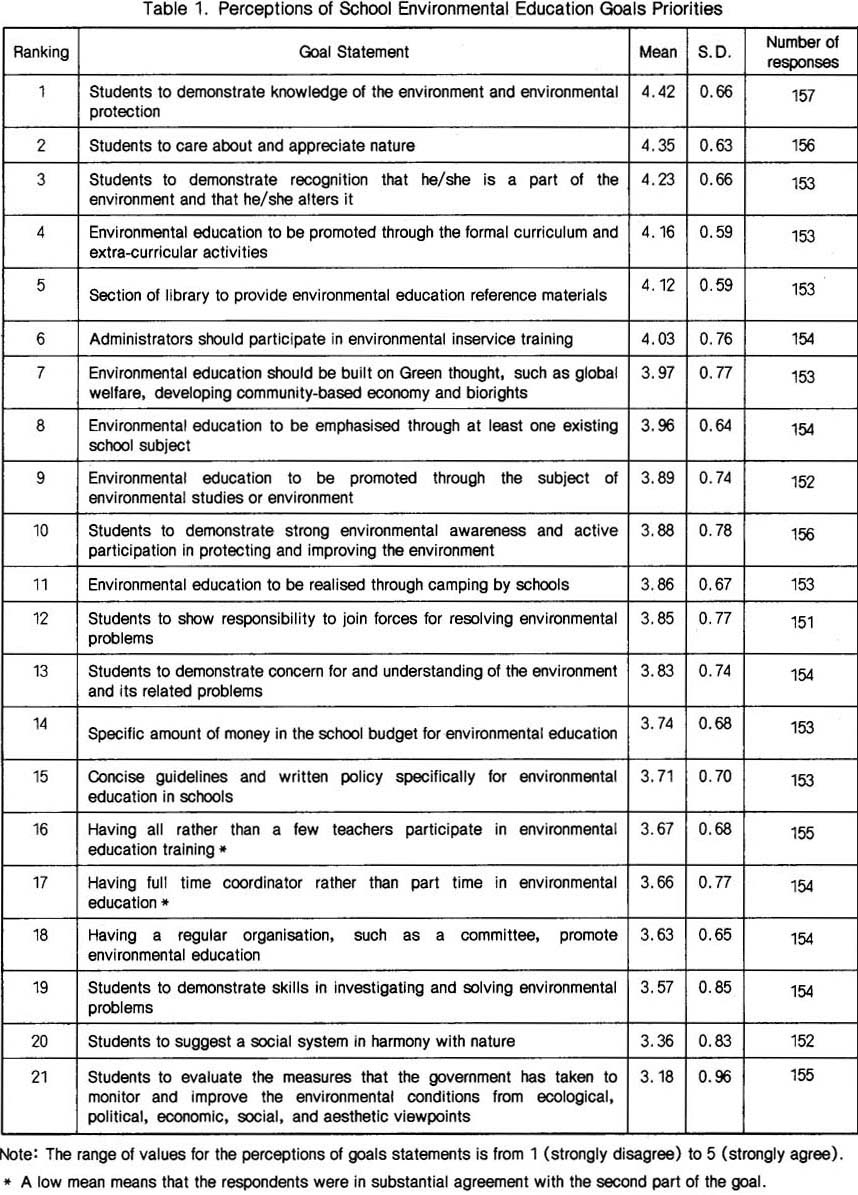
On the other hand, affective goals, such as “Students to demostrate strong environmental awareness and active participation in protecting and improving the environment” and “Students to show responsibility to join forces for resolving environmental problems” are comparatively less well supported by the respondents. In contrast,the respondents attach lower priorities to such goals as “Students to demonstrate skills in investigating and solving environmental problems”, “Students to suggest a social system in harmony with nature”, and “Students to evaluate the measures that the government has taken to monitor and improve the environmental conditions from ecological, political, economic,social and aesthetic viewpoints”. It is also notable that the respondents support the view that “Environmental education should be built on Green thought, such as global welfare, developing a community-based economy and biorights”.
The above results suggest that the teachers are more supportive of the cognitive and affective objectives of environmental education which emphasise environmental knowledge and attitudes, respectively. It is also apparent that teachers in Macau have a low level of agreement with the affective objectives emphasising action and participation as well as skills objectives, such as problem-solving and enquiry. In addition, higher levels of cognitive learning for students (including the ability to suggest a social system in harmony with nature and to evaluate government’s environmental measures from different viewpoints)are grossly neglected by the teachers. These results imply that teachers prefer goals pertinent to education about the environment to those related to education in and for the environment.
As regards the institutional commitment to implementing environmental education, the following approaches were considered to be important:
(a) Environmental education to be promoted through the formal curriculum and extra-curricular activities (4.16);
(b) Section of library to provide environmental education reference materials (4.12);
(c) School administrators should participate in environmental in-service training (4.03).On the other hand, the development of a school environmental education policy and document, the employment of a full-time environmental education co-ordinator and the setting up of a specific committee for promoting environmental education are perceived to be lower priorities amongst the list of goal statements.
USE OF TEACHING RESOURCES IN TEACHING ENVIRONMENTAL ISSUES
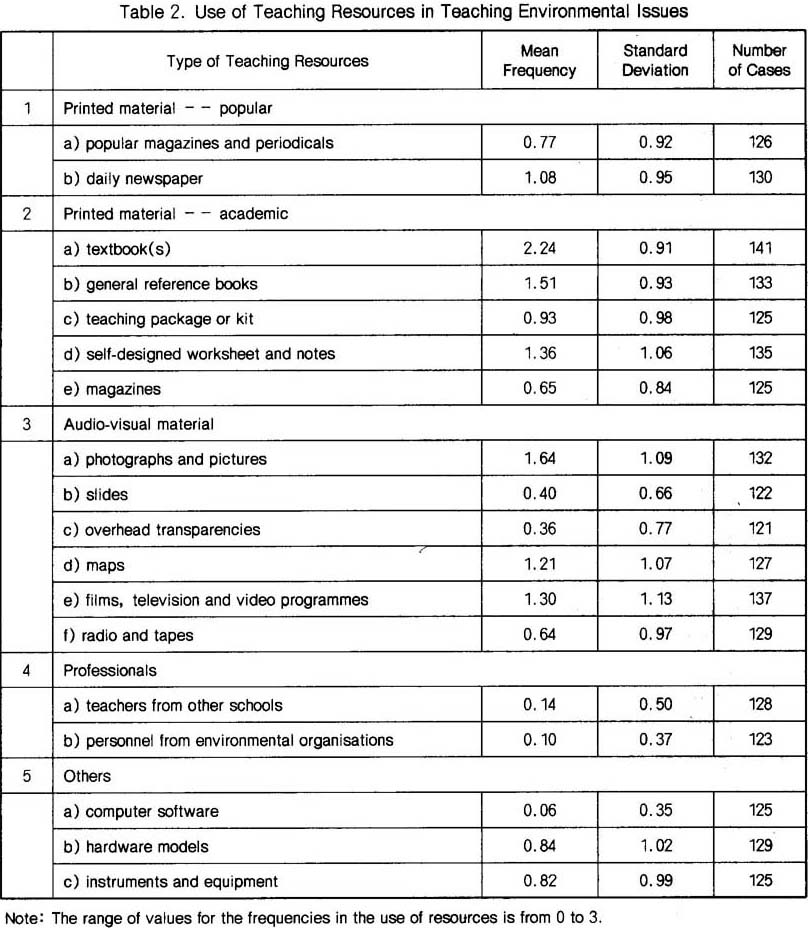
The respondents in Macau were requested to state the frequency with which they had referred to, consulted or employed various resources in teaching environmental issues by using the following codes: (a) 0 if not used at all; (b) 1 if used only rarely (about once a month or less); (c)2 if used occasionally (about two to three times a month); and (d) 3 if used frequently (about four times or more a month). These resources include popular printed materials, academic printed materials, audio-visual materials, outside professionals, organisations and other resources,such as computer software.
The results showed that textbooks were more frequently used (mean value of 2.24) by the social studies, health education and science teachers.Forty-six percent of the respondents stated that they use textbooks frequently in teaching environmental issues. This is followed by the use of photographs and pictures (mean value of 1.64),general reference books (1.51), self-designed worksheets and notes (1.36), and films,television and video programmes (1.30).Furthermore, the respondents rarely employed outside professionals, organisations, computer software, slides, overhead transparencies,hardware models, or instruments and equipment in teaching environmental issues (Table 2).
EXTENT OF ENVIRONMENTAL EDUCATION
Part of the questionnaire investigated the emphasis placed on environmental education in subject teaching. The respondents were asked to rate the extent of their teaching of environmental issues by assigning a value from 0 (did not teach at all) to 3 (taught in considerable detail) to a variety of issues and attitudes. The results showed that the following had been taught in some detail (Table 3):
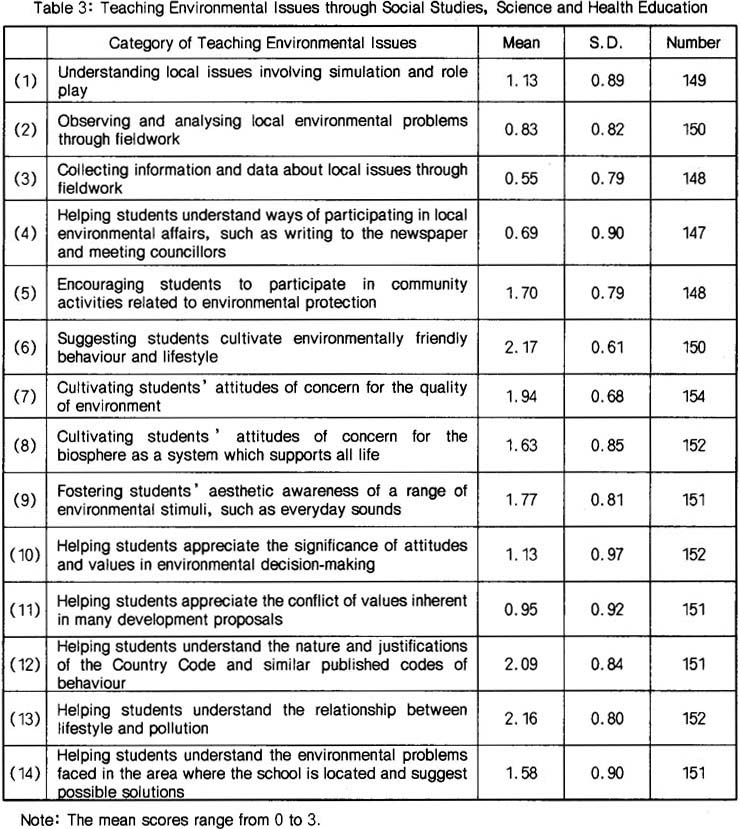
(a) Suggesting that students cultivate environmentally friendly behaviour and lifestyle;(b) Helping students understand the relationship between lifestyle and pollution; (c) Helping students understand the nature and justifications of the “Country Code” and similar published “codes of behaviour”.
In contrast, low scores were found in the following areas:“Collecting data about local issues through fieldwork”, “Helping students understand the ways of participating in local environmental affairs”, “Observing and analysing local environmental problems through fieldwork”,and “Helping students appreciate the conflict of values inherent in many development proposals”.
Judging from the results, it could be asserted that due attention was given to helping students cultivate environmentally friendly behaviour.However, the significance of participating in local affairs of environmental concern as well as the study of local issues and the development of skills pertinent to environmental education seemed to be grossly neglected by the respondents. This shortcoming deserves further attention from educators for the development of environmental education. It is because these practices help students develop a sense of responsibility regarding environmental problems to ensure appropriate action to help solve these problems,avoid future problems and promote environmental well-being.
PERCEPTIONS OF DESIRABLE TEACHING STRATEGIES
The initial objective of environmental education is to foster an understanding of, and sensitivity towards, the environment. Ultimately, this awareness may be translated into an appreciation of the consequences of individual and corporate action with respect to the environment and, where appropriate, participation in such action. School subjects, such as social studies, science and health education, will only contribute more fully to environmental education and achieve the goals outlined above if teachers adopt more effective and desirable teaching/learning strategies, especially those recognising the students as active, rather than passive, participants. In the questionnaire the respondents were asked to choose (in rank order)the three most frequently used and desirable teaching strategies for teaching the topic of pollution. The results revealed that despite a significant number of “no responses”, a substantial proportion of respondents most frequently used questioning, discussion, the use of textbook(s),notes or worksheets and the use of audio-visual aids. Regarding most desirable teaching strategies, the respondents attached higher priorities to fieldwork, the use of audio-visual aids,experiments, games and simulations, and value clarification strategies.
These frequently-employed strategies match quite closely with the types of teaching resources they used, comprising textbooks and,occasionally, audio-visual materials, such as photographs and pictures. When these strategies and resources are translated into practice, they are likely to be less effective and desirable in implementing education for the environment. They may, however, be effective in promoting education about the environment in which dissemination of environmental knowledge and skills is emphasised.
DISCUSSION
It is notable that generalisations about the contribution of social studies, science and health education towards environmental education in Macau cannot be made with ease. This is due to the fact that teachers, when teaching a combination of subjects, cannot distinguish the element of and approaches to environmental education in related subjects. Furthermore, the standard deviation of the data from the mean values in the previous sections seems to match well with the diversified education systems in Macau, which facilitate a diversity of practice in teaching.
The reliance of teachers in Macau upon textbooks with the occasional use of worksheets,notes and audio-visual materials as teaching resources, when coupled with the employment of traditional and resource-based strategies, is likely to support the implementation of education about the environment. Environmental education in the environment is perceived to be an important and desirable component of environmental education,but fieldwork is being neglected in actual practice.Education for the environment is still the area that does not receive adequate attention despite there being signs that values and attitudes are taught in social studies, science and health education. The development of environmentally friendly behaviour in students has also been encouraged.Nonetheless, the components of action and participation in environmental education, including the involvement of students in local environmental issues and the evaluation of environmental issues from different perspectives, are seldom emphasised. To successfully implement the triad of education about, in and for the environment through subject teaching, much work has to be done to overcome problems encountered and to improve the existing situation.
The dominance of traditional teaching strategies and the use of textbooks at the primary level is partly dictated by the large class size, which usually is an average of 40 to 50 students. Some schools in Macau still have classes with 60 to 70 students. In addition, children often have to sit side by side in long narrow rows in small classrooms. Under these circumstances, there is little that teachers can do other than adopting transmissive and rote-learning approaches (Morris, 1990; Bolina, 1993). It is, therefore,imperative for the Macau government to allocate more resources to improve the teacher-student ratio and the learning environment.
The large class size also imposes constraints on the arrangement of fieldwork even though many teachers perceive education in the environment as an important component of environmental education. Moreover, teachers may be anxious about the problem of safety for outdoor activities.To improve this situation, the government may consider building some field studies centres for school children and the general public. In addition,the school may organise some pollution-free picnics and visits to the countryside, such as the Coloane Northeast Trail and the Coloane Fitness Circuit, so that students have more opportunities to practise their codes of behaviour and appreciate the beauty of the environment. Also, teachers may involve students in the greening of the school environment and encourage more project work in the local surroundings (e. g., the school grounds and neighbourhood).
The provision of teacher education for environmental education should be a high priority for action. It is important for the teachers to improve their competencies in environmental education and to initiate its full implementation through the formal and informal curricula where school conditions allow. In addition, school administrators should also be encouraged to participate in such programmes so that they can improve the institutional commitment to the implementation of environmental education in schools.
There is a current emergence of different agendas for environmental education in primary schools, which are suggested by supporters of radical environmentalism. For example, a primary school in Thomasroith, Austria participated in a Centre for Educational Research and Innovation project. There were four categories of initiatives related to environmental education (Haas, 1991):(a) effecting direct changes in the environment - - cleaning the bed of a stream and operating a container depot for waste recycling in a school;(b) using personal contacts for influencing the local population - - organising parents’ evening meetings on environmental activities and a flower campaign; (c) exhibitions - - operating an environmental display case in the village square;and (d) informing the local population - - designing mail leaflets on environmental subjects.
Furthermore, the “eco-school” concept was implemented in some schools in New Zealand (Buchanan and Springett, 1991). Some of the practices included the following: (a) setting up a community recycling centre within the school grounds; (b) developing environmental beautification projects within the school and surrounding community; and (c) evaluating and modifying the school' s own resource management practices. With greater emphasis upon active and experiential learning, these innovative practices are claimed to be highly conducive to education for the environment.
As regards the curriculum in Macau,centralisation may not necessarily be a desirable measure for improving the present system, which has long enjoyed a high degree of autonomy.Instead, the diversity of curriculum practiced may provide a fertile ground for teachers to explore the feasibility and desirability of various approaches to environmental education.
LIMITATIONS OF THE STUDY
There are inevitably some limitations of this study. First of all, most of the samples in this study were teaching a combination of the subjects of social studies, science and health education,which makes the analysis of the contribution of individual subjects towards environmental education very difficult. When the respondents were requested to complete the same questionnaire about individual subjects during a pilot study, almost all respondents claimed that their teaching approaches did not differ amongst social studies, science and health education.Furthermore, the teachers were unwilling to respond to the same questionnaire twice. Some items of the questionnaire were left unanswered.Part of this situation may be explained by the fact that educational research for schools is not welldeveloped, and thus primary teachers in Macau are not accustomed to completing questionnaires.
REFERENCES
Bolina, M. 1993. Primary Curriculum Change in Macau: The baby or the bath water? In Proceedings of the International Symposium on Curriculum Changes for Chinese Communities in Southeast Asia: Challenges of the 21st Century,edited by C. C. Lam, H. W. Wong and Y. W. Fung, 154-158. Hong Kong: Department of Curriculum and Instruction, Faculty of Education, The Chinese University of Hong Kong.
Bray, M. and P. Hui. 1991. Curriculum development in Macau. In Curriculum Development in East Asia, ed. C. Marsh and P. Morris, 181-201. London: Falmer Press.
Bray, M. 1992. Centralization versus Decentralization in Curriculum Development:Contrasting patterns in Hong Kong and Macau.New Horizons, 33, 15-23.
Buchanan, B. and D. Springett. 1991. The Ecoschool. In Our Common Future: The way forward, ed. D. Springett and C. M. Hall, 120123. Palmerston North: New Zealand Natural Heritage Foundation.
Colquhoun, D. 1989. Emancipatory health education and environmental education: The emergence of the new public health. Australian Journal of Environmental Education, 5, 1-8.
Fullan, M. 1991. The New Meaning of Educational Change 2d ed. New York: Teachers College Press.
Fung, Y. W. and J. Lee. 1990. A comparative study of geography curricula in Hong Kong and China with reference to their contribution to environmental education, In Teaching Geography In and About Asian Pacific Countries, ed. P. Stimpson and Y. L. Kwan, 516 Hong Kong: IGU Commission on Geographical Education / University of Hong Kong.
Geographical Association’s (GA) Sixth Forms / Universities Working Group. 1981. How environmentally literate are we? A selfassessment exercise for teachers of geography - - and their pupils. Teaching Geography, 7 (2), 76-77.
Haas, K. 1991. Austria: A primary school’s initiative. In Environment, Schools and Active Learning, Centre for Educational Research and Innovation (CERI), 39-45 Paris: OECD.
Huckle, J. F. 1983. Environmental education, In Geographical Education: Reflection and Action,ed. J. F. Huckle, 99-110. Oxford: Oxford University Press.
Huckle, J. 1991. Education for sustainability: Assessing pathways to the future. Australian Journal of Environmental Education, 7, 43-62.
James, R. K. and G. Potts. 1981. Assessing environmental education in the public schools.School Science and Mathematics, 81 (2), 103114.
Kyriacou, C. 1986. Effective Teaching in Schools.Oxford: Blackwell.
Lee, C. K. J. 1992. The contribution of geography teaching in Hong Kong and England to environmental education: A comparative study.Paper presented at the 9th Annual Conference,Towards Effective Education, organised by the Hong Kong Educational Research Association,21 - 22 November 1992, Hong Kong.
Lee, C. K. J. 1993. Environmental education through Geography: An analysis of the senior scondary curriculum and a study of teacher perceptions of curriculum objectives in Hong Kong. In Proceedings of the International Symposium on Curriculum Changes for Chinese Communities in Southeast Asia: Challenges of the 21st Century, edited by C. C, Lam, H. W. Wong, and Y. W. Fung, 201-206. Hong Kong: Department of Curriculum and Instruction,Faculty of Education, The Chinese University of Hong Kong.
Lee, K. P. C. 1988. Teaching ethics and social responsibility through science: A Hong Kong approach. Hong Kong Science Teachers Journal, 16 (2), 242-250.
Lewin, K. 1990. International perspectives on the development of science education: Food for thought. Studies in Science Education, 18, 123.
Linke, R. D. 1980. Environmental education in Australia. Sydney: George Allen and Unwin Australia.
Lucas, A. M. 1980. Science and environmental education: Pious hopes, self praise and disciplinary chauvinism. Studies in Science Education, 7, 1-26.
McFadden, C. P. 1991. Towards an STS school curriculum. Science Education, 75 (4), 457469.
Morris, P. 1990. Curriculum Development in Hong Kong. Education Paper 7. Hong Kong: Faculty of Education, University of Hong Kong.
Ng, G. T. L. ed. 1991. New Environmental Paradigm Survey 1991. Hong Kong: Hong Kong Environment Center.
Parker, W. C. 1991. Renewing the Social Studies Curriculum. Alexandria, Virginia: ASCD.
Rao, C. N. R. 1986. Ethics in relation to science and technology education and development. In Ethics and Social Responsibility in Science Education, ed. by M. J. Frazer and A. Kornhauser, 1-12. Britain: ICSU/Pergamon Press.
Robottom, I. M. 1987. Contestation and consensus in environmental education.Curriculum Perspectives, 7 (1), 23-27.
Schlaadt, R. G. 1988. School health education. In Content of the Curriculum, ed. R. S. Brandt,149-186. Alexandria: ASCD.
Stimpson, P. 1992. Geography, environment and education in the 1990s. The Hong Kong Geographer, 9 (2), 1-11.
Wraga, W. G. and P. S. Hlebowitsh. 1990. Science, technology, and the social studies. Social Education, 54 (4), 194-195.
Tao, P. K. 1992. Issues study in STS. Curriculum Forum, 2 (2), 73-79.
Yau, L. L. L. 1992. Environmental education through the teaching and learning of geography.The Hong Kong Geographer, 9 (2), 12-29.