Acid Rain in Macau (1990-1992)
TAM Kam Weng,LEI Chu San,YOUNG Sing Ming,CHOI Wai Wa,CHEN Wei Ji and CHAN Shek Kiu(University of Macau) António VISEU(Serviços Meteorológicos e Geofísicos de Macau)
澳門的酸雨
本文指出由一九九零年至一九九二年,在澳門所有降雨中,有百分之七十五至百分之八十六之酸鹼度是低於五點六,基於雨水様本中之硫酸鹽濃度是高於硝酸鹽濃度(2.87毫克/公升與1.15毫克/公升之比較),故硫酸鹽是引起澳門酸雨之主要原因,文章中採用Box-Jenkins模式方法所作出之預報指出,澳門之酸雨仍然持續,最後提出一些減少酸雨產生的策略。
INTRODUCTION
The most important effects of acid rain are those on ecological systems, human health and materials. In many countries in the world, acid rain has become a matter of serious concern, and Macau is no exception. Due to the very rapid social and economic development beginning in the 70s, the Macau Government started the Macau Air Quality Monitoring Project in early 1985. The project included the study of factors that affected the air quality, locations and characteristics of polluting sources in Macau, urban traffic, as well as studies of meteorological factors that characterized pollutants and dispersion in different time scales.①
The major emission sources of air pollution in Macau are the power plant, cement factory,incineration plant, automobiles, garment factories and toy factories. Sulfur dioxide (SO2) and oxides of nitrogen (NOx) are the common pollutants emitted from most of the above-mentioned sources. In the atmosphere, SO2 and NOx are oxidized gradually to sulfuric acid and nitric acid.
There are three years’ data availble regarding the pH value of rainfall in Macau. The rain samples are collected by an automatic rain collector, which is located at Fortaleza station.
The main objective of this paper is to analyze the pH value of rainfall in Macau, to determine the cause of the acid rain by analyzing the 〔SO42-〕,and 〔NO3-〕, and to present some strategies to control acid rain.
GENERAL INFORMATION ON MACAU
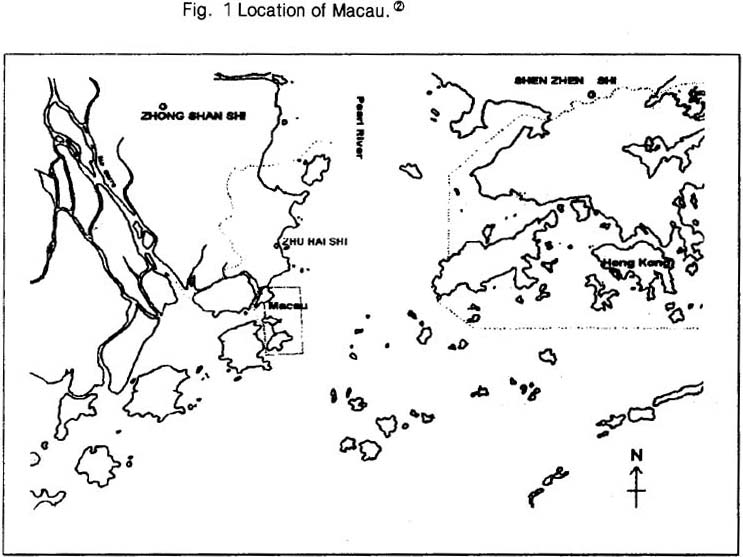
The Territory of the Macau is composed of the Macau peninsula, Taipa and Coloane islands, with areas of 6. 4 Km2, 3.8 Km2 and 7.1 Km2,respectively, located at a latitude of 22°N on the Pearl River delta, on the South China coast as shown in Fig 1. Macau has a population of about 450, 000 inhabitants. The southern part of the Macau peninsula has mainly residential and commercial zones, while the northem part is densely populated and has small and medium size factories. Macau has about 56,680 motor vehicles.At peak hours their mean speed in the main roads is below 15 Km/h. There are significant and frequent discontinuities in traffic flux,, resulting in significant deterioration of air quality.
In summer, the absolute maximum temperature reaches 38.9℃, and the absolute minimum temperature is -1.8℃ during winter. The air temperature and the precipitation vary regularly during the year, showing clearly the main influence of the polar air masses during the winter (Nov.-Feb.),resulting in low values for temperature, humidity (71 percent to 82 percent) and precipitation, and the predominant wind direction is NNW. On the contrary, from May to September, under the influence of maritime tropical air masses, the climate of Macau is typically tropical, with a mean monthly temperature of 25℃ to 28℃ and relatively humidity of 81 percent to 86 percent. The weather is very warm and moist; frequent rain showers occur. The surface winds are predominantly from ESE to SSE. During the day time, due to the sea breeze effect, the winds are from SSW to WSW.③
ANALYSIS
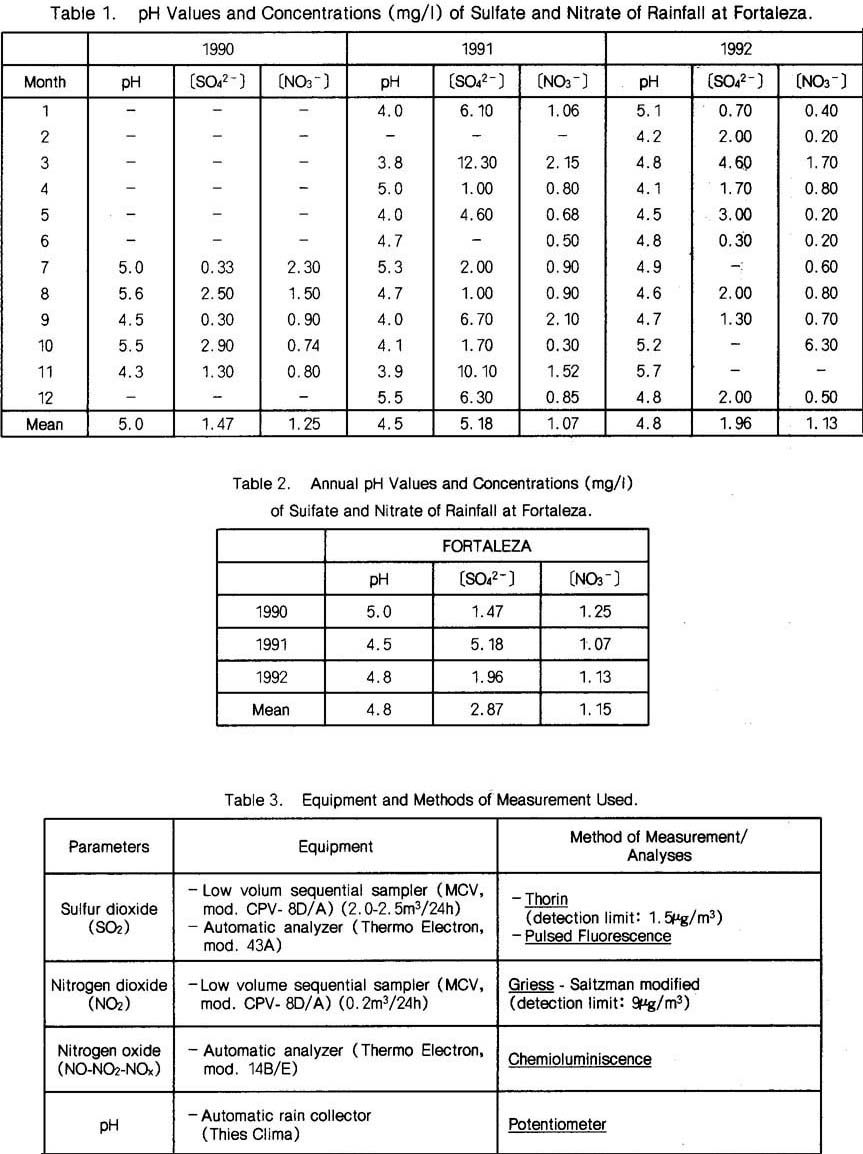
Three years’ (1990-1992) data from the air pollution monitoring network of the SMGM (Serviços Meteorológicos e Geofísicos de Macau)are used to investigate the spatial and temporal variations of 〔SO42〕, 〔NO3-〕 and pH value of the rainfall, and the data are shown in Tables 1 and 2.The kinds of equipment and methods of measurement used are indicated in Table 3.
Monthly data on 〔SO42-〕 and 〔NO3-〕 in mg/l of the rainfall at fortaleza are plotted in Finure 2. In Figure 3,the pH values of rainfall are shown.
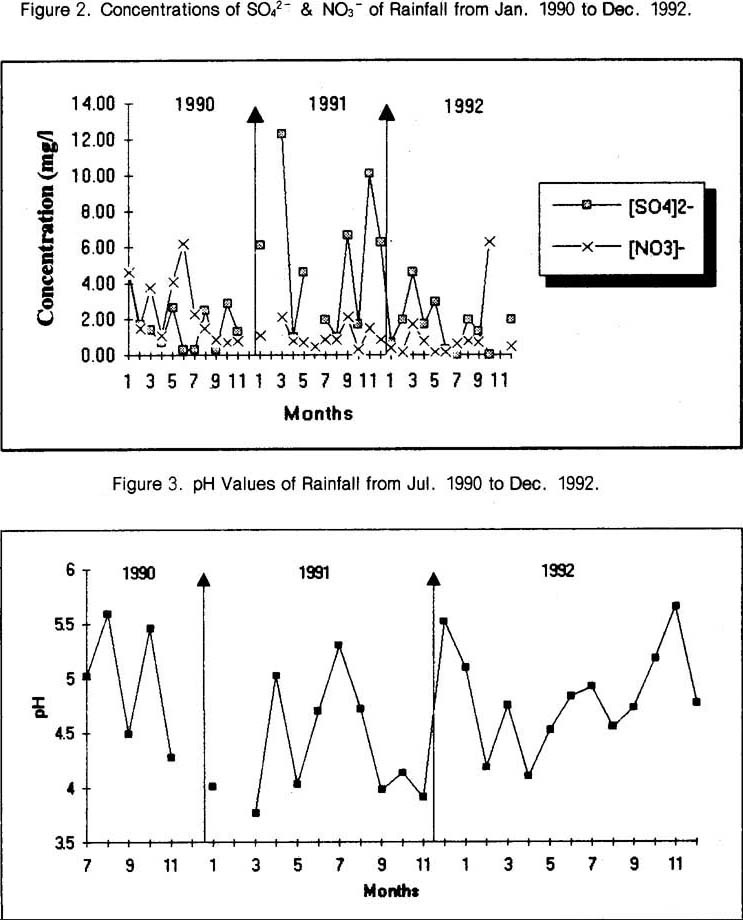
The concentration of sulfate is higher than that of nitrate, as shown in Table 2 and Figure 2. On the other hand, as indicated in Figure 3, acid rain occurred from Jul. 1990 to Dec. 1992. Rainfall with pH less than 5.6 was 75 percent in 1990, 84.6 percent in 1991, and 86. 4 percent in 1992.Seasonal variations in sulfate concentration were observed in Figure 2, 〔SO42-〕 and 〔NO3-〕 showing a maximum during winter and a minimum in summer. For the sake of combating acid rain, it is important to have á method of prediction.Consequently, time series analysis is applied to pH values of rainfall collected at Fortaleza. We use the Box-Jenkins model because it requires only 50 (preferably 100) observations, and the actual situation of Macau can satisfy the requirement of the Box-Jenkins model.④1.Identification:
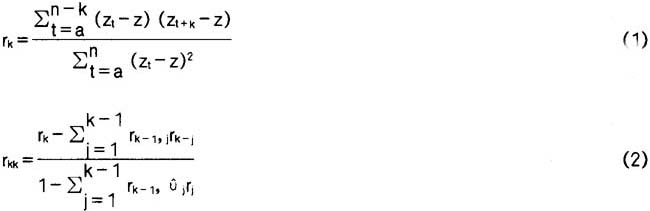
The identification procedure is carried out by determining the sample autocorrelation and partial autocorrelation by equations(1) and (2):
where

Z=average of first difference of pH value of rain samples
Zt=first difference of pH value of rain samples
The results of sample autocorrelation and partial autocorrelation are shown in Table 4.

From Table 4. we see that the behavior of the theoretical aurocorrelation and theoretical partial autocorrelation functions of this time series is possibly identical to the behaviour of the secondorder autoregressive model:

where
yt=pH value of rain sample
2.Estimation:
Having tentaively identified a particular stationary time series model, we estimate the parameters. By using the least squares estimation and the equations (4), (5), and (6), we have:


3.Diagnostic Checking:
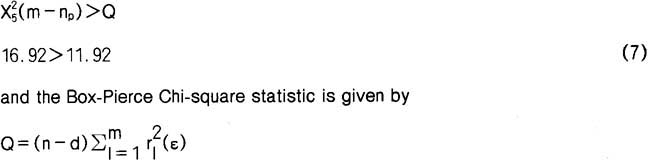
To examine the adequacy of this model, we compute the residuals first. Then we calculate the sample autocorrelation function of the residuals r (ε). We can conclude that the fitted model adequately describes the rainfall time series because
where
m:Number of residuals=12,
np:Number of parameters estimated=3,
n:The number of observations in the rain samples=120,
d:The degree of differencing=1.
4.Forecasting:
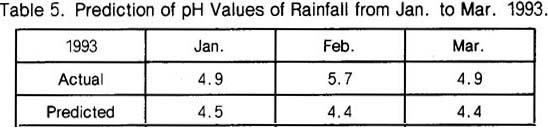
Evaluation of the fitted model is made directly with the real data. The forecasting shows the declining tendency of the pH values.
yt=-0.01533+0.57275yt-1+0.34673yt-2+0.08053yt-3+εt
We observe that a second-order autoregressive model may be appropriate to predict the pH value of rainfall from Jan. to Mar. in 1993(Table 5).
DISCUSSION
Reasons of the Presence of acid rain in Macau:
The results of Table 5 show that the acid rain problem probably will persist in the coming days. Because of the small scale of local industries, sulfur dioxide concentrations have very low yearly averages (10 to 20 μg/m3), with the monthly averages of 35 μg/m3 during winter, daily maxima being 200 to 240 μg/m3. Nitrogen dioxide concentrations have monthly averages from 50 to 100μg/m3 during summer, becoming 15 percent to 25 percent higher during winter.⑤ Sulfur dioxide probably contributes to the acid rain phenomenon because the concentration of sulfate is higher than that of nitrate. A ccordint to the ambient Air Quality Standard (GB 3095-82)of the Natinal Standards of the People's Republic of China (UDC 551.510.4), Macau is classified Grade 2 or Grades 1-2. The grading of Macau is almost the same as that of Zhuhai.⑥ On the other hand, Macau is easily influenced by outside pollutants because of the prevailing wind direction. The most frequent wind directions are from ESE(17 percent) and NNW(15 percent), with a mean speed of 13 Km/h; the less frequent wind directions are WSW, W, WNW and NW (below 2 percent in each direction), with low mean speeds of 7 to 9 Km/h. Hence, this gives support to the idea that the presence of acid rain in Macau may not solely be a local phenomenon. South China is a new economic growth center and is undergoing rapid industrialization. Inevitably, acidic pollutants are generated in one region and then transported to another region.
Reducing and controlling acid pollution in Macau:
There are no cheap, readily available alternative sources of energy, and the costs of replacing outdated combustion equipment or installing emission controls may be prohibitively expensive.Moreover, a renewable material scheme seems impractical in Macau. Under such circumstances, the means of reducing and controlling acid pollution in Macau would be by cutting polluting emissions.There are four main routes to reduce polluting emissions:
A. Replacing high air-polluting fuel with natural gases and low sulfur fuel so as to reduce SO2 in Macau.
B. Passing regulations of environmental protection to limit the amount of air pollutant emitted.
C.Macau is too small and has too many vehicles.The number of vehicles increased from 8,372 in 1970 to about 56,680 in 1993. Motor vehicles emit nitrogen oxides, hydrocarbons and other pollutants, so once the number of motor vehicles has been reduced, the amount of pollutants will diminish.
D. Energy conservation with improved energy consumption efficiency and increased use of public transport may reduce the quantlties of fuel burned, and thereby lead to a reduction of polluting emissions. The quantity of fuel consumed has increased from about 100×103t in 1982 to about 200×103t in 1991 due to rapid economic development. It is time for every resident to conserve and use energy more efficiently so as to pollute less.
CONCLUSION
Three years’ ( 1990-1992 ) acid deposition measurements have been analyzed. The main results are summarized as follows:
1.75 percent - 86 percent of the rainfall in Macau is acidic. The pH values of the rainall are from 3.65-6.72.
2. The concentration of sulfate is higher than that of nitrate (about 2.87mg/1 against 1.15mg/1).
3. The concentration of sulfur dioxide in Macau can be classified as Grade 1-2 according to the ambient Air Quality Standard (GB 3095-82)of the National Standards of the People’s Republic of China (UDC 551.510.4).
4. Acid rain in Macau is due to foreign effect.
5. From our Box-Jenkins modeling, we predict that the acid rain in Macau is going to persist in the near future.
Moreover, this paper proposed that controlling acid rain is one of the quintessential local environmental issues for Macau. To be effective, it is important that all the Macau residents are aware of the effects of acid rain. If our environmental quality declines, then everyone in Macau will suffer. Acid rain is not only a problem for Macau, but also for the rest of the world. It is only through interregional or international cooperation that the problem of acid rain may be tackled.
ACKNOWLEDGMENT
The authors would like to thank Lck Hon Chio and Chan Hong Kit of the Serviços Meteorológicos e Geofísicos de Macau for collecting and processing the raw data.
NOTES
①António Viseu, “Macau Air Quality Monitoring” in Proceedings of the Seminar on Protecting the Earth in Macau. Gabinete Técnico do Ambiente, Macau, 1993, 15-23.
②Manuel Luís F. M. Alves, “Space of Macau” in Proceedings of the Symposium on Population and City Growth in Macau. Centre for Macau Studies, University of East Asia, Macau, 1990,59-74.
③Renato A.C. Carvalho and António Viseu, “Air Quality and Meteorological Study in a Tropical Urban Area (Macau)” in Proceedings of the Technical Conference on Tropical Urban Climate. Dhaka, Bangladesh, 1993, 1-8.
④Bruce L. Bowerman and Richard T. O’Connell,Time Series and Forecasting. (California: PWS publishers, 1979), 334-389.
⑤Renato A.C. Carvalho and António Viseu, “Air Quality and Meteorological Study in a Tropical Urban Area (Macau)” in Proceedings of the Technical Conference on Tropical Urban Climate. Dhaka, Bangladesh, 1993,1-8.
⑥J.H. Chen, “Investigation of Acid Precipitation in Zhuhai Area” in Proceedings of the Environmental Protection Papers of Zhuhai.Committee of Environmental Protection Papers of Zhuhai, 1992, 148-149.