Family, School and Attitudes toward Delinquency as Correlates of School Juvenile Delinquency in Macau*
Cheong Choi, Siu-pang Li, Siu-man Wong (Faculty of Education, University of Macau)
家庭,學校對不艮行為的態度與澳門學校青少年問題之相關性
|
1195名來自小五至高三的男女學生於94年初參與了一項封閉式的問卷調查。本調查主要探討被訪者對家庭及學校之依附程度,此兩個變項之相關性,以及自我報告所犯不良行為之次數。結果顯示,雖然被訪者與父母之關係不俗,他們對家庭的依附卻頗弱。被訪者普遍都喜歡學校及尊敬師長。一半以上的被訪者認為學生應遵守校規,亦並不覺得自己是問題學生。男女被訪者經常作“高空擲物”、“飲酒”、“作弊”、“午夜流連街頭”及與“父母吵架”。
家庭依附、學校依附及對不良行為的態度此三個自變項與不良行為皆有負面而顯著的關係。當中,對不良行為的態度與不良行為之相關性最強;對於不良行為,三個自變項共解釋29%之方差。本文亦討論是項研究結果所帶出之啟示。
1. Introduction
Over the past years, juvenile delinquent behaviour has been a popular topic in social research conducted in Western countries (Elliot, et. al., 1979, Feldman, et. al., 1991, Hill & Atkinson, 1987) and in HongKong (Cheung & Ng, 1988, Lau & Leung, 1992, Ngai, 1993). However, not much research has been done to examine the prodlem in Macau.
Recently, numerous accounts of delinquent behaviour such as substance abuse, self-inflicted injury and school dropouts have been published in the local press.① The ever-growing problem of juvenile delinquency reflects the crises experienced by some Macau's youngsters.
The youth in Macau have grown up in a time of affluence. Macau, which under rapid social and economic changes since the 1980s, is a modern and vibrant society. However, similar to other rapidly developing cities, the more advanced they are, the more complicated the society will become. Thus today's young people face problems in establishing a secure sense of personal identity, in developing a stable value system and in choosing a direction for their lives, which are much more complex than was the case in more static social eras (Conger, 1975).
On the other hand, the mobile society like that of Macau provides a wider variety of choices in interpersonal relationships and social involvement for the youth to facilitate personal growth and development. Whether the individual adolescent will be able to take advantage of the opportunities provided by this mobile society, or will instead be overwhelmed by the complexity of the attendant problems and become more vulnerable to the influences of delinquency will depend largely on the degree of support provided by adults and peers in the social setting of family and school (Forisha, 1983).
2. Theoretical Setting
Family and school are generally acknowledged to be the most significant social institutions that influence individual development (Moos, 1976; Sameroff, 1983). In the last one or two decades, much effort has been made to uncover the social factors contributing toadolescent delinquency (Hudak, et. al., 1980; Voorhis, et. al., 1988;Wells & Rankin, 1988). Among the delinquency theories, control theory emphasizes that what restrains the youth from becoming delinquent is the social bond. Hirschi (1969) sees four components in this social bond: belief in general conventional values, involvement in conventional activities, commitment to conventional activities and attachment to others. According to Hirschi, the higher one ranks on each of these components, the lower the probabilities of delinquency.
Control theory has been well-supported by studies conducted over many years showing an association between delinquency and the lack of effective bonds to the major social institutions (Akers, 1973; Conger, 1976). With respect to the Chinese youngsters, Lau & Leung (1992) found that poorer parent-child relation and poorer relation with school were associated with higher frequency in committing delinquent acts in both boys and girls, whereas pupils with good relation with parents and school tend to be lower in delinquency. The study of Ng (1975) also lent support to control theory. Young offenders were found to be less attached to the family and school, to be more involved in unconventional activities, and to hold more unconventional beliefs. It is interesting to see whether the theory is also applicable to the situation in Macau.
In the present study, attachment to family and school, which form an essential part of the "attachment" dimension of Hirschi's social bond theory, will be examined. Another component, belief in conventional values, will be measured using the variable "attitude toward delinquency". The dependent variable in this study is the delinquent behaviour.
The major purpose of the present study is to examine adolescent delinquent behaviour in Macau through the adoption of Hirschi's control theory.
3. Methodology
3.1 General Design
The present study deals with the testing of social factors which are hypothesized to increase the occurrence of delinquent behaviours among school youngsters in Macau. Such investigation of correlation among the variables can best be achieved through the adoption of a sample survey, as both the practicality of data collection and availability of relevant data can ensure a satisfactory and representative result. Skillful interviewers who had experienced in social sciences field were employed to administer the survey in which participants are requested to self-administer a closed-ended questionnaire. A pilot test had been conducted in middle December, 1993 to check and rectify the questionnaire items before the main survey. No before and repeated measurement was conducted. This is a cross-sectional questionnaire survey.
In this study of juvenile problems in Macau, the sample was drawn from a sampling frame of all private primary schools which had primary five and six classes, and all private secondary schools which had classes from Form one to From five or From six in Macau in the 1993/4 academic year. A stratified and quota sampling method was employed to select randomly two schools from each grade to form the final sample. The sixteen selected schools were first contacted for their prior consent to participate in the survey, they were then invited to choose two classes from the designated Forms to answer the questionnaire.
A total of 1195 male and female students from the sixteen schools answered the questionnaire between January and February 1994. Respondents were aged from 10 to 26. All students completed the questionnaires either under the supervision of their teachers or the research team members inside their classrooms. The questionnaire is anonymous in order to guarantee confidentiality of data. In addition, The adoption of the self-report method on delinquency also guarantees the respondents a relatively higher sense of privacy, thus encourages thereport of "dark figures" neglected in offical records.
3.2 Variables
Variables used in this report of delinquency problems in Macau students are family attachment, school attachment, attitude toward delinquency and delinquent behaviour. Details of these variables are illustrated in the pilot survey report of this study (Choi, 1994).
4. Findings
Frequency tables outlining the general picture of the individual variables, such as family attachment, school attachment, and delinquent behaviour were attempted. This would be followed by an examination of the correlation among the variables. Finally, the multiple-linear regression method was employed to analyse the relations between the independent and dependent variables.
4.1 Family attachment
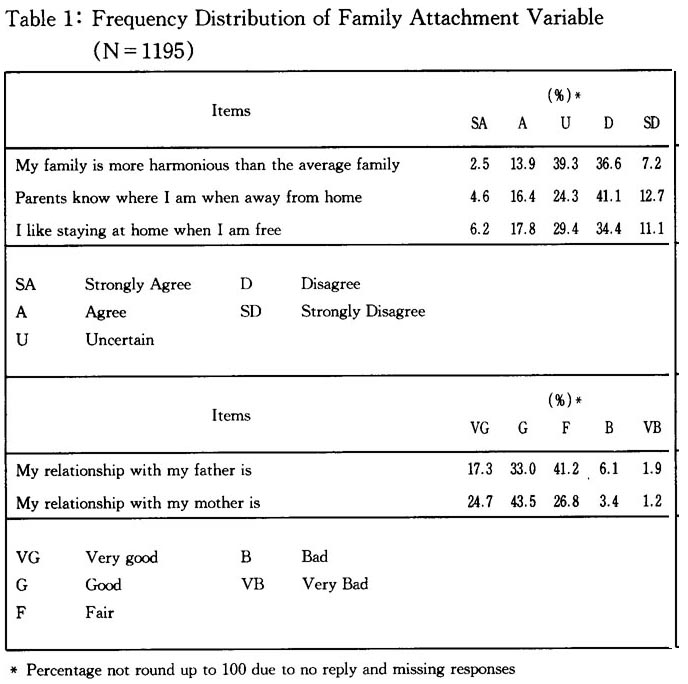
Five questions were developed to measure the degree of family attachment among respondents in this study. Table 1 illustrates the percentage distributions of answers to the five questions.
The degree of family attachment among the respondents was low when we consider the answer of the first three questions. More respondents claimed that they did not have a harmonious family; their parents did not know where they were when they were away from home; and they did not like staying at home when they were free.
Respondents had a better relationship with their mother than with their father. As many as 68.2 per cent of them claimed that they had either very good or good relations with their mother, compared with just over half of the respondents replied these with their father.
4.2 School attachment
Fourteen questions were employed to measure the degree of school attachment in the study. Table 2 shows the distributions.
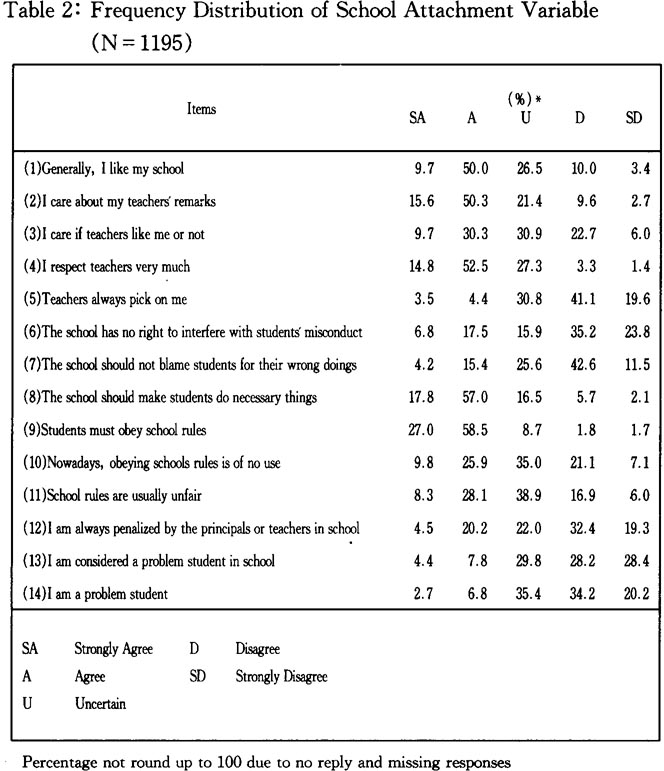
The school attachment variable is arbitrarily divided into three dimensions for easy interpretation. The first dimension which consists of the first five questions of the group focuses on an examination of school and teachers perception. Generally. respondents had demonstrated a relatively good remark toward their school and their teachers. Over half of them depicted that they liked school, cared about their teachers' remarks, or respected their teachers.
The second dimension concerns about school control and school rules. There are six of them (Question 6 to 11). Over half of the respondents agreed or strongly agreed that the school had the right to interfere with their misconduct, that students should obey school rules, that obeying school rules was important.
The last dimension examines whether the respondents were problem students at school. There are three questions in this dimension. Again, over half of the respondents claimed that they were not always penalized in school. As many as 54.4 per cent of them strongly disagreed or disagreed that they were problem students.
4.3 Delinquent Behaviour
After the measures of family and school attachment, respondents were asked to provide answers to forty questions asking about the delinquent acts in which they had committed in the past twelve months. Answers to these forty questions are listed in Table 3. Since male and female respondents may have significant differences in their self-report of these delinquent behaviours, report of the frequency is made between the two sex, and a Chi-square test and Gamma are used to denote the differences and relations between delinquent behaviours and sex.
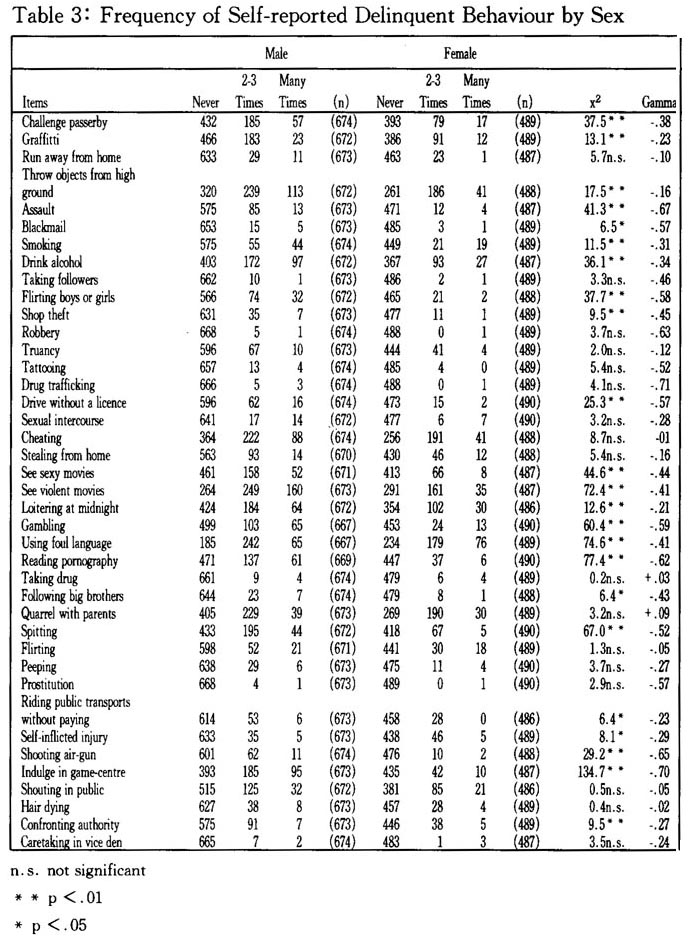
Male respondents were more likely than females to have reported delinquent behaviours in the past twelve months. Of the forty items, females had higher percentage than males in only five of them. Female students in Macau were more prone to cheat in examinations, use foul languages, take drug, experience rows with parents, and practise self-inflicted injury than the male students. Not all of the items differed significantly between the two sex. Run away from home, robbery, truancy, for example, were statistically insignificant.
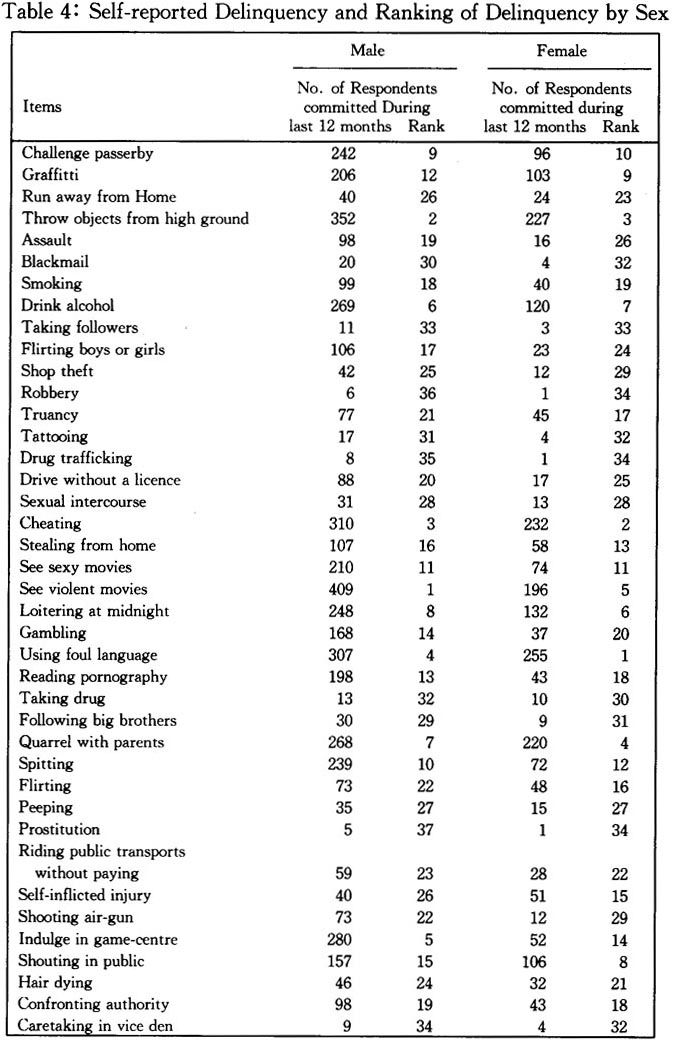
In Table 4 we presented another list showing the gross number of male and female respondents who reported committing the delinguent behaviours within the twelve month period and the ranking of such behaviour in the group. Delinquency is sex differentiated as reported by the male and female respondents in this study. Most male respondents indicted that they saw violent movies last year, amounting to 61 per cent of the population in the male group. For the females, they were more likely to use foul languages; 255 out the 489 (52 per cent) female respondents reported that they had such delinquent behaviour.
In addition to the use of foul language which was common between both male and female respondents, there were five more items that exhibited high percentage in both groups. In Macau, we saw that both male and female students like to throw objects from high ground, drink alcohol, cheat at school, loitering at midnight, and quarrel with parents.
 4.4 Family and School Attachment Index
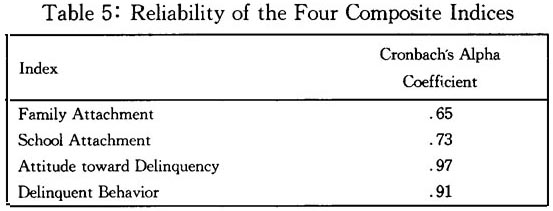
To facilitate the analysis of the effects of family and school attachment on the delinguent behaviours among our respondents, items used to measure the various variables were computed to from corresponding indices. Scores obtained from the five items of the family attachment questions, for example, were summed to become a new scale and named as the family attachment index. Cronbach's alpha was used to examine the reliability of the index. All four newly constructed indices exhibited moderate to high reliabilities.
Male and female respondents of different ages tend to have different family and school attachment experience. Will the boys exhibit higher level of family and school attachment than the girls, or vice versa? In the next section we look at the difference in the measures of family and school attachment between boys and girls. The two variables of family and school attachment were arbitrarily divided to form two levels: high and low level of family or school attachment. The cutting points of the levels were the average score of the variables. Those scores fell below the average would become the low level of family attachment or school attachment, whereas the scores above the average score become the high level of family attachment or school attachment. Table 6 shows the frequency of male female respondents within each level of the variables.
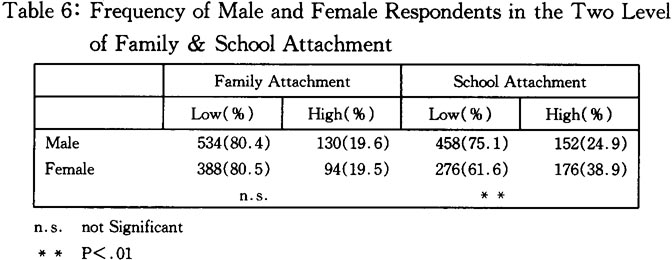
Using the Chi-square tests, there was no significant difference between the boys and girls in terms of their level of attachment to their family. Both male and female respondents in this survey of delinquency in Macau depicted similar percentage in their levels of family attachment. Nevertheless, female respondents had a stronger attachment to school than their male counterparts. 38.9 per cent of female respondents indicated that they had high school attachment, as compared with 24. 9 per cent of the males. Such difference was statistically significant at the .01 level. Moreover, different age groups may display differently in their levels of attachment. We now subdivide the respondents into three age groups for further analysis.
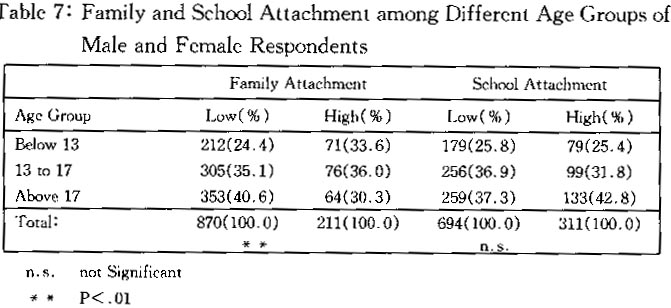
Higher age groups appeared to have weaker family attachment. 40.6 per cent of the respondents aged above 17 had low level of family attachment, whereas less than 25 per cent was found in those who aged below 13. The difference in age in family attachment was statistically significanlty at the . 01 level, indicating that different age groups did exhibit differently in the level of family attachment. When it came to the level of school attachment, elder respondents showed a tendency to increase in percentage in their level of attachment to school. More elder respondents showed that they had low level of school attachment than the younger age groups (37. 3 per cent in the above 17 group as compared with 25.8 per cent in the below 13 group). Such tendency of higher percentage in the elder group was also found in the high level of school attachment (42.8 per cent compared with 25.4 per cent). The difference, however, was not statistically significant.
4.5 Correlation and Path Analysis
What will be the relations amongst our variables? Will a higher family attachment also lead to a higher school attachment, or the opposite?Before we go to the test of our path model and the estimation of direct and indirect effects of the independent variables, we take a glimpse of the correlations of the variables.
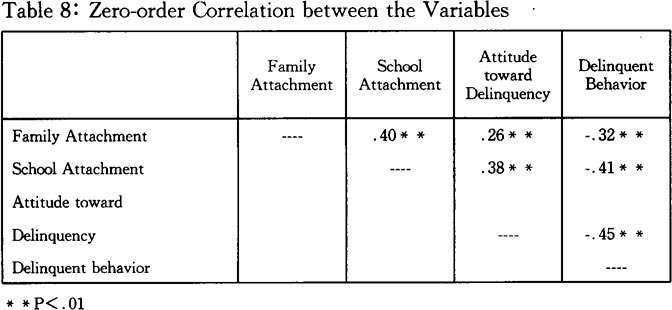
All predictor variables (family attachment, school attachment, and attitude toward delinquency) had a negative and significant correlation with the criterion variable (delinquent behaviour), indicating that respondents with low family or school attachment, incorrect attitude toward delinquency (i. e., report that most of the delinquency are not bad or a little bad only) tended to exhibit a higher degree of delinguent behaviours.
Among the variables, attitude toward delinquency had the strongest correlation with delinquent behaviour (r =-.45). This was followed by school attachment which had a correlation coefficient of -.41 with the delinquent behaviour. Family attachment was moderately correlated with the criterion variable (r =-.32).
Respondents who had strong family attachment also had strong school attachment and a correct attitude toward delinquency. Their correlation coefficients were . 40 and . 26 respectively. School attachment had a relatively higher correlation than family attachment with attitude toward delinquency. The variable had a correlation coefficient of . 38, showing that school attachment (i. e., accept the school) could be more important than family attachment (i. e., accept the school) could be more important than family attachment (i. e., accept the family) in controlling the respondents away from delinquency.
Following the zero-order correlation analysis, we shall present the test of various effects of the variables on the criterion variable using a stepwise multiple linear regession method.
The path analysis shown in figure 1 gives an estimation of the direct effect of the predictor variables upon the criterion variables. We shall use the path coefficients and the correlation coefficients to compute the indirect effect and common effect of the variable.
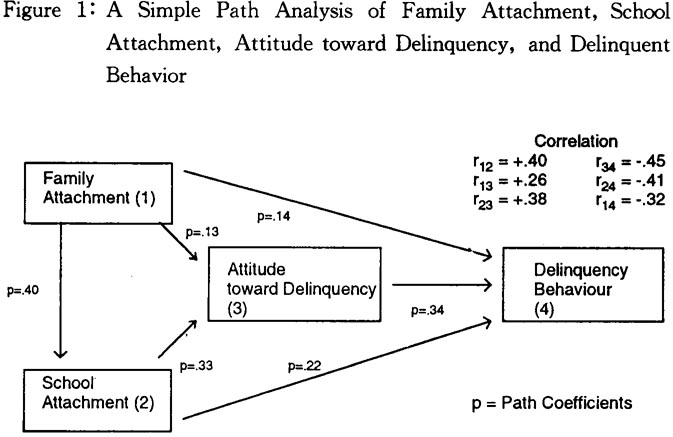
The predictor variables in path model shown in figure 1 had direct and indirect effects on delinquent behaviour. This indicated that family attachment exerted both a direct effect, and an indirect effect via school attachment and attitude toward delinquency on delinquent behaviour. Likewise, school attachment also exerted a direct and an indirect effect through attitude toward delinquency on delinquent behaviour.
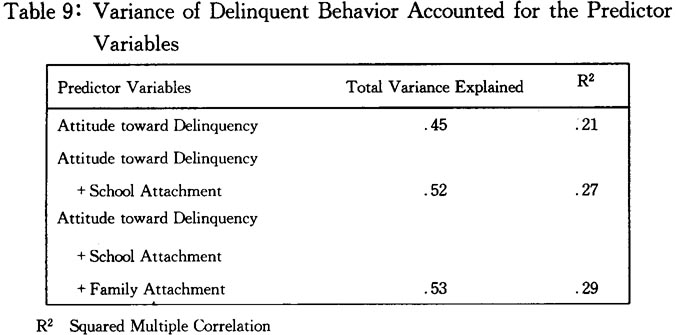
The three predictor variables altogther account for 53 per cent of the total variance of the criterion variable. Taking into account of the number of the predictor variables, such impressive result should be cautioned. Table 9 shows the variances accounted for by the three predictor variables. Attitude toward delinquency contributed much to the explanation of the criterion variable. It alone had accounted for 85 per cent (45/53) of the total explained variance. Family attachment appeared to be the least powerful variable in explaining the delinquent behaviour. The variable increased the explained variance by only one per cent.
We further compare and portary the effects of the predictor variables.The direct and indirect effects of the variables are examined in Table 10.
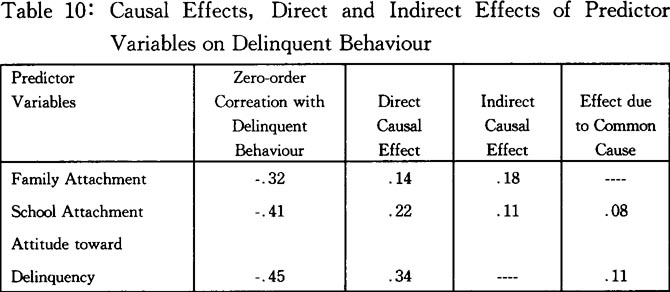
From Table 10 we again see the strongest direct effect on delinquency behaviour is from the variable measuring attitude toward delinquency.And of the total causal effect exerting upon delinquent behaviour from the school attachment variable, 67 per cent (22/23) of the effect is direct and 33 per cent (11/33) is indirectly through toward delinquency.As for the family variable, the direct effect to delinquent behaviour is 44 per cent (14/32). 56 per cent(18/32) of the effect is indirectly through school attachment and attitude toward delinquency on delinquent behaviour.
5. Conclusion
Generally, results in this study support the control theory in delineating that respondents with weak family and school bond, and with unconventional values tend to exhibit more delinquent behaviours. For the family attachment element, the results seem to support that youngsters are more attracted by school and friends than their family. As family is one of the most important institutions for adolescents in their life course of development, a sound family relationship cannot be overlooked. In short, family education style should be re-examined and courses about family education should be organized by school and the public family service associations.
Secondly, the results for school attachment reflects that quite a small number of students, more than 13 per cent of them, did not like schooling. About 30 per cent of them claimed that they did not care if teachers liked them or not. It suggests that a more effective communication network should be established in schools so that school authorities could be able to understand more about the needs of these group of students.
We are also surprised by the findings about the forty self-reported delinquent behaviours committed by some of the students. Although the number of students committing the delinquency such as, prostitution, taking drug, robbery, sexual intercourse, drug trafficking, blackmailing, shop theft and caretaking in vice den is low, the results could be astonishing to some of the school authorities. Such problems should be dealt with properly by all the relevant parties. To prevent is always better than to cure.Finally, we would like to stress that the present study is restricted to those youth who are at school. Because of the special situation in Macau. there are school-aged youngsters who are not studying in schools. Many studies show that delinquent behaviours increased sharply after adolescents left school and become drop-outs. To tackle the youth problem in a more comprehensive direction, proper studies about youth without schooling is another urgent task for the Macau society.
6. Reference
Akers, R. L. (1973) Delinquent Behaviour: A Social Learning Approach, Belmont, California: Wadsworth Publishing Company Inc.
Cheung, Y.W. & Ng.A. (1988). Social Factors in Adolescent Deviant Behaviour in Hong Kong: An Intergrated Theoretical Approach. International Journal of Comparative and Applied Criminal Justice Vol.12, No. 1:27-45.
Choi,C., (1994). Secondary-school Girls' Attitude toward Delinquency in Macau: a Pilot Study. In Yuan D.Y.et. al. (eds.). Proceedings of the International Conference on Population and Development in Macau, December, 1993. University of Macau, Macau.
Conger,J.J. (1975). Contemporary Issues in Adolescent Development.New York: Harper and Row.
Conger, R.D. (1976) Social control and Social Learning Models of Delinquent Behaviour: A Synthesis, Criminology, 14:17-40
Elliot, D.S.,Ageton, S.S. & Canter, R.J. (1979). An Intergrated Theoretical Perspectives on Delinquent Behaviour. Journal of Research in Crime and Delinquency Vol. 16:3-27
Feidman, S.S., Rosenthoal. D.A. Reynaud, R.M., Leung, K. & Lau, S. (1991). Ain't Misbehaving: Adolescent Values and Family Environments as Correlates of Msisconduct in Australia, Hong Kong and the United States. Journal of Research on Adolescence 1(2),109-134.
Forisha, B. (1983) The Experience of Adolescence: development in context. lllinois: Scott, Foresman & Company.
Hill, G.D. & Atkinson, M.P. (1987). Gender, Familial Control and Delinquency. Criminology Vol. 26, No. 1:127-147.
Hirschi, T. (1969). Causes of Delinquency. Berkeley: University of California Press.
Hudak, M.A. Ander A. & Allen R. O. (1980). Delinquency and Social Values: Differences between Delinquent and Non-delinquent Adolescents, Youth and Society Vol. 11:352-368
Lau,S. & Leung, K. (1992). Relations with Parents and School and Chinese Adolescents' self-concept, Delinquency and Academic Performance. British Journal of Educational Psychology, 62, 193202.
Moos, R. H. (1976). The Human Context: Environmental Determinants of Behaviour, New York: John Wiley.
Ngai, S.Y. (1993). A Study on Delinquent Behaviour, Strain,Conventional Bonding and Delinquent Bonding among Adolescents.Research Report submitted to the Social Science & Education Panel.The Chinese Unversity of Hong Kong.
Ng, A. M. C. (1975). Social Causes of Violent Crimes among Young Offenders in Hong Kong, Hong Kong : Social Research Centre,The Chinese University of Hong Kong.
Sameroff, A.J. (1983). Development Systems: Context and Evolution.In W. Kessen (Ed.), Handbook of Child Psychology Vol. 1 (pp.237294) New York: John Wiley.
Voorhis, P. T. et. al., (1988). The Impact of Family Structure and Quality on Delinquency: A Comparative Assessment of Structural and Functional Factors. Criminology. Vol.26, No.2: 235-261.
Wells, L.E. & Rankin, H.J. (1988). Direct Parental Controls and Delinquency. Criminology Vol. 26, No. 2: 263-285.
Acknowledgment
Data for this paper were partly extracted from a study project on the Social Causes of Juvenile Delinquency in Macau conducted by the authors in December 1993. The survey was financed by the Research Committee of the University of Macau. The authors would like to express heartfelt thanks to Prof. Ying-jie Wang. Dean of the Faculty of Education, University of Macau and the anonymous schools for their support in the survey.
* Manuscript of this paper was presented at the Ⅱ International Symposium on Asian Youth Studies, Macau, 2-6 September, 1994.
Notes
①Reports of soaring juvenile crimes in Macau can be, for example, seen in the Macau Daily News, 10 October, 6 & 7 November, 1993; 3, 27,28,30 March 1994.