LEIBNIZ, JESUITS, I QING:Chinese Impact on Modem European Thought
Fred Gillette Sturm
〔提要〕:耶穌會與中國學者的接觸始於明末清初,成果豐碩,雙方都從這些交往中增長學識。德國哲學家萊布尼兹從清初的宋學儒家學者那裡,全盤接過《易經》的主要思想,可見這些交流對歐洲思想影響之大。有好幾位學者,尤其是尼達姆認為這種衝擊的結果就是向西方引進另一個可供選擇的了解自然程序的摸式;引進用內動的辯證論程序的相關概念來取代內在的,固定的先驗唯目論的概念或其否定;也引進算術二進制。這些札根於中國知識史達兩千多年的思想,湧入歐洲的思想領域,引發歐洲哲學、科學、政治發展的深刻革命,從十八世紀初開始,直至今日。
Joseph Needham, in the second volume of his monumental study Science and Civilization in China, expresses extreme interest in an apparent resemb]ance between certain Chinese philosophic positions, most notably the neo-Confucianism of the Cheng-Chu school, and the modern European movement known as Philosophy of sections. He mentions this at some length in three separate sections, the first concerning Tung Chung-Shu,(1)the second regarding the appendices of the I-Ching,(2)and the third about Sung dynasty Neo-Confucianism.(3) In each instance he refers to correspondence between the German philosopher Leibniz and certain Jesuits of the China mission at the end of the 17th and beginning of the 18th century suggesting that the resemblance is more than coincidental, Leibniz serving as the intellectual bridge. In the first of these passages Needham writes:
The greatest of all Chinese thinkers, Chu Hsi in the 12th century (a. d.)developed a philosophy more akin to the philosophy of organism than to anything else in European thought. Behind him he had the full background of Chinese correlative coordinative thinking, and ahead of him he had - Gottfried Wilhelm Leibniz. Here it is not possible to do more than mention the great movement of our time towards a rectification of the mechanical Newtonian universe by a better understanding of the meaning of natural organization. ... With varying acceptability of statement, it runs through all modem investigations in the methodology and the world-picture of the natural sciences. ... Now if this thread is traced backwards, it leads through Hegel, Lotze, Schelling and Herder of Leibniz (as Whitehead constantly recognized), and then it seems to disappear. But is that not perhaps in part because Leibniz had studied the doctrines of the Neo-Confucianist school of Chu Hsi... ? And would it not be worth examining whether some thing of that originality which enabled him to make contributions radically new to European thought was Chinese in inspiration?(4)
He concludes the third passage with these words:
I propose for further examination the view that Europe owes to Chinese organic naturalism, based originally on a system of correlative thinking, brought already to brilliant statement in the Taoist philosophers of the 3rd century (bce), and systematized in the NeoConfucian thinkers of the 12th (ce), a deeply important stimulus, if it was no more, in the synthetic efforts which began in the 17th century to overcome the European antinomy between theological vitalism and mechanistic materialism. The great triumphs of early modern natural science were possible on the assumption ofa mechanistic universe ... but the time was to come when the growth of knowledge necessitated the adoption of a more organic philosophy. ... when it came, a line of philosophical thinkers was found to have prepared the way - from Whitehead back to Engels and Hegel, from Hegel to Leibniz - and then perhaps ... the theoretical fundamentais of the most modern European natural science owe more to men such as Chuang Chou, Chou Tun-I, and Chu Hsi than the world has yet realized.(5)
Gottfried Wilhelm Leibniz does occupy a very special place in the history of modern European philosophy. He is the first major German philosopher of the post-Renaissance period. AIthough be was a prolific author, his writings appeared in such a sporadic fashion and cover so vast a range of subject matter and interpreted that it has been impossible to categorize him neatly in histories of European philosophy. In tracing the mainstream of continental thought during the 18th, 19th and early 20th centuries, Leibniz is usually interpretred as the exponent of a rationalistic position which served Kant well in the elaboration of criticai philosophy, and which continued to provide a framework for the development of post-Kantian idealism from Fichte through Hegel. In our century Leibniz has been “re-discovered”. He is hailed as the pioneer in the development of both symbolic logic and the binary system which forms the basis for modern computer programming. At the same time he is seen as a forerunner of the twin concerns of the Vienna Circle movement, viz the establishment of a formai language into which the languages of the separate sciences can be translated and the establishment of an Encyclopedia of Unified Science. There has been a second “re-discovery” of Leibniz in this century by Whitehead and Needham who see him as the philosophic mind which made possible the breakthrough of the biological sciences during the 19th century, and which stands as the fountainhead of all modern vitalistic and organismic philosophies. It is no exaggeration to say that his has been one of the most germinai minds of modern intellectual history within the European heritage, and that directly or indirectly he has helped shape many of the directions which that history has taken. To what extent, if any, was he influenced by Chinese thought? Is there sufficient evidence to support the thesis that much that is new in modern European science and philosophy represents an appropriation of insights which are basically Chinese?
Leibniz was born in 1646, two years after the birth of the Ching dynasty. He died 70 years later in 1716. His lifetime encompasses on the Chinese scene the earliest period in the deveiopment of Ching learning, that stage which Liang Chi-chao’ in his book Intellectual Trends in the Ching Period, has called “the Formative Period”(6). To put it simply this initial stage was characterized by the rejection of the long-dominant Lu-Wang variety of Neo-Confucianism and a brief resurgence of Cheng-Chu or Sung Neo-Confucianism just prior to the beginning of the Return-to Han Learning movement. Neither Leibniz, nor his informants, were directly in touch with the writings of such men as Ku Yen-wu, Yen Jo-ch’u, and Wang Fu-chin. Nevertheless the Jesuit missionaries in China at the time were highly interested in Sung dynasty Neo-Confucianism as it was being revived and re-interpreted, and Leibniz was closely in touch throughout his life with most of these men through direct correspondence and through the reading of their books and articles. As early as 1666, at the age of 20, Leibniz wrote his provocative De Arte Combinatoria, making mention of his acquaintance with Spizel’s De Re Litteraria Sinensium Commentarius. Just before he died in 1716 he penned his long letter to M. de Remond concerned exclusively with Chinese philosophical concepts. In the 50 years which intervene between these two striking testimonies to Leibniz awareness of Chinese thought at the very beginning and at the end of his adult life, there is ample evidence of a continuity of concem for sinological study on his part. I shall review that evidence briefly before proceeding to the main thesis of this paper.
The importance of the first work to come from his pen(7) for the understanding of his later thought cannot be underestimated. In De Arte Combinatoria be proposed a method which would analyze complex terms into simple terms (a method which led him later on to the articulation of his peculiar concept of monad), anda system of symbols for representing these simpie terms which could serve as a universal language for the articulation of all human knowledge, and which can be the basis for a symbolic logic which would serve not only the ends of demonstration but of discovery as well. The idea of such a symbolic system came to him, he reports, thorough a consideration of the ideographic nature of Chinese written language. This meditation upon Chinese language and the symbolic expression of simple terms grew out of reading the Spizel volume in Chinese literature. It should be noted that Spizel provides as well a brief and superficial treatment of the I Ching, of the Yin/Yang principles, of the Five Elem ents, and of Chinese alchemy.
Two years later, in 1668, Leibniz made the following observation in a letter: “No matter how foolish and paradoxical the Chinese ordinarily appear to be in re medica, nevertheless, theirs is better than ours.” This is of little consequence, perhaps, and merely reflects a spirit of the times: the admiration for, and imitation of, things Chinese by European intellectuals, a stance which Chinese intellectuals shared vis-a-vis European mathematics and science (compare, for example, Ku Yen-wu’s statement written about the same time to the effect that Europeans utilized different techniques in astronomy than the traditional Chinese, but nonetheless proved to be more effective in this area). Still, it shows that Leibniz was involved in ah attempt to keep up-to -date with the latest news from China. Shortly after this, upon reading Fr. Athanasius Kircher’s book on Chinese architecture (China Monumentis Illustrata), he initiated correspondence with this Jesuit, and the 1670s mark a period of correspondence with most of the leading figures in the China mission. In a letter written to Count Ernst von Hessen-Rheinfels in 1687 Leibniz mentions reading the volume Confucius Sinarum Philosophus published that year by the Jesuits Intorcetta and Couplet. It was two years later in 1689, that he made a trip to Rome to interview Fr. Philippe-Marie Grimaldi, home on a brief furlough. In this series of conversations Grimaldi convinced Leibniz that the Emperor K’ang-hsi was the closest approximation any human monarch had ever come to Plato’s ideal philosopher-king. Later, when Leibniz was trying to establish scientific academies throughout Europe and in Russia, he wrote to Grimaldi (20 December 1696) urging him to convince K’ang-hsi to found a Chinese scientific academy. Indeed, the decade of the 1690s is marked by a second spate of correspondence between Leibniz and the leaders of the Jesuit mission in China. Excerpts from the letters he received during this period of correspondence appear in the preface Leibniz wrote for the volume Novissima Sinica, Historiam Nostri Temporis Illustratura which appeared in 1697, a second edition printed in 1699. Here Leibniz waxes eloquently as a Sinophile, referring to the emperor K’ang-hsi as “the monarch...who almost exceeds human heights of greatness... educated to virtue and wisdom... earning the right to rule”, and calling China “the Middle Kingdom of Asia” while Germany is “the Middle Kingdom of Europe”. While judging Europe to be ahead of China in theoretical philosophy he considered China further developed in moral philosophy.
As the 18th century began Leibniz found himself caught up in two quite different.aspects of Chinese studies. One of these was the I Ching and its retevance of binary arithmetic. The other was the Rites Controversy in which his Jesuit friends and correspondents became deeply embroiled.
Fr. Jean-Baptiste Regis translated the I Ching into Latin. Fr. Joaquim Bouvet senta copy to le Gobien with the note:
Although some believe that the I Ching, the oldest Chinese and perhaps the world’s oldest work, and the primary source from which this nation (an opinion ascribed to by all scholars) has derived its science and tradition, contains only an evil doctrine, full of superstition and without fundamental or basic principles; I am not of their opinion and I am even convinced that they delude themselves and that they do injustice to the ancient Chinese who appear to have had long ago a philosophy as sound and as sane, and I dare to add, perhaps sounder and more logical than ours today.
When le Gobien shared this with Leibniz he realized at once the great similarity between the system of binary arithmetic he had to develop in 1679 and the I Ching symbols of Yin, Yang, trigrams and hexagrams. A correspondence immediately arose between Leibniz and Bouvet regarding the I Ching and binary notation. In April 1701 Leibniz sent Bouvet a table of binary numbers. He received a reply in November in which Bouvet had worked out two alternative arrangements of the 64 hexagrams based on Shao Yung’s Circular Diagrams which could serve to symbolize binary progression. Within two years Leibniz published an extensive article on binary notation in the Memoires de 1’ Academie Royale des Sciences (1703) entitled “De Progressione Dyadica: Explication of Binary Arithmetic which is constituted solely of the characters 0 and 1, with remarks concerning their utility and concerning the way in which they reveal the meaning of the ancient Chinese figures of Fu Hsi”. The explication of the latter remark is done in terms of the Pa Kua, or “eight trigrams”. Leibniz correlation of trigrams, binary numbers, and dinary numbers is here given in chart form:
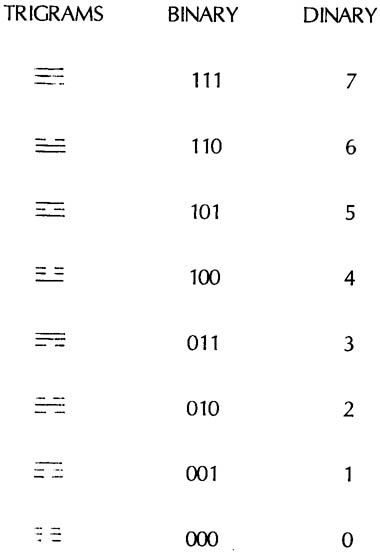
Insisting that his scheme of binary arithmetic is not an original invention of his own, but merely a re-discovery of the initial insight of the author of the I Ching, whom he identifies as the emperor Fu Hsi, Leibniz presents this in support of Bouvet’s thesis that the I Ching yields the key to an understanding of all the sciences! This same analysis, along with the Bouvet thesis, was made privately in a letter Leibniz wrote to the Jesuit mathematician, Fr. Bartholo-maeus de Bosses, in 1709.
The Rites Controversy upset Leibniz greatly and he was finally drawn into it because of an inner sense of involvement. Two books appeared in 1701 which constituted a major attack upon the view of the majority of the Jesuit missionaries in China. The thesis common to both authors was that Chinese culture is traditionally materialistic and therefore essentially a-religious. Leibniz owned copies of both works and made copious marginal notes in each showing the intensity of his concern for an adequate understanding of the Chinese mind. I refer to Traite sur quelques points de la religion des Chinois, by the Jesuit Fr. Nicolas Longobardi, and to Traite sur Quelques Points Importans de la Mission de la Chine, by the Franciscan Fr. Antoine de Ste. Marie. One of Leibniz marginal notes is of special importance for our purposes. In Longobardi’s text, where Chu Hsi is accused of materialism, there appears the following statement:“They imagine that from the primal matter (Li3), air (ch’i4) came forth naturally and by chance.” Leibniz comments: “The subject of all generations and corruptions (altemately) assuming and divesting itself of diverse qualities or accidental forms... is not the Li~$3 but rather the protogenous air (ch’s4) in which the 1i~$3 produces the primitive Entelechies, or substantial operative virtues which are the constitutive principle of spirits”. On 1 April 1715 the Regent of the Councils of the Duke of Orleans, M. de Remond, wrote to Leibniz and asked him to render an opinion about the nature of the Li Hsueh which could assist in the resolution of the Rites controversy. Leibniz responded a year later with a letter written on the eve of his death. Countering the charge by Longobardi and de Sainte-marie, Leibniz penned the well-known lines:
At first ... one doubts if the Chinese do recognize ... spiritual beings. But after some deliberation, I conclude they do, although they perhaps have never recognized these beings as separate from, and completely beyond, matter .... I am myself inclined to believe that spirits have bodies ... Li~$3... not as the prime spiritual being, but spiritual being in general,the entelechy, i.e. that which is endowed with activity and perception. ... He (Chu Hsi)seems to indicate that the particular li~$3 is an emanation from the great Li~$3.
The letter appeared two years after publication of the two works which articulate most clearly and succinctly Leibniz basic ontological position: Principles of Nature and Grace and Monadilogy. The work “entelechies” is used to designate “simple substances” or “created monads”. Here in his concept of the monad, central to the notion of organism, there is within his own mind a dialectic of thought between the Neo-Confucian concept of 1i~$3 and his own notion of the monad. By this I mean that Leibniz not only interprete Chu Hsi after his own lights, but at the same time creates his own position under the impact of Sung Neo-Confucianism.
To make the record of Leibnzi involvement in China studies complete mention needs to be made of the study of Chinese games, “Annotatio de quibusdam lidis”, published in the journal Miscellanea Berolinensia (Vol. I, 1710).
The important question before us, however, is not how involved Leibniz was throughout his life in studies of Chinese culture and philosophy, but rather the extent to which his own thought was influenced by Chu Hsi and Sung Neo-Confucianism as transmitted to him by Jesuitic inter-preters of the commentaries of Ching scholars. Are we justified in asserting that there has been an appropriation of Chinese insights in the historical development of modern European science and philosophy which might be traceable through Leibniz?
Wing-tsit Chan raises a serious objection to such ah assertion in his discussion of Chu Hsi in the Source Book in Chinese Philosophy:
Needham correctly understands Neo-Confucian philosophy, espcially as developed by Chu Hsi, as essentially organic. ... Surely the Neo-Confucian conception of the universe is that of a single organism. ... Impressed with this relational character of Chinese philosophy,Needham saw a striking similarity between Chinese organism and that of Whitehead. He also has made a most illuminating study of Chu Hsi’s influence on Leibniz and the philosophy of organism. We must remember, however, that in Chu Hsi’s philosophy, the world is more than just an organism, for principle in metaphysical. Moreover, while the many similarities between Neo-Confucianism and Whitehead’s organism ... are surprising, there is absent in Neo-Confucianism Whitehead’s God, who as the principle of concretion, is ultimate irrationality.(8)
Professor Chan is raising two objections. In the first instance he is insisting “that in Chu Hsi’s philosophy, the world is more than just an organism, for principle is metaphysical” On this point we find Leibniz in clear agreement with Chu Hsi. In a letter to Remond de Montmart be wrote:“when I seek for the ultimate reasons of mechanicism and the laws of motion I am surprised to discover that they are not to be found in mathematics and that we must turn to metaphysics.” From his earliest essay concerning ontology, the Discours de Metaphysique (1686) to the fullest statements in the Principles of Nature and Grace and Monadology (1714) Leibniz is insistent that central to reality are neither physical points nor mathematical points but rather metaphysical points. The distinction drawn in the 1714 writings between the physical point (real but not true), the mathematical point (true but not real) and the metaphysical point (both true and real), is anticipated in the 1686 essay:
But if we come down to detail we see the metaphysical laws of cause, of power, of activity, holding good in admirable manner in all nature, and prevailing even over the purely geometrical laws of matter, as I found in accounting for the laws of motion; a thing which struck me with such astonishment that ... I was forced to abandon the law of the geometrical composition of forces, which I had defended ... when I was more of a materialist.
Whitehead explicitly acknowledges his indebtedness to Leibniz on this point. Regarding Chan’s second objection, viz, that “there is absent in Neo-Confucianism Whitehead’s God ... the principle of concretion”, it should be noted that this is absent in Leibniz as well. The Whiteheadian God is a sort of 20th century Deus ex machina, a modern version of Plato’s demiurge which appears in the Timaeus. Apparently neither Plato nor Whitehead could grasp the Chinese concept of organism, although their respective predecessors, Pythagoras and Leibniz, had done so. Whitehead and Needham both suggest that Leibniz marks the point of origin in the history of western European thought for proposing the model of the organism as a viable, and preferable, alternative to that of the machine. Did this idea spring full-blown from the creative mind of Leibniz, or did he rely upon the work of a predecessor? It has been suggested that Leibniz stands within the Pythagorean-Platonic tradition. Frank Thilly has called our attention to the professor under whom Leibniz did his graduate work in geometry at the University of Jena. Erhard Weigel “had convinced Leibniz of the truth of a conception that remained the basis and guiding principles of all his later efforts to construct a world-view:”(9)
Although Leibniz’ vision of harmony may have been transmitted to him by Professor Jena, his understanding of that harmony was not. The abandonment of the “law of the geometrical composition of forces” to which he alludes in the passage just cited from Discourse on Metaphysics makes this clear. Furthermore it is evident that the Platonic resolution of the problem of how to relate the essential realm of eternal ideas to the existential realm of spatio-temporal objects and events as given in the Timaeus would not be acceptable to Leibniz. In his great debate with adherents of Newtonian mechanics he is quite insistent that external agents be barred from explanatory systems-whether “occult causes” such as Newton’s gravitational force, or the Platonic demiurge. Presumbly he could have found his model in the Pythagorean tradition with its emphasis on the fundamental monadic-dyadic relationship. The problem in establishing a Pythagorean base for the Leibnizian insight is one of documentation. Actually it wo uld have to rely on the neo-Pythagorean heritage which has existed at the edges of the mainstream of European thought and has constituted part of the esoteric or “occult” tradition. It is much easier to defend the thesis which Needham has proposed, viz that Leibniz was influenced profoundly by the Neo-Confucian tradition, especially as it represents an attempt to explicate certain fundamental ideas found in the I Ching and its appendices. The amazing parallel between the following passages from Leibniz’1714 works and the neo-Confucian understanding of li~$3理 and ,ch’i4,氣 of the inner dialectic between the yin~$1 and the yang~$2 陽, when read against the background of Leibniz’ study of Chinese thought prior to their composition makes it difficult to deny Needham’s suggestion in favour of an undocumented thesis of Neo-Pythagorean influence:
“Monads are not pure forces:they are the foundations not only of actions but also of resistances of passivities...”
I distinguish (i) the primitive entelechy or soul; (ii)primary matter or primitive passive force; (iii)the monad, completed by these two; (iv) mass or secondary matter or the organic machine ... ; (v) the animal, or corporeal substance.”
In his essay on “Harmony and Conflict in Chinese Philosophy”, Derk Bodde wrote that
“the universe, according to prevailing Chinese philosophical thinking, is a harmoniously functioning organism consisting of an orderly hierarchy of inter-related parts and forces,which though unequal in their status, are all equally essential for the total process. ... This cosmic pattern is self-contained and self-operating. It unfolds itself because of its own inner necessity and not because it is ordained by any extemal volitional power.”(10)
The passage could be used as an accurate description of Leibnizian cosmology as well, and helps to point up the parallel.
The recognition of extreme affinity with- if not direct indebtedness to - Neo-Confucianism is made by Leibniz himself when he defended Bouvet’s thesis that the I Ching does provide the key to all scientific understanding. I do not deny the originality and genius of the mind of Leibniz. The evidence is overwhelming, however, that he himself recognized amazing correspondences between his insights and those of Chinese intellectuals, and that he continued to develop his own ideas after such recognition was acknowledged.
Whitehead has deviated from the Leibnizian model of organism through his appeal to the Platonic tradition as given in the Timaeus. This deviation is not the case in two other intellectual positions which also owe much of their foundational thinking to the Leibnizian heritage, viz the Hegelian and the Marxist.
Needham’s analysis of the organismic model, patterned after the Leibnizian notion of the self-contained, windowless monad, overlooks the extreme importance of the related idea of an inner dialectic. Both Needham and Whitehead seem to fail to comprehend the Leibnizian notion of organism which is not dependent upon an external agent for its development, but develops much like the Supreme Ultimate as the result of a dynamic inner dialectic.
Hegel understands this, and the dialectic of his Absolute Idea bears a striking resemblance to the analyses of the interaction of yin and yang within the triadic relationships symbolized in the trigrams and hexagrams of the I Ching. The “left-wing” Hegelians make use of this concept as the key for understanding natural process and human history. It is almost as if the Dialectical Materialists had read Leibniz’ defense of Bouvet’s statement that the I Ching provides the key to all the sciences. The Marxist polemic against mechanistic materialism and re-definition of the concept “matter” reminds one of the Leibnizian rejection of Newtonian mechanics. Despite Kant’s preference for Newton, bis articulation of the categories in triadic form was instrumental for transmitting the notion of dialectic in the European tradition, and the Marxists clearly belong to tradition which was introduced to European thought by Leibniz.
Joseph Levenson devotes a chapter in the third volume of Confucian China and its Modern Fate: The Problem of Intellectual Continuity to “the place of Confucius in Communist China”. The problem Maoist intellectuals face in relating the Chinese tradition-especially the main stream of Chinese civilization-to Dialectical Materialism is an extremely difficult one and as yet unresolved despite persistent efforts to intellectually demythologize Confucius and discredit the entire Confucian tradition as the continuing ideology of the exploiting classes throughout China’s history. My thesis will not be popular with Maoist intellectuals ar first sight, but its acceptance would assist in placing Diamat firmly within the Chinese philosophic heritage. Dialectical Materialism owes much of its theoretical framework to the Confucian philosophic tradition. Maoist thought is Marxist-Leninist in orientation. Marx was an Hegelian although he participated with Feuerbach in the procedure of standing Hegel on his head-or rath er taking him off his head and standing him on his feet again”. Hegel owed most of his ideas concerning organism and dialectic to the Kantian tradition, although his ontology would not be acceptable to the criticai philosophy of Kant. Kant was greatly indebted to the Leibnizian position even though he rejected its popular articulation. Leibniz acknowledged deep affinities with, if not direct indebtedness to, the Neo-Confucianism of the Sung dynasty as this was re-articulated by early Ch’ing scholars and interpreted as the rationale underlying the I-Ching. This is not to suggest that Leibniz’ concept of Neo-Confucianism was accurate, nor is it to defend the Ch’eng-Chu school as the best interpretation of a heritage which is decidedly plura[istic. Neither is it to suggest that Leibniz is a proto-Marxist, or that Mao is a after-day Leibnizan. It is to insist upon a genuine and discernible line of filiation, however.
As a minimal thesis it can be affirmed that Leibniz was a bridge across which certain basic insights of Chinese philosophy, including the organismic model and an inner dialectic, were introduced into the mainstream of European thought. The impact of these ideas has been felt profoundly in philosophy, in the sciences, and in political ideology.
(1)Joseph Needham. Science and Civilization in China. Cambridge:The University Press, 1955. Vol. II, pp.291-293.
(2)ibid. pp. 339-345.
(3)ibid. pp. 496-505.
(4)loc.cit.
(5)loc.cit.
(6)translated by Immanuel C.Y. Hsu Cambridge:Harvard University Press, 1959, pp. 20 ff, 45 f.
(7)This does not count his Baccalaureate thesis written at age 17.
(8)rinceton:Princeton University Press, 1963. pp. 636 f.
(9)A History of Philosophy.
(10)in Studies in Chinese Thought (edited by Arthur Wright).Chicago:University of Chicago Press, 1953. pp. 67 f.