A BRIEF HISTORY OF POSTCARDS
For several years after the British invented the first stamp stuck on an envelope in 1840, most mail consisted of letter sheets folded inside an envelope. However, in 1865 an innovative German artist posted a card on which he had written his words of congratulations. And in 1869, drawing inspiration from the German artist's creativity, an Austrian economist proposed that the post office issue postcards.So, on lst October of the same year, the first official postcard was sent out from Austria. Early postcards were plainly designed and patterned, with only the name of the issuing institution or ‘Union Postale Universelle' printed on them. The first photographic postcard featuring the Eiffel Tower appeared at the International Exposition in Paris in 1889. In August 1897, China also issued her first postcard.Postcards caught on quickly, partly because of the cheaper postage, partly because cameras were not yet quite popular at that time. Moreover, postcards could be sent as gifts to friends and relatives living far away, or be kept as souvenirs, to cherish the wonderful memories of your traveis.
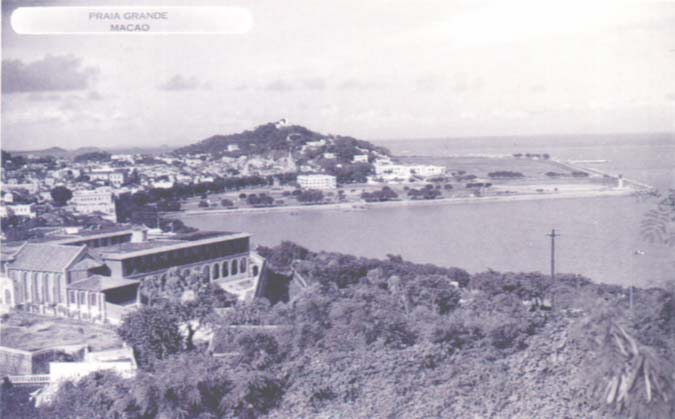
利用原照片直接製作成的風景明信片。
Postais ilustrados produzidos directamente a partir de fotografias originais.
These scenic postcards were directly made from original photographs.
The Post Office of Macau issued its first batch of postcards in 1885, with postage already printed on the card, which was called ‘postal stationery card'. The front featured the king of Portugal, D. Luis I, and the face value, while the back was blank leaving space for the sender to write the message. In 1898, to commemorate the 400th anniversary of the discovery of the route to India, Portugal issued a set of 8 scenic postcards in Macau, though all featuring famous sights and places of interest of Portugal.
In as early as 1844, a Frenchman named Jules Itier carne to Macau with his Daguerreotype camera and took the first batch of pictures of Macau, probably also the first batch of photographs of Asia. But postcards featuring Macau scenery did not appear until 1898. And even these postcards were not printed in Macau. As a matter of fact, in the early days almost all scenic postcards of Macau were produced by private publishers of Hong Kong, all in monochrome lithographic prints, with one side blank for the sender to write the message and the other side being reserved for the receiver's name and address. Particularly worth mentioning is the fact that most of the colour postcards emerging after 1905 were actually black-and-white photographs to which colours were added by hand, owing to the high cost of colour photographs at that time. These postcards, In spite of their artificial colouring, held special appeal with their primitive simplicity. In the early 1920's, there were more and more photo studios producing postcards directly from photographs. Later there were still some photographic coloured postcards but the quantity was very small, because the photos had to be printed one by one.
The greatest joy of postcard-collecting lies in bringing back to mind a panorama of Macau of the past hundred years, tracing the variety of patterns and pictures to the sites of the spectacles. And the actually posted postcards are valuable postal objects for appreciaiton, with our predecessors' sentiments and feelings about their life in Macau. Indeed, we find many of these posted cards filled with words of praise for our beautiful city, thus enabling us to get a glimpse of what Macau was like a century ago. As the postcards of Macau that have passed on to us are extremely rare, it has been a difficult task to collect them. The appeal and challenge is so irresistible that it has become a life-long pursuit.
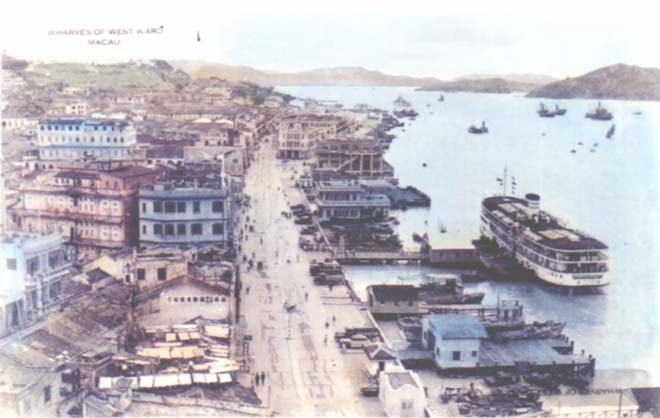
在原照片上用水彩塗色的“彩色”風景明信片。
Postais "coloridos" produzidos através da introdução de cores nas fotografias a preto-ebranco
The ‘coloured' scenic postcards are actually water-colours on photographs.