II. The status quo and problems of economic relationship betweenHong Kong and Macao
1. Historical review of economic development between Hong Kong and Macao
Hong Kong and Macao are located respectively on the east and west bank of the Pearl River mouth, separated by 42 nautical miles with Lin Ding Yang Sea lying in between. The two citieshave long had a close economic relationship. Macao was established in 1535 and was one of the most prosperous transshipment ports in the Far East. In the 300 years since then and until the outbreak of the Opium War, especially in the late 16th century and early 17th century, transshipment trade reached its golden age. During the period, Macao associated itself with China's southeast coastal regions as its backup for dealing in bulk in silk cloth. Three international trade routes emerged: one which started from Lisboa to Goa to Macao, a second which extended from Macao to Nagasaki,and a third from Macao to Manila and on to Mexico, etc., forming a husk of trade routes on the seas to Europe, Asia and Latin America.However, after the Opium War, Hong Kong was taken over by the British. Hong Kong emerged as free port, being one of the five major ports opened up for trade on the southeast coast of China.Macao's position as a port of transshipment declined drastically. In the 1847, the Government of Macao made gambling legal, and since then, Macao gradually developed into a gambling city in the East---a consumer city of tourism and gambling near Hong Kong and its neighboring regions.
From the 60's of the 20th century, Hong Kong and Macao moved into a new period of development. Beginning in the 1960s,Hong Kong capital has been invested in various sectors of Macao's economy on large scales, especially in the entertainment, casinos,and export-oriented processing industries. This gave an impetus to an all-round cooperation among sectors of Hong Kong and Macao economies such as banking, insurance, trade, transportation,warehousing, real estate, construction industries, and even the retailing sector. This notable break-through of economic relationship was due to many factors.
Firsly is the geographic proximity of Hong Kong and Macao,as well as common historical background, social and languageculture. Secondly, Macao was then ready for incoming investment and the government amending the legislature and introducing policies for attracting foreign investment. Thirdly, in comparison with Hong Kong, Macao had advantages of low capital investment costs, with low tariffs and quotas of textile goods for exports,affording greater marginal profit for investment in Macao by Hong Kong investors. Thus, a combination of factors resulted in the development and economic tie between the two cities of which the "Hong Kong factor" came to be a major impetus in Macao's economic take-off, driving it to modernization from the mid-'70s.On the other hand, Macao became an undeniable factor contributing to the economic boom in Hong Kong.
After the mid-80's, as China's "Open Door and Reform" policy proceeded forward, a comprehensive economic cooperation among Hong Kong, Macao and Mainland China, especially with the Pearl River Delta region in Guangdong. There was a massive relocation of Hong Kong and Macao's manufacturing industries to Mainland China, which resulted in the allocation in which Hong Kong and Macao served as the "front store" and Mainland China as the "backyard mill". One of the consequences of such a regional economic cooperation was a decrease in investment by Hong Kong businesses in Macao, which to some extent adversely affected trade between them. With the onset of the Asia financial storm in 1997,in which affected Hong Kong, and the worsening situation of law and order in Macao, there was a drastic decrease in the number of Hong Kong tourists visiting Macao. Those are some signs of decline in economic linkage between the two cities, which are worth the attention of all sectors of Macao's general public.
2. The status quo of economic relationship between Hong Kong and Macao
2.1 Overview: Hong Kong capital in Macao
Large-scale of Hong Kong capital invested in Macao from the 60's. In 1961, Hong Kong businessmen Stanley Ho, Henry Y.T.Fok, Yip Hon and Teddy Yip form a company, and won the bid for the exclusive franchise to operate casinos, for which they incorporated Macao Tourism and Amusement Co., Ltd. (STDM).This was the prelude to large-scale Hong Kong capital investing in Macao. Most of the Hong Kong capital in the 60's, invested in manufacturing industries. Taking advantage of textile quotas and the scheme of general favor that Macao enjoyed, they set up their factories in Macao, laying a foundation or the territory's exportoriented processing industries, mainly in the textile, garment, and toy making industries and etc. From the 70's to the 80's, capital from Hong Kong were also invested in Macao's banking, insurance,warehousing, hotel and food, real estate, and retail industries.During this period, Hong Kong capital took the lion's share of foreign investment in Macao, and became the engine of the Macao economy, which could be seen in two main areas:
(1) Macao Tourism & Amusement Co. Ltd. (STDM), a Hong Kong investment, has become the strongest, most influential conglomerate in the economy. After decades of development, it is no longer a company which operates merely the gambling business.Instead, its operation now covers almost every sector of the economy, including hotel, tourism, real estate, construction, finance,major public projects, etc. With nine casinos and their subsidiary companies, the STDM has the entire gaming industry under control,including casino games, horse racing and various lotteries. One of this business associates, the Shun Tak Group company, which is listed on the Hong Kong stock market, owns the largest fleet of jetfoils in the world, and runs over 70% of the passenger traffic business on the sea route between Hong Kong and Macao. Thehotels in which it has shares including Hotel Lisboa, Hotel Sintra,Hotel Estoril, Hotel Hyatt Regency Macao, Hotel Kingsway, Mandarin Oriental Macao, the Westin Resort, etc. It is therefore Macao's number one hotel management group. The STDM is also one of the largest property developers in Macao and one of the major investors in the massive Nam Van Lake project. It has also actively engaged itself in the development of various infrastructure projects, including the new Hong Kong-Macao Ferry Terminal, Ka-Ho Container Port,Macao International Airport, etc. According to the company statistics,its net assets in 1997 amounted to 23.445 billion Macao dollars. No other enterprises can surpass it in terms of the influence on Macao's economy.
(2) Hong Kong capital is the main stay of Macao's four pivotal industries, with the all important gaming industry is almost entirely in its control. Hong Kong capital also accounts for a major part of investment in Macao's hotel industry. In the case of export-oriented processing industry, it is estimated that Hong Kong businessmen invest in more than 70% of Macao's factories. The same is also true of large enterprises in the manufacturing industry, which are run either by sole proprietors or on a joint-venture basis. In property development, Hong Kong capital had long been the major driving force until the 90's, when Chinese capital was injected. Later, when the property market was at its lows, there was a gradual downsizing of Hong Kong capital in real estate. In the insurance sector, Hong Kong capital has accounted for a significant portion, where a majority of banks and insurance companies conduct their business through regional headquarters or related institutions located in Hong Kong.Besides, Hong Kong capital also accounts for a part of Macao's warehousing and retailing.
Hong Kong capital has long taken the lead in the development of Macao's economy, as the most significant sourceof investment. However, since the end of the 80's, and as the economic cooperation between Hong Kong and Mainland China became increasingly robust, as a shift of investment focus from Macao to the Mainland has gradually taken place, causing an apparent drop in investment in Macao, and thus undermining the leading role of Hong Kong capital in Macao's economy. Hong Kong capital has been replaced by the quickly emerging Chinese capital as the biggest investor in Macao.
2.2 Tourism and gaming industries
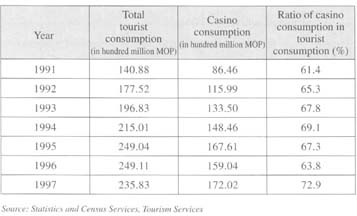
The tourism and gaming industry has long taken a key position --the biggest pivotal industry -- in Macao, except for a period in the mid-80's. The statistic show that this sector accounted for 45% of Macao's GDP in 1997. The industry includes casino's operation, tourist services, hotel, restaurant, entertainment, passenger transportation, jewelry, souvenirs, and antique businesses, of which the gaming industry is the core. From the 80's, there has been steady rise in gambling service consumption to the total tourist consumption in Macao, from 61% in 1991 to 73% in 1997 (see table 1).
Table 1: Ratio of casino consumption to tourist consumption in Macao
Macao's tourism and gaming industry relies considerably on Hong Kong in the following ways:
(1) Hong Kong entrepreneurs are the most important investors and operators of Macao's gaming industry. The Macao Tourism and Amusement Co. Ltd. (STDM), of which Hong Kong businessmen Stanley Ho, Winnie, Ho, Henry Y. T. Fok and Cheng Yu-tung, etc.are the major owners, has now the exclusive franchise of Macao's casinos operation (which expires in 2001). The nine casinos under its management, namely, Casino Lisboa, Casino Palace, Casino Kam Pek, Casino Mandarin Oriental, Casino Diamond, Casino Jai alai,Casino Kingsway, Casino Taipa, and Casino New Century, are literally operating in monopoly. The STDM is also in control of various companies which have been granted concession in lottery operations. In 1984, it took over Macao (Yat Yuen) Canidrone,which was licensed to run greyhound racing business. In 1991, a Hong Kong-Macao conglomerate in which the STDM was in the lead, purchased 51% shares of Macao Jockey Club. The Sociedade de Latarias Wing Hing Lda., which is affiliated with the STDM, is running operations of lotteries such as "pacapio", lottery, tombola,etc. In 1998, the exclusive franchise of football betting, which is valid for one year, was granted to Macao Lottery Co. Ltd., also affiliated with the STDM.
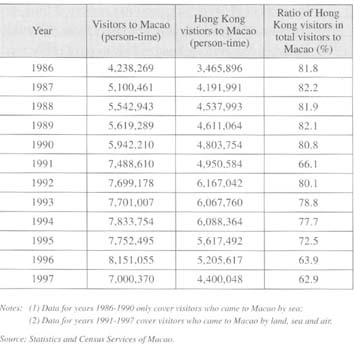
(2) Hong Kong is the largest source of visitors for Macao's tourism and gaming industry. For a long period, the mere number of Hong Kong tourists has had decisive effects on the development of Macao's tourism and gaming industry. In 1987, the Hong Kong government simplified procedures for permanent residents traveling to Macao. With the introduction of night jetfoil service in 1990,travel between Hong Kong and Macao has become quick and easy.These measures have led directly to the big increase in the number of Hong Kong visitors, and hence the boom of tourism and gamingindustry, because they enabled the travel to and fro between the two cities convenient and expeditious. According to the statistics,in a period of many years up to 1992, Hong Kong visitors accounted for more than 80% of the total tourists (see Table 2). Most travel agencies in Macao are in fact branches of those headquarters in Hong Kong. As to package tours of overseas visitors to Macao,they have for long been promoted and organized by travel agencies headquartered in Hong Kong. In 1996, overseas visitors who came to Macao via Hong Kong amounted 1.78 million, which accounted for 30% of the total number of visitors accessing Macao through Exterior Port Terminal, indicating that many of them came via Hong Kong.
Table 2: Ratios of Hong Kong visitors to the total visitors in Macao
2.3 Export-oriented processing industry
Current manufacturing industry in Macao is in essence an extension of that in Hong Kong. From the 60's, the rapidly emerging manufacturing industries in Hong Kong, mainly those of textile and garment, were beginning to be subjected to import controls by countries such as Britain and the United States, which led eventually to the introduction of a "Multi-fiber Agreement" in 1974. The Agreement insitutionalized a system of quotas against textile imports.Then, Macao was viewed by western countries as a "non-major exporting region", and therefore was granted ample quotas for its textile exports. In view of this advantage, many Hong Kong businessmen came to set up their factories in Macao, which in turn laid down the foundation of textile and garment industries. In the early 70's, European and American countries adopted the policy of "general tariff favor" for products imported from developing countries. This gave incentive to some of those non-textile-garment manufacturers in Hong Kong, mainly those of plastic toys, to move their factories to Macao. In such a historical background, Macao's export-oriented processing industry was able to initiate, develop,and reach its highest in the mid-80's. The statistics show that in 1984, Macao's export-oriented processing industries, mainly that of garment, textile and toy-making, accounted for as much as 35.99%of its GDP, surpassing that of tourism and gaming industries and becoming the number one sector of the economy. Unfortunately,from late 80's, this sector began to shrink. However, Hong Kong remains its position as the biggest source of investment in Macao's processing industries. It is estimated that more than 70% of those processing enterprises in Macao are from Hong Kong, and a majority of those major enterprises and factories are owned by Hong Kong businessmen, or run on a joint-venture basis. A considerable portion of orders is sub-contracted from Hong Kong.
Nearly all production equipment, raw materials and accessories of sorts needed by Macao's processing industries have to be imported. Therefore, production equipment, raw materials,accessories and unfinished goods account for quite a high ratio,usually more than 55%, of the imports. However, with neither a deep-water seaport nor an international airport available in Macao,
Table 3: Trend of ratios of imports from Hong Kong and Mainland China in Macao's imports (in hundred million Macao dollars)
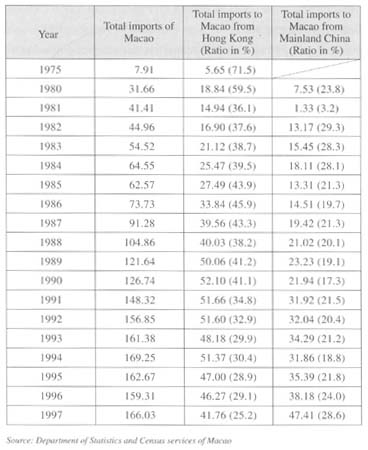 communication with the outside had to rely on Hong Kong, which means that most of the imports had to be transshipped by way of Hong Kong. Hong Kong has, for a long time, remained a major source of imports for Macao. During the mid-70's, when processing industries were rapidly growing, the imports to Macao via Hong Kong accounted for more than 70% of Macao's gross imports, which ratio remained at 60% in the early 80's and between 35-45% in the following 10 years. Before 1996, the above ratio ranged number one in Macao's gross imports (see Table 3).
2.4 Property sector
Hong Kong's influence on Macao's property industry is mainly marked by: (1) the introduction in the 60's of property sale "by floor and by installment plan" which was first established by Hong Kong real estate dealers such as Henry Y.T. Fok, driving drove the initial development of Macao's property industry; (2) by the fact that, for over 20 years from the 60's to the early 90's, Hong Kong was one of the major driving forces behind the development of Macao's property market; and (3) by the fact that business cycle of Hong Kong's property market has had a direct or indirect impact on the ups and downs of Macao's property industry.
Before the 60's, Macao's property development industry remained backward and stagnant. The Government adopted a conservative policy towards property development that required the property should only be sold by individual buildings, on a oneoff payment-against-keys basis. Until the early 60's, motivated by the rapid growth of western economy, particularly that in Hong Kong, when the government of Macao adopted a policy of "developing Macao by absorbing foreign capitals" and Hong Kong's model of property sale "by floor and by installment plan", which gave rise to the later development of Macao's property industry. In1972, the first housing estate, lao Hon San Chun, was completed and was put on sale using the methods of saling "by floor and by installment payment". It was immediately sold out. This kind of sale coincided with the bullish stock market in Hong Kong, where ample capital was available. Part of the capital flew to Macao, giving rise to an unprecedented speculation on the property market, and hence pushing Macao's property industry to its first climax after the World War Two.
After the 1975 petroleum crisis in the Middle East, there was another boom in the property market in Hong Kong, where land prices and property prices went on a steep rise, resulting in rapid increase of production cost. This caused part of Hong Kong capital to turn to Macao again at a time when the government of Macao stipulated that for investing in garment and textile industries etc.investors should buy their own property, and for incorporating trading companies, investors should have their own permanent premises. These measures stimulated Hong Kong investors to invest in real estate in Macao. As a result, it led to a second peak of its property market. However, in the early 80's, Macao's property industry experienced a difficult period of adjustment, triggered by the flagging property market in Hong Kong. The situation did not turn for the better until 1984 when the Chinese and the British governments signed a joint declaration on the Hong Kong issue,and in 1985 when the Sino-Portugese Joint Declaration was published, indicating that the Macao issue should be resolved by way of diplomatic negotiations.
In April 1987, investors' confidence was heightened by the signing of the Joint Declaration on Macao by the Chinese and the Portuguese governments. At the same time, the government of Macao announced the start of several large infrastructure projects.This gave a tremendous boost to the development of propertyindustry, and to Macao's economy. In those days, property prices in Macao were equivalent to only one quarter of those in Hong Kong, which attracted some Hong Kong capital to return to Macao.In 1991, the government of Macao amended the Land Code and other related regulations on land bidding, which resulted in a steep rise of land and property prices. The government offered for bidding six stretches of land reclaimed from the sea near the Exterior Ports,which were won by Hong Kong businessman Stanley Ho in conjunction with Hong Kong property developer Li Ka-Shing, Cheng Yu-tung etc. There would have reached another climax of Hong Kong capital investing in Macao's real estate if those six stretches of land had not later been recalled by the government for rebidding. In the early In April 1987, 90s, many Hong Kong businessmen and residents engaged in speculation on buildings still under construction. The statistics show that in 1991 in Macao,of the 5,000 property deals with the worth of more than 700,000 Macao dollars, more than 70% of the buyers were from Hong Kong.From this, we could have a glimpse of Hong Kong people's influence on and interest in Macao's property market. However, it is undeniable that during that period, it was Chinese capital that was invested most heavily, and that capital inflow, mostly came from various cities and counties in the Pearl River Delta region.
2.5 Finance sector
The finance sector of Macao relies heavily on Hong Kong,and could be characterized basically as an extension of Hong Kong's finance industry. This could be seen in the following:
(1) Hong Kong dollar takes an extremely important position in Macao's financial system economy. Macao has the same monetary issuing system as Hong Kong, the system of "Currency Board".Since 1972, Macao dollar has been linked to Hong Kong dollar. InOctober 1983, Hong Kong adopted the linked exchange rate to have Hong Kong dollar pegged to US dollar by way of Hong Kong dollar, at an official exchange rate of 103 Macao dollars to 100 Hong Kong dollars. According to the regulations of Macao's monetary issuance, there are two issuing banks - the Banco Nacional Ultramarino and the Bank of China, authorized by the government.They need to deposit a specific sum in foreign currency, mainly in Hong Kong dollar, at an official exchange rate, to the Monetary and Foreign Exchange Authority of Macao (AMCM). On receipt of the deposit, the AMCM issues a guaranty for the deposit and its liquidity, with a certificate of debit, by virtue of which the issuing banks issue Macao dollar bills at the official exchange rate.Therefore, Hong Kong dollar has a very important position in Macao's foreign exchange reserve.
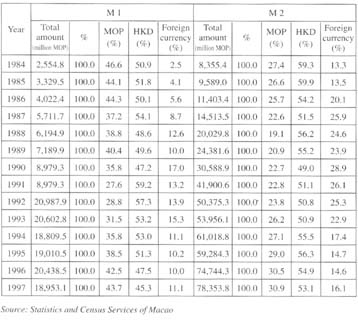
Hong Kong dollar has long been the most widely circulated currency in Macao. This remains to be the case even today. The amount of Hong Kong dollar in circulation even surpasses that of the local currency, Macao dollar. This unique phenomenon may be clearly seen in the ratio of Hong Kong dollar and Macao dollar in Macao's currency in circulation, namely M1 plus M2. Since the mid-'80s, the ratio of Macao dollar in M1 (money in circulation plus savings deposits) has plunged from 46.6% in 1984 to 27% in 1991,whereas that of Hong Kong dollar has climbed from 50.9% to 59.2%in the same period. Though this trend began to reverse in 1992, the ratio of Macao dollar in M1 reached only 43.7%, lower than that of Hong Kong dollar, which was 45.3%. In the case of M2, Macao dollar took a ratio of only 30.9%, far lower than that of Hong Kong dollar, which stood at 53.1% (see Table 4). Today in big business deals and in external trade payments, the amount of Hong Kong dollar in use far surpasses that of Macao dollar. Similarly, in bank deposits, Hong Kong dollar also dominates the other. This is aunique phenomenon of currency substitute in the Macao economy.Therefore, the stability of the exchange rate of Hong Kong dollar will greatly affect Macao's financial system and economy.
Table 4: Ratios of Macao dollar and Hong Kong dollar in Macao's money supply
(2) Financial operations of Macao rely significantly on Hong Kong. The structure of Macao's financial system is simple, with banking as the main trunk and insurance as the complement.Business is mainly along the line of deposit and loan, with an inadequately developed finance market. Of the 22 banks and 21 insurance companies, a considerable number operate under their regional headquarters in Hong Kong. Even the banks incorporated locally are in close business association with related banks in Hong Kong. Of the deposits in the banks, those in Hong Kong dollaraccount for a great portion. Given that the local inter-bank market is not well developed, the banks have, after reserving the necessary working capital, to consign their balances with banks in Hong Kong, and lending of call-money is likewise mainly made through their regional headquarters or associated banks in Hong Kong.Therefore, Hong Kong is the major extra-territorial banking extension of assets and liabilities. On account of this situation and because of the key position Hong Kong dollar taking in Macao's finance, the trend of interest rate generally follows that of Hong Kong. Thus stability of Hong Kong's interest rates affects Macao's finance industry and economy. As lacking finance markets, Macao's dealings in foreign exchange, securities, bonds and gold are mainly conducted by Macao's financial agencies through their regional headquarters or associated agencies in Hong Kong.
2.6 External transportation and communication
In spite of the fact that Hong Kong and Macao are on either side of the Pearl River Mouth, they have totally different ports. The Victoria Harbor in Hong Kong is one of the three best natural ports in the world, whereas the ports in Macao are shallow. As for many years Macao have neither a deep-water port nor an airport, most of Macao's exports had to go via Hong Kong. According to a rough estimate, the part of Macao's gross exports by water routes accounts for 95% or more, all of which by transshipment through Hong Kong. The remained 5% is delivered by air, and again three fifths of that is via Hong Kong which is the most important transshipment port for Macao's exports. In the case of passenger transportation,Far East Hydrofoil co. provides very convenient 24-hour ferry service in every 15 minutes. The trip only takes an hour.
For telecommunication, communication between Hong Kong and Macao is very frequent and speedy. In Macao Telecom Co.Ltd., Hong Kong Cable and Wireless PLC has 51% shares, and CITIC Hong Kong has 20%.
3. Problems in the relationship between Hong Kong and Macao
3.1 Lack of regional cooperation and coordination in the top-level
Though Hong Kong and Macao are nearly next door neighbors with close economic associations, there has long been an apparent lack of top-level cooperation and coordination between them, because the two have been subjected to the rule of different regime's - the British and the Portuguese. Macao has not been so much important to Hong Kong as Hong Kong has been to Macao in economic terms, because of Macao's tiny scale of economy. So there has been disparity in their relationship. During its colonial rule of Hong Kong, the British Hong Kong government has never cared to give even a thought to the Portuguese ruled Macao, whereas due to their intense national pride, the Portuguese Macao government would not have anybody say that Hong Kong is in any way superior to Macao, or anybody compare Macao with Hong Kong. Under such circumstances, the British Hong Kong government had neither placed businesses, like regional economic cooperation and coordination of economic policies, on any agenda nor in any projects of economic development. There has never been any communications between the two governments. On the other hand,the Portuguese Macao government had not made use of the advantage of Hong Kong as an international trade and finance center. It would not break the "on-parity" air and take the initiative to talk with the British Hong Kong government about further economic cooperation and possibility to establish any authoritative inter-governmental organization for this. The little relationship maintaining was just some official or semi-official connections on specific affairs, such as the "Pearl River Delta Tourism PromotionAgency", the "Promotion of a Larger Tourism Region Between Guangdong, Hong Kong and Macao", etc., which was proposed and organized by Hong Kong Tourist Association, and joined by Tourist Services of Macao Government, and Guangdong Bureau of Tourism.
This remains to be the case even now. Especially as at the period of return in 1997 and 1999, the governments became too preoccupied with the return to appreciate any importance and urgency of the matter. Even after Hong Kong's return to China, a study entitled "Review of Hong Kong Development Strategy" was published by the Hong Kong SAR government in 1998, in which a goal was set for 2011 for Hong Kong to become an ideal regional and international metropolitan city, one of the major cities in the Pearl River Delta. Nothing was mentioned in the study about the neighboring Macao, which is closely associated with Hong Kong in economic terms, when discussing a joint development strategy with Guangdong and other Mainland provinces. This can only be seen as a serious flaw in the Hong Kong-Macao economic relationship, and of course it is one of the consequences of lacking initiative on the part of Macao government to try to nurture cooperation and win Hong Kong's support and accommodation.
As a result, economic cooperation between the cities basically remains on a spontaneous, low and non-official level, which follows the market trends. This situation forms a stark contrast with the south China trend, centered on the Pearl River Delta, moving toward economic union. Without top-level cooperation between the cities,problems confronted by the business people of the two places on specific matters of their relationship are usually not resolved timely,and economic cooperation does not move forward, but backward.This problem should be seriously concerned by the governments of Hong Kong and Macao.
3.2 Lack of coordination in gaming and tourism industry resulting in decrease of Hong Kong visitors to Macao
In the past, there was a taciturn convention between the two places concerning gaming industry policy, namely, that there will be no casinos in Hong Kong, and Macao does not run horse racing. When Macao Jockey Club was formally inaugurated in 1989,the two places could nevertheless arrange their timetable so that races do not coincide in time, and direct competition may be avoided. However, since the emergence of casino liners around Hong Kong in the '80s, a scenario of direct competition have been unfolding between casinos in the two cities. Now such liners that cruise near Hong Kong have amounted to seven. The largest reached a tonnage of 50,000, with splendid and advanced facilities and all kinds of entertainment services, docked near Kowloon, which is very convenient for visitors from Hong Kong. It is reported that there will be another luxurious liner of 70,000 tons joining the fleet in 1999. These fleet pose a direct and grave challenge to Macao's ill-managed casinos. Mr. Stanley Ho, general manager of the STDM has said on a public occasion that those liners have a grave impact on Macao's gaming industry, with a 15-20% decrease of the "median" business, is mainly Hong Kong visitors. Apparently, Hong Kong and Macao have no coordination regarding the gambling businesses.
Hong Kong is the biggest source of visitors for Macao's casinos. However, since 1992, there has been a drop in the number as well as in the ratio of Hong Kong visitor. As the statistics show that from 1992 to 1997, the ratio of Hong Kong visitors to the total visited Macao was dropping year by year, from 80% to 63%. One reason for this decline could be found in the past few years, during which there was a considerable rise in the number of visitor from Mainland China and Taiwan. However, from the net figures of Hong Kong visitors we do not see much optimism: from 6.167 million to4.40 million person-times for the same period, with a drop of 29%.There may be many causes for the situation. Apart from the flagging economy in Hong Kong and the deteriorating public security in Macao which makes visitors balk, there have been other factors such as the rather out-of-date management of casinos, old-fashioned facilities, lack of innovation, and competition from the floating casinos in Hong Kong. Besides, in Macao, there has been inadequate development of tourist resources. The general impression is that Macao falls short of what visitors expect of a resort for family holidays, business and conference tours. This generalization may be inferred from the components and the pattern of consumption of Hong Kong visitors. In the 1997 statistical sample of Hong Kong visitors, male accounted 71.2%, staying for an average of 1.28 day.Non-casino visitors consumed an average of only MOP846.5, lower than that by general visitors. The figures indicate that Macao has not been so attractive to Hong Kong visitors, and the only attractive spot may be the casinos.
3.3 Decline of investment in Macao's manufacturing industry and diminishing trade between Hong Kong and Macao
Since the mid-80's, as Mainland China, especially the Pearl River Delta areas, pursued its opening-up, the Pearl River Delta has gradually replaced Macao by becoming the first choice for investment by Hong Kong manufacturing enterprises. Hong Kong and Macao manufacturers have been moving their labor-intensive production lines to the Mainland. During this period, production cost in Macao was continuously increasing, with a shortage of laborers, while textile quotas and general favor advantages that Macao enjoyed were being eroded. All these factors resulted in inadequate follow-up on investment in Macao by Hong Kong manufacturers. This may be inferred from the trend of change inthe number of production facilities and the number of workers.According to the statistics, the number of production facilities dropped from 2,270 to 1,339 during 1990 - 1997, with a decline of 41%, and that of workers employed in manufacturing from 64.7thousand to 38.7 thousand, at a drop of 40%.
There was a lack of impetus in the investment in Macao's manufacturing sector by Hong Kong, or even a decrease, resulting in a drop in the trade ratio and gross value. The statistics show that in 1990 Macao's gross import from Hong Kong reached an all-time height of MOP5.21 billion. But since then, it has been decreasing year by year, with the 1997 figure standing at only MOP4.18 billion,at a drop of 20%, and meanwhile a drop from 42.2% to 25.2% also occurred in what those imports accounted for in the gross imports.On the exports front, an unprecedented MOP 1.93 billion was achieved in exports to Hong Kong in 1989, which dropped to MOP1.32 billion in 1997, 31.6% down, and a concurrent drop from 14.7% to 7.7% was recorded of the ratio of such exports to the gross exports for the same period. Obviously, Macao relies a great deal less on Hong Kong than it used to do, and instead, China is gradually substituting for the position of Hong Kong.
3.4 Hong Kong investment in Macao's real estate industry falling into depression
Hong Kong investment in Macao's real estate construction industry has gradually taper off, and even halted, after reaching its peak in the early 90's. This was the time when Macao government changed its way of land sale from negotiated concession to a system of public auction, and increased land supply by a large scale. A great deal of foreign investment was then attracted into the market,especially from the Mainland, leading to a dramatic rise in land and property prices, which was more than what the local economydemanded and what local people could afford. Investment risks were thus increased. During this period of time, major Hong Kong real estate developers generally did not participate in Macao's land auction. Later, China began its macro-economic adjustment in 1993 by tightening credit, which resulted in the withdrawal of Chinese capital from Macao's real estate market, leaving the market in a more serious state of property over-supply, and hence a bearish market. Yet, from 1996 to mid 1997, Hong Kong's real estate market boomed, which further differentiated the price between the two places. The difference for office space was as large as 10-15 times then. However, Hong Kong investors and speculators considered Hong Kong's real estate market as more profit-promising and apparently reduced interest in returning to Macao's market.Afterwards, Macao's property market lapsed into an unprecedented depression, in which some Hong Kong investors and speculators were bogged down because of not being able to promptly withdraw.
Even now, price difference on the two markets still varies,but few Hong Kong people come to buy property in Macao for their own use, mainly because (1) complicated transactions procedures in Macao with a backward legal system making purchase very inconvenient; (2) limitations on travelling documents of Hong Kong visitors for staying in Macao; (3) ferry fare is a rather big expense for an one-hour journey; and (4) inadequate promotion by concerned parties of Macao.
3.5 Insufficient coordination in finance sector
For historical reasons, Macao and Hong Kong's finance has been closely associated. In contrast, however, the coordination between the counterparts is obviously not enough. Macao handles the situation passively, and it may be seen in the following aspects:
(1) The corresponding supervising authorities in the financesector lack close coordination. Apart from the few coordination agreements on specific matters, such as the prevention of "money laundering", there has not been coordination between the Monetary and Foreign Exchange Authority of Macao and the Hong Kong Monetary Authority. In terms of supervision, Hong Kong has a set of fairly comprehensive laws and regulations regarding finance operations such as foreign exchange, securities dealings, etc.,whereas a lack of supervisory laws and codes is apparent in Macao.Therefore, some finance investment companies took advantage of loopholes in Macao's legal system by setting up offices in Macao.These companies deal in foreign exchange and securities business as brokerage for mostly Hong Kong clients, and thus create a supervisory vacuum beyond Hong Kong Monetary Authority. The number of such speculation entities in Macao amounted to 30-40 at its peak.
(2) Macao is not well prepared for the financial risks that is inherented in the monetary policy of "linkage to the Hong Kong dollar". Due to the monetary policy of "linkage to Hong Kong dollar" a fairly large part of Macao's foreign exchange reserve is denominated in Hong Kong dollar, which is the most widely used currency in Macao. Therefore, fluctuations in the exchange rate of Hong Kong dollar have great impact on Macao's finance system and its economy. From the experience of the recent financial storm in Asia which struck Hong Kong's "linked rate of exchange",insufficiency of preventive measures and countermeasures against the potential risk of exchange rate on the part of Macao are discernible.
(3) Macao's banking interest rate is bound to follow that of Hong Kong, just as Hong Kong's interest rate does that of the United States. But when Hong Kong's Banking Association and various banks adjust the interest rate, only in view of Hong Kong'seconomic and financial situation, with little regard to that of Macao.
(4) It failed to take full advantage of Hong Kong as the Pacific-Asian finance center to serve Macao's financial purposes.Hong Kong has a sound financial system-- a developed finance market with various finance instruments in use. As its neighbor,Macao is financially closely related to Hong Kong. However, Macao's finance sector is unitary in structure, and small in scope of operation.It is greatly centered on banking, supplemented by insurance, both of which again are based mainly on conventional retail business,in the absence of a corresponding finance market. One reason for this is naturally the small scale of Macao's economy, with limited market potentials. On the other hand, it is due to the lack of cooperation with Hong Kong, and failure to take full advantage of Hong Kong to serve Macao's purposes of financial development.
(5) Development of offshore finances inadequate.International survey has shown that both Hong Kong and Macao are ideal places to develop offshore finance, especially in Macao.In Macao, the amount of foreign currencies in circulation is much larger than that of Macao dollar, and local banks are no match for those overseas banks in terms of resources. Though this is one of the drawbacks for local finance sector, it is nevertheless one of the advantages for developing offshore finance services. Unfortunately,Macao fails to take full advantage of being close to Hong Kong,currency linking to Hong Kong dollar, and without foreign exchange control, etc., to develop offshore finance operations.
3.6 Increased operational cost due to expensive transportation expenses
Macao does not have a deep-water seaport. Most of the cargo exports have to go by Hong Kong for transshipment. However,transport fees charged on cargo transport have been too high.Transport and dock handling fees charged on every standardcontainer amount to MOP10,655, 47% higher than that charged for delivery from Hong Kong to Europe. Causes of such high cost are many-fold, one important factor is that international buyers and freight carriers in Hong Kong are in certain monopolistic relationship with cargo carrier brokerage in Macao, based on their combined interest. Besides, transport and docking costs have been continuously increasing, giving rise to prices hikes of transport between the two cities. This situation has resulted in business operational cost in Macao going up steeply, resulting in Macao's competition edge being blunted. Because of all this, some Macao manufacturers are considering reducing their reliance on Hong Kong, and turning to Shenzhen's Yantian port for transshipment.